Sunset Whale Watching Oahu: When to Go and What to Expect
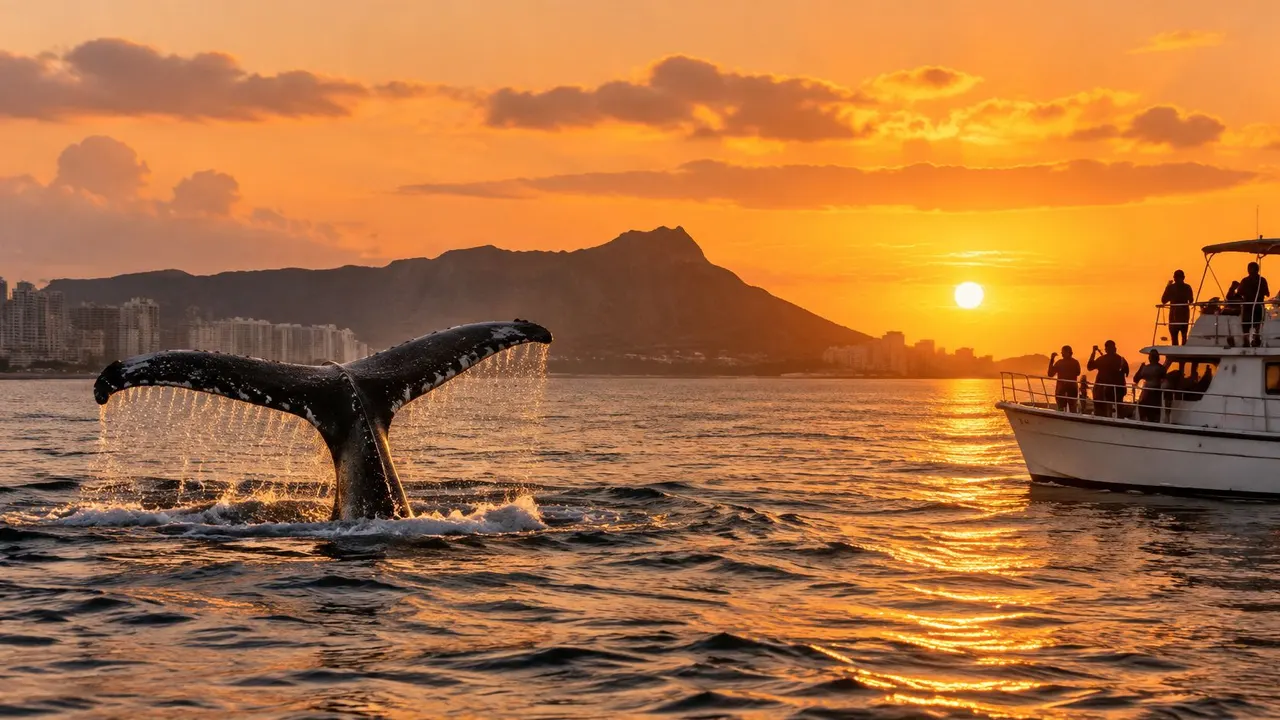
Table of Contents
- What the counts actually show
- Oahu is not Maui, and that's fine
- What that means for departure time
- The honest limits
- What a sighting actually looks like
- When a whale surfaces beside the boat
- What passengers should and shouldn't do
- Matching the trip to the traveler
- Plan for the possibility of no whale
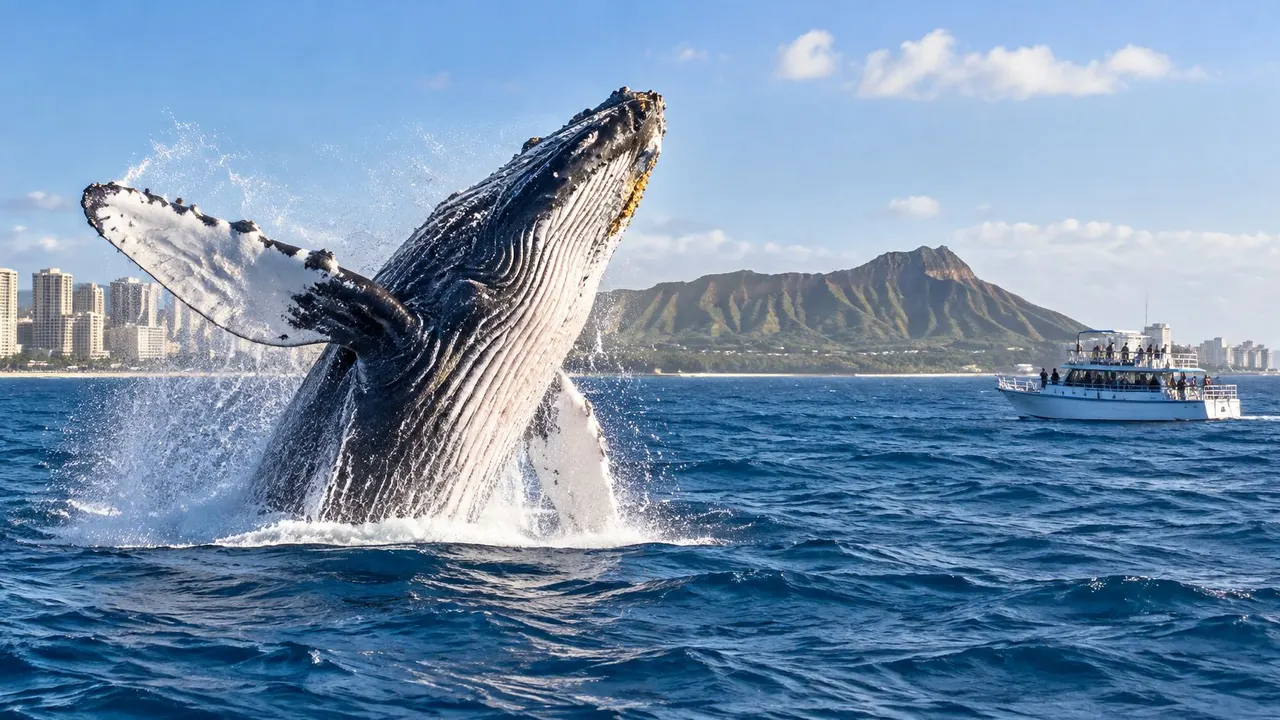
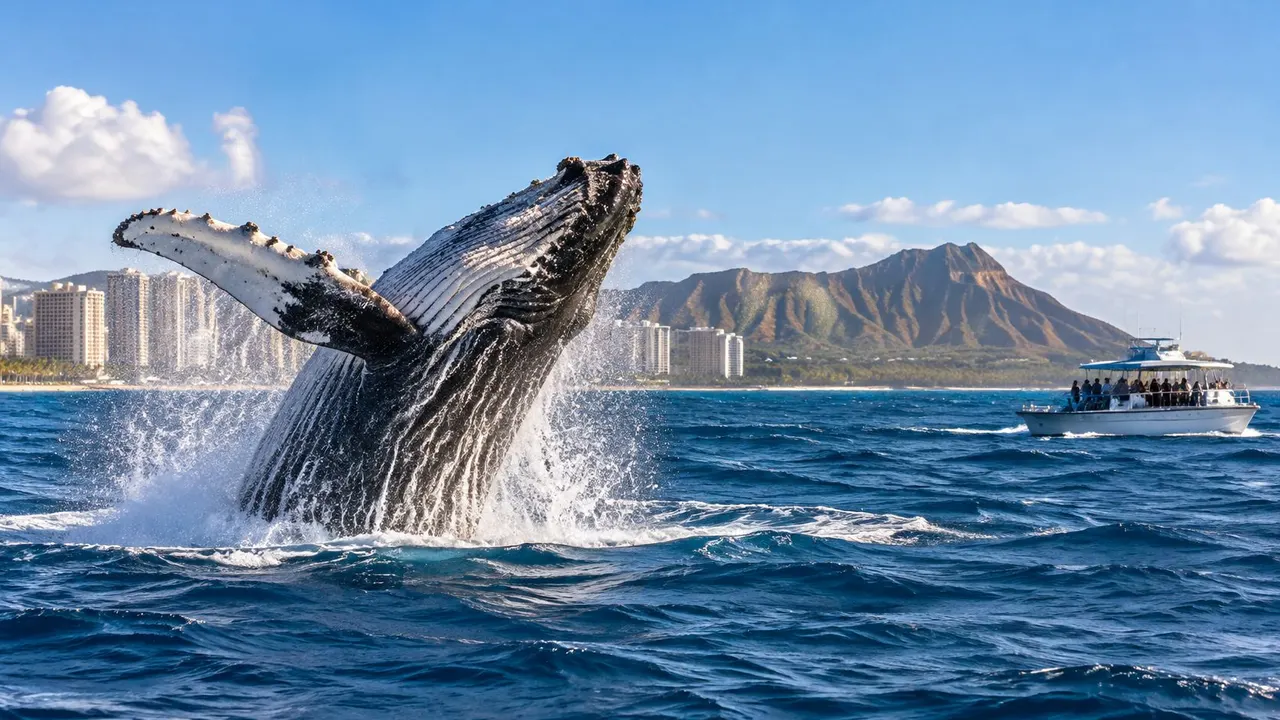
January through March gives you the strongest odds of seeing humpback whales on an Oahu sunset cruise, because that's when the animals are most concentrated in Hawaiian waters. June through August is a different trip entirely, a sunset cruise with no whale promise, since the humpbacks have left for northern feeding grounds.
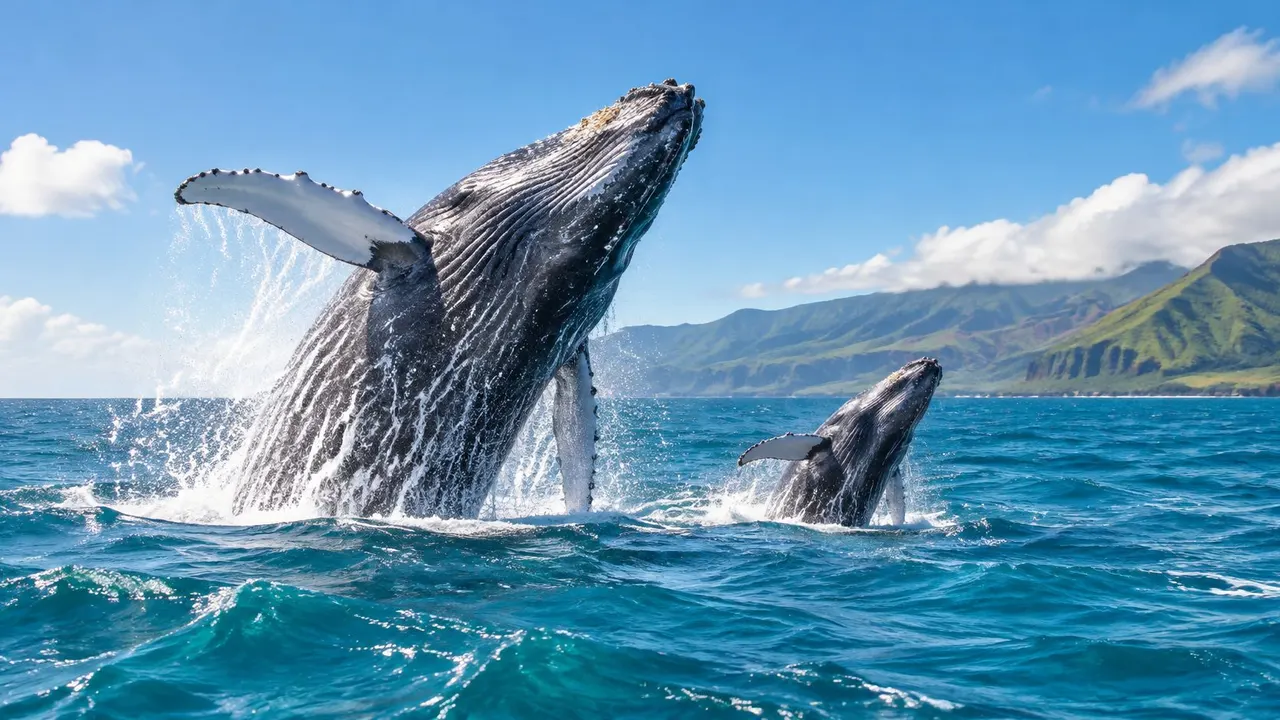
The scale of what came back is the part that reframes the whole evening. Commercial whaling and other human pressure cut humpback whales to fewer than an estimated 5,000 animals in the world's oceans during the 1960s, and the North Pacific population later recovered to roughly 20,000 whales, including an estimated 12,000 that visit Hawaii, according to NOAA Fisheries. You're not watching a rarity. You're watching a recovery, in the last hour of daylight, from a boat that has to keep its distance.
That distance is where most travelers get confused. People board expecting to steer toward a whale, and the law says the opposite: the boat holds its position and lets the animal decide. What follows is the season, the evening, and the rules that shape what your photos will look like.
Best Months for Sunset Whale Watching in Oahu
Whale season off Oahu runs on a migration calendar, and that calendar decides whether your evening is a whale trip or a scenery trip. NOAA puts the regular viewing period in Hawaiian waters at November through April, with the highest activity generally from January through March, the core window for winter whale-watching excursions and sunset cruises (Hawaiian Islands Humpback Whale National Marine Sanctuary). Roughly half of the North Pacific humpback population travels to the islands each winter and spring to mate, give birth, and nurse calves.
Humpback whale activity near Oahu by month
| Months | Whale activity near Oahu | Planning note |
|---|---|---|
| September to October | Humpbacks begin arriving; sightings near Oahu are sparse | Early season, sunset scenery is the safer promise |
| November to December | Regular viewing period begins in Hawaiian waters | Sightings build; book with a flexible date |
| January to March | Highest activity and the strongest odds | Best window for a whale-focused sunset cruise; book ahead |
| April to May | Whales start heading north and activity tapers | Still possible, but fewer sightings |
| June to August | Humpbacks are largely absent from Hawaiian waters | Choose the sunset cruise for the views, not the whales |
What the counts actually show
Volunteer counts are the clearest public measure of how many animals are out there on a given winter day. During the final 2024 Sanctuary Ocean Count, observers recorded 282 humpback whales from Oʻahu, part of 855 whales logged across the participating Hawaiian islands (The Garden Island). The 2025 season closed with 220 humpback whales across 10 Oʻahu sites on the final count day (The Garden Island). Those are counts from shore stations, not from boats, but they tell you the animals are distributed along the coast rather than clustered in one bay.
Oahu is not Maui, and that's fine
Set your expectation: the Hawaii Department of Land and Natural Resources notes that Oahu generally has fewer sightings than Maui, Lanai, Molokai, Kauai's north coast, and Hawaii Island's Kohala coast (Hawaii DLNR). Fewer is not zero, and an Oahu departure buys you a short run to open water instead of a long channel crossing.
Planning rule: choose the month first, the departure time second, book third. Travelers who book a time slot and then hope for a date are the ones who end up whale watching in July.
Our own Waikiki Whale Watching Cruise runs inside that January to March window and looks for humpbacks that winter along the Waikiki coastline. If you want the fuller month-by-month picture before you commit to dates, read our guide to the Hawaii humpback whale watching season.
Why Sunset Is the Best Time to Watch Whales
Sunset earns its reputation for two separate reasons, and only one of them is about photography. The other comes from acoustic and visual research in Hawaiian breeding areas, which found that singing humpbacks shift offshore during the day and move nearer to shore around evening, with researchers identifying a possible sunset-related nearshore movement (NOAA Office of National Marine Sanctuaries).
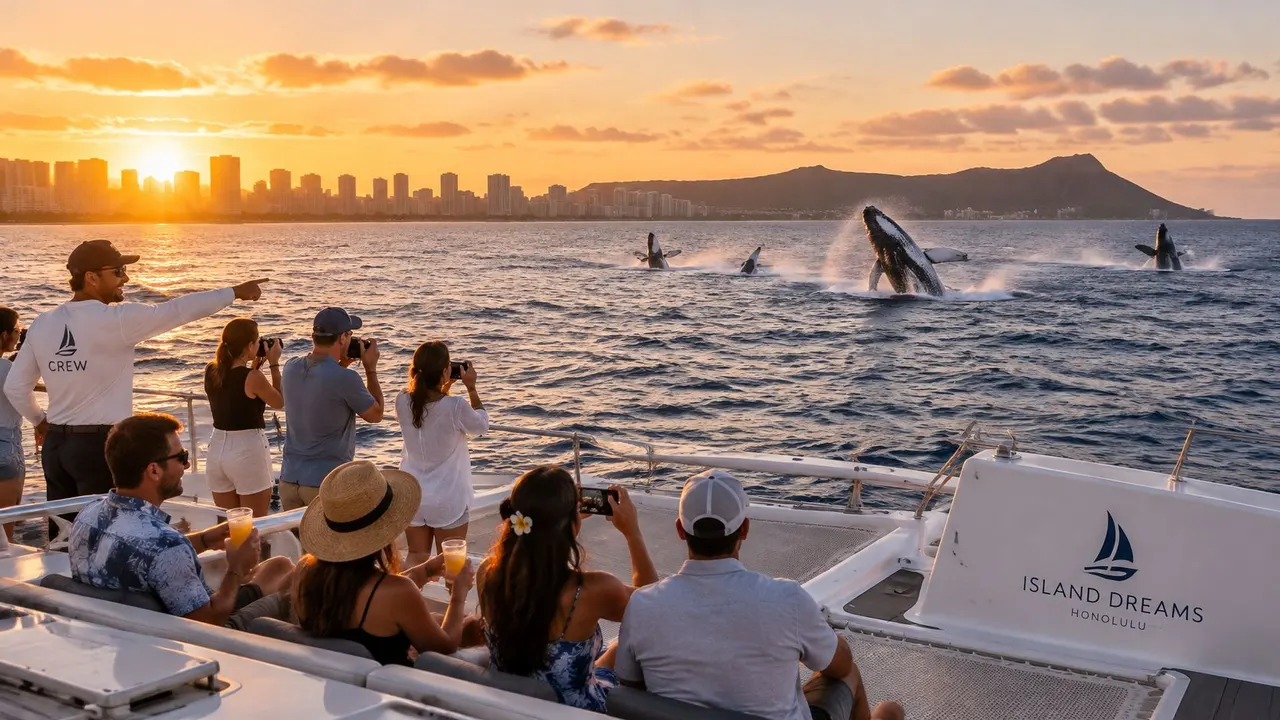
Passive acoustic studies added a measurable detail to that picture: a temporary 2 to 3 dB increase in nearshore sound levels around sunset in the 1.56 to 3.12 kHz band, which points to a real change in whale activity or distribution during that window. In plain terms, the hour you find most beautiful is also an hour when the animals may be shifting closer to the coast.
What that means for departure time
The practical takeaway isn't "leave at sunset." It's leave early enough to be on station before golden hour. A boat still transiting when the light turns gold is a boat missing the window. Our sunset departures are timed to put you in open water while the sun is still above the horizon, so the last hour is spent watching rather than traveling.
Then there's the light itself. Low warm sun on the water, Diamond Head turning amber behind you, and a shorter usable window for photographs than expected. Shoot in the first ten minutes of good light, not the last.
A whale photographed at 200 yards in gold light beats a whale photographed at 200 yards in flat noon glare. Same whale, same legal distance.
The honest limits
Research describes tendencies in breeding grounds, not a schedule. Weather and sea state still decide each trip, and a choppy evening can flatten the surface a whale needs to be visible against. The wildlife rules don't relax at dusk either: vessels stay at least 100 yards from humpbacks and slow to no more than 6 knots within 400 yards. Whales don't keep a tighter evening timetable than they do at dawn, which is why the morning versus afternoon activity question has a more interesting answer than most tour copy admits.
What Happens on a Sunset Whale Watch Cruise
The evening is easier to enjoy when you know its shape in advance. Living Ocean Tours, Oahu's top rated and most reviewed snorkel company, runs sunset departures daily from Kewalo Basin Boat Harbor beside Waikiki Beach, which keeps the transit short and the time on the water long.
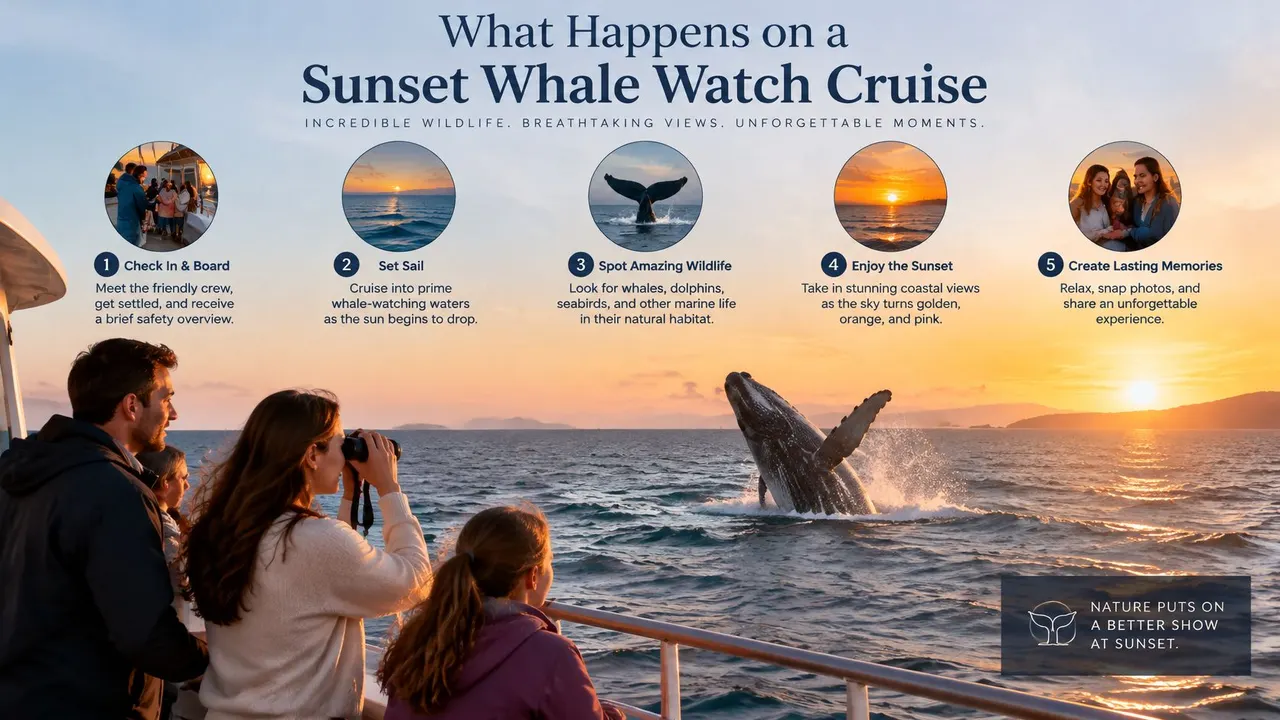
Here's the sequence most guests experience:
- Check in about 30 minutes before departure at Kewalo Basin, with time to park, use the restroom, and sign in without rushing.
- Board and hear the safety briefing, which covers lifejacket locations and the whale-viewing behavior expected on board.
- Cruise the Waikiki coastline while the crew scans for blows, backs, and flukes. This is the quiet part, and it's when most of the looking happens.
- Reach golden hour as the sun drops behind the island and Diamond Head glows. Cameras come out here.
- Watch on the return leg, when a whale may surface between you and the harbor.
- Return to Kewalo Basin after dark, with the city lights on one side and the water on the other.
Sunset cruises run 90 minutes. All tours other than the BYOB sunset cruise operate on the vessel Lokahi, which has a cash bar on board, so bring a card or small bills rather than assuming you can open a tab. The BYOB sunset cruise is the exception, and it's the one to book if you'd rather bring your own.
What a sighting actually looks like
Almost never like the brochure. The first sign is usually a blow, a puff of mist off to one side that vanishes before you're sure you saw it. Then a dark back rolling through, a dorsal fin, and sometimes a tail lifting as the whale sounds. The whole thing might last fifteen seconds and happen 150 yards away.
That distance is not the crew being timid. It's the encounter working exactly as designed, and it's the reason the animal keeps behaving like a whale instead of diving away from an engine.
You'll want to book the Waikiki Sunset Cruise knowing which version you're choosing: the golden-hour cruise with a bar, or the BYOB run with your own cooler.
Humpback Viewing Rules Every Passenger Should Know
The most common misconception on a whale cruise is that a closer view is a better view. Federal and Hawaii law prohibit approaching a humpback whale within 100 yards, or 300 feet, by any means, and the restriction covers boats, kayaks, paddleboards, swimmers, drones, and other vessels or devices, year-round in waters within 200 nautical miles of the Hawaiian Islands (Hawaii Division of Aquatic Resources).
The rule is not only a number. Viewers must also avoid intercepting whales or disrupting their normal behavior, which is why a compliant captain watches from a distance instead of maneuvering toward an animal. A short, distant, undramatic sighting is the rule working, not the trip failing.
Humpback viewing distances and vessel responses
| Situation | Rule | What to do |
|---|---|---|
| Approaching a humpback by boat, kayak, swimmer or drone | Stay at least 100 yards (300 feet), year-round | Do not approach; keep distance |
| Mother and calf in a designated area | Stay at least 300 yards (900 feet) | Hold back further and do not enter the path |
| Whale surfaces within 100 yards on its own | Motorized vessel stays stationary | Engine in neutral; wait for the whale to leave |
Designated mother-and-calf areas raise the minimum to 300 yards, or 900 feet, even though the general approach limit stays at 100 yards, and aircraft must remain at least 1,000 feet from humpbacks. The rules also prohibit placing a vessel, person, or object in a whale's path so that it approaches within the restricted distance (Hawaii Division of Aquatic Resources).
When a whale surfaces beside the boat
This happens, and it's the moment passengers get excited enough to ask for things the captain can't do. A motorized vessel should hold still with the engine in neutral, not off, and wait for the whale to move away (Hawaii DLNR Division of Boating and Ocean Recreation). Neutral keeps steerage and control; drifting near a surfacing animal doesn't.
What passengers should and shouldn't do
- Don't enter the water. Not to swim, not to "get a better angle," not for a photo.
- Don't shout or whistle to bring a whale closer. That's disrupting normal behavior.
- Don't press the captain to reposition for a tighter shot. The answer has to be no.
- Stay seated when the crew asks, especially during a surprise surfacing near the hull.
- Keep trash on board and never throw food or objects overboard.
If swimming with humpbacks is on your mind, the short answer is that swimming with whales in Hawaii isn't a tour product here, and no operator can legally put you in the water near one.
Choosing a Sunset Trip for Families, Couples and Groups
Three questions settle which trip you should book. Who's in your group, how flexible are your dates, and is the whale the goal or is the sunset the goal? Answer those and the choice becomes obvious.
| Traveler | Format that fits | What to check |
|---|---|---|
| Families with young children | Early-evening departure | Lifejackets in children's sizes, a briefing kids can hear, stable deck |
| Couples | Golden-hour sunset cruise | Departure timing, bar service, quieter seating |
| Multi-generational groups | January to March sunset cruise | Same odds for grandparents and kids; easy boarding |
| Private celebrations | Private charter | Group size up to 40, timing, what's included |
| Eco-focused travelers | Any departure that opens with the rules | Conservative approach, no pursuit, no encircling |
| Flexible planners | Shared departure on the best-forecast day | Swell and wind forecast 24 hours out |
A family with a five-year-old and a grandmother in the same party has one real constraint: nobody wants a three-hour channel crossing. A short run from a harbor near Waikiki keeps the trip inside the attention span of the youngest passenger and the stamina of the oldest.
Matching the trip to the traveler
Families do best when the whale isn't the only thing happening. Pair the wildlife with the ride itself, the coastline, and the sunset, so a quiet stretch of water doesn't become a disappointment. Couples tend to care more about the light and the pace than the species count, and a sunset cruise delivers that even in July.
Groups and celebrations need space more than narration. If you're coordinating cousins, coworkers, or a birthday, a private charter for up to 40 guests keeps your people together and lets the timing flex around your plans.
Eco-conscious travelers should watch how a crew talks before the boat leaves the dock. A briefing that leads with distance, behavior, and what passengers shouldn't ask for is a better signal than any marketing line.
For a family-focused breakdown of timing and expectations, see our notes on Oahu whale watching with families.
If you want a second option to compare, Sunset Cruise Waikiki is an exceptional alternative worth pricing against your first choice. Check departure times, group size, and what's included before you decide, because a lower fare that excludes drinks or runs a shorter route isn't cheaper.
Book Your Sunset Whale Watch Before January
Peak season inventory goes first, and January to March departures are the ones that sell out while people are still deciding. Work in this order:
- Pick your month. January to March if whales are the goal, any month if the sunset is.
- Pick the departure that matches your group, using the traveler table above.
- Book now, not on arrival. Check availability while your dates are still flexible.
Our Waikiki Whale Watching Cruise runs January 2 through March 31, lasts 1.5 hours, welcomes ages 3 and up, and costs $49 per person. That's the whale-focused trip. The sunset cruise is the golden-hour trip, and the two are separate products rather than one combined tour.
Full details on the whale trip live on the Waikiki Whale Watching Tour page. If you'd rather sort dates with a person, our office is at 1125 Ala Moana Blvd Slip B-01, Honolulu, HI 96814, open 7 days a week, reachable at info@livingoceantours.com or +1 (808) 436-3483.
Plan for the possibility of no whale
Whales are wildlife. A January date improves your odds; nothing guarantees a sighting. Before you pay, read the cancellation and no-sighting terms on the booking page so you know exactly where you stand if the water stays quiet, and ask about rescheduling options while you're at it.
On the day, arrive 30 minutes early and check the marine forecast before you leave the hotel. Swell and wind decide more about your evening than any other variable, and a breezy afternoon can turn a comfortable cruise into a long one.
Living Ocean Tours runs sunset cruises and seasonal whale watching from Kewalo Basin Boat Harbor, minutes from Waikiki Beach, with sightings treated as wildlife encounters rather than promised attractions. If your dates land between January and March, book the whale trip and bring a zoom lens; if they land anywhere else, book the sunset cruise for the light and the coastline. Visit Living Ocean Tours to compare departures and pick the evening that fits your group.