Waikiki Whale Watch: Best Months and Sighting Odds
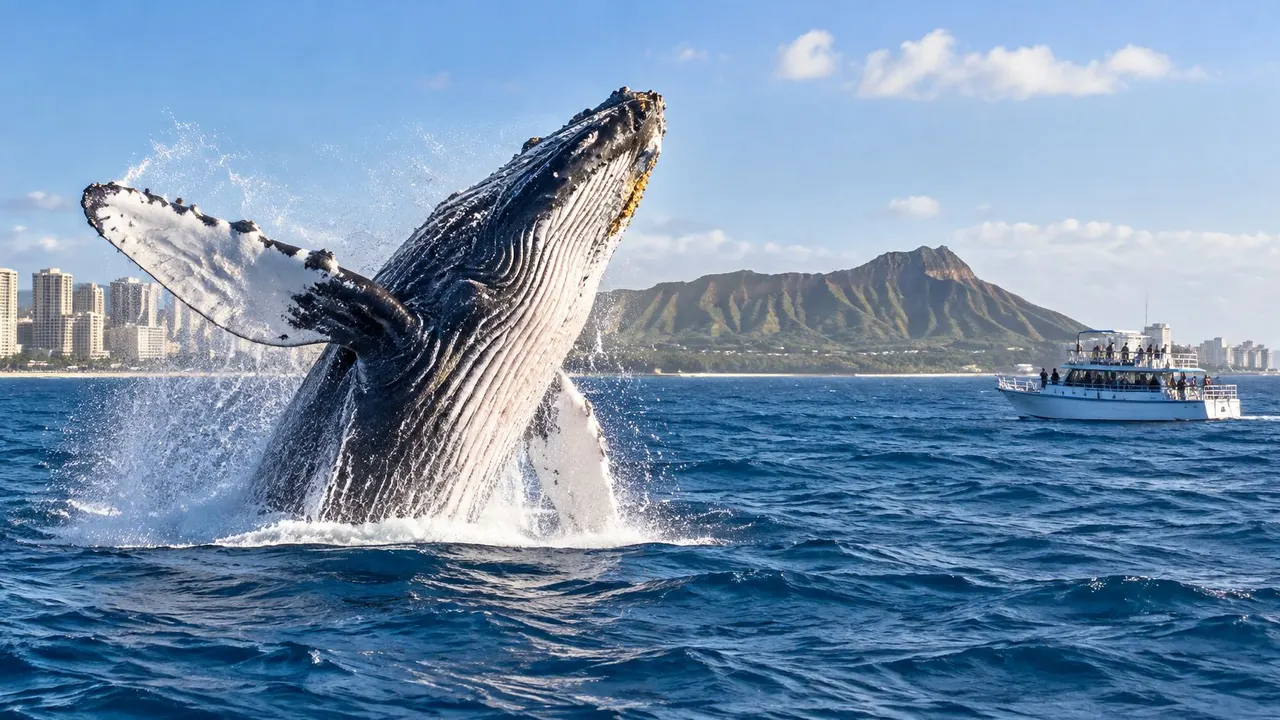
Roughly half of the North Pacific humpback population, potentially up to 12,000 whales, returns to Hawaiian waters each winter to mate, give birth and nurse calves, according to NOAA's Hawaiian Islands Humpback Whale National Marine Sanctuary. That's the scale behind every Waikiki whale watch. You aren't scanning an empty ocean for a stray animal. You're visiting a breeding ground that an entire ocean-basin population depends on.
That number hides the part travelers need. Humpbacks come to Hawaiʻi to reproduce, not to feed, and their presence thins out sharply at both ends of the season. The odds on any single boat trip swing hard from month to month, which means a whale watch is wildlife viewing with shifting probabilities, never a guaranteed sighting. The calendar decides more than the boat does.
This guide covers the months that matter, the free shoreline check worth doing before you spend a dollar, the distance rules that limit what any captain can do when a humpback surfaces nearby, and the practical choices that separate a good trip from a disappointing one.
Table of Contents
- Best Months and Sighting Odds From Waikiki
- Kewalo Basin Departures and What Happens Onboard
- Distance Rules Every Responsible Whale Boat Follows
- Planning a Whale Watch With Kids and Older Guests
- Free Shore Viewing Near Waikiki
- Book Your Waikiki Whale Watch Before the Peak Season
Best Months and Sighting Odds From Waikiki
January and February carry the best odds for a Waikiki whale watch. That's the answer most travelers need before anything else. The Hawaiʻi Department of Land and Natural Resources puts peak activity generally in January and February, and notes that sightings are common around Oʻahu, though less frequent than in several other locations around the state. That last clause matters, because plenty of visitor content sells an Oʻahu whale watch as though it were a Maui one. It isn't.
The full season runs wider than the peak. NOAA's sanctuary program describes humpbacks generally arriving between November and April, with January through March the recognized peak viewing period. The state guidance stretches the edges further, noting whales may arrive as early as September and remain through May. Those edges are real but thin. A September or May sighting is a stroke of luck, not something to build a vacation around.
What each month actually delivers
| Month | Whale presence | Sighting odds | Planning note |
|---|---|---|---|
| September | Early arrivals possible | Uncertain | Shoulder season, few whales |
| November | Whales begin arriving | Building | Season opens, odds rising |
| December | Numbers rising | Good | Strong mid-season option |
| January | Peak period | Highest | Best odds, book early |
| February | Peak period | Highest | Best odds, same as January |
| March | Still strong | High | Late peak, reliable |
| April | Late departures | Declining | Fewer whales, lower odds |
| May | Stragglers possible | Uncertain | Rare, not worth planning around |
December is the month people misjudge in both directions. Whales are arriving, numbers are climbing, and a trip in the last week of the month is a different proposition from one in the first week. March holds up well because the peak tapers rather than collapses. April is when the grounds start emptying out, and a boat covering a lot of water for a single distant spout is a fair description of late season.
What a sighting actually looks like
Expect a blow first, the mist of exhaled breath that hangs above the surface for a second. It's the most common thing you'll see and the cue every lookout on board is scanning for. After that, the surface behavior you might get includes:
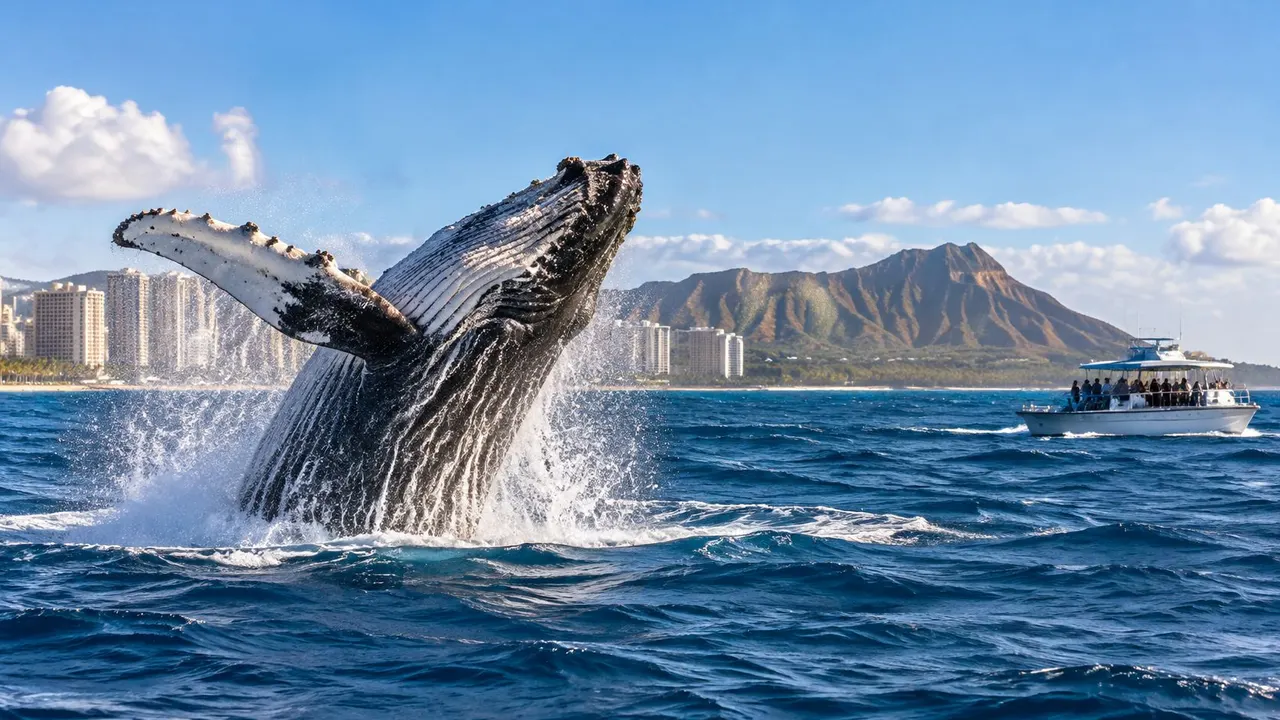
- Breach. The whale launches most of its body clear of the water and lands in a spray you can hear across the boat. Spectacular, infrequent, and impossible to schedule.
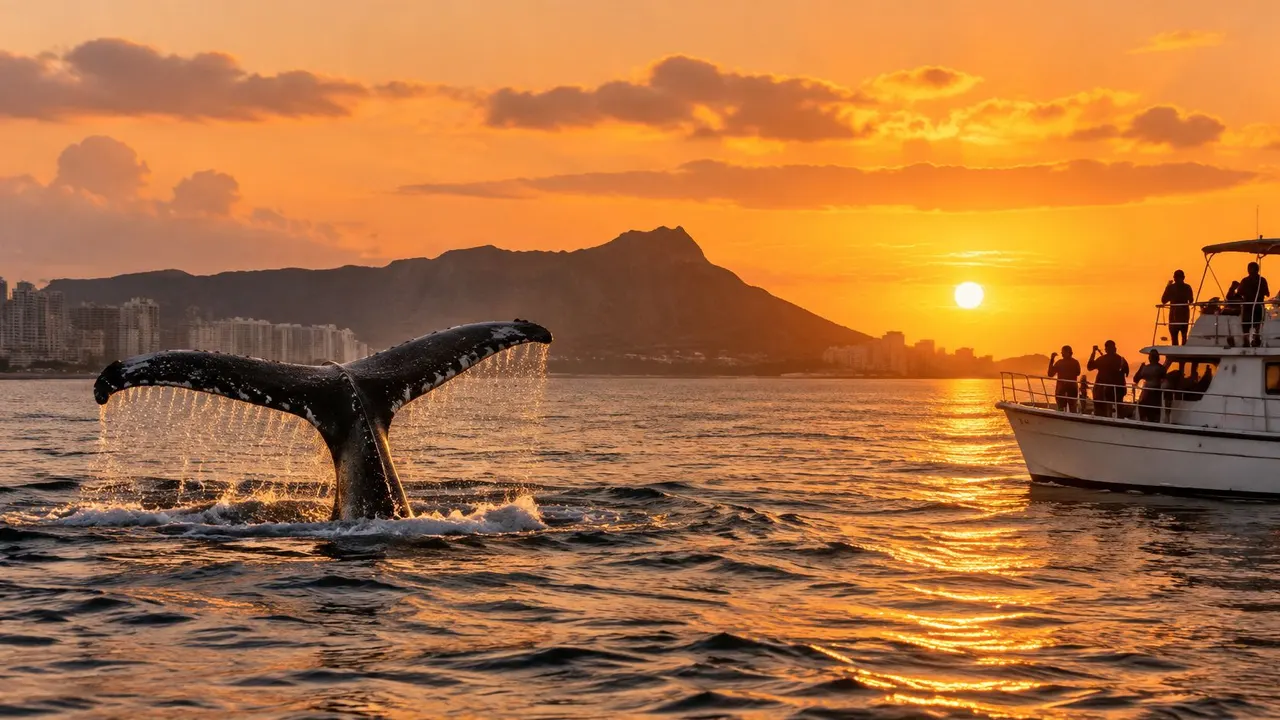
- Tail slap. The fluke comes down flat and hard, cracking the surface and carrying a long way in calm air.
- Spy-hop. The whale rises vertically with its head out of the water, apparently looking around. Children read it as curiosity, and they're not wrong.
- Pec slap. A long pectoral fin slaps the surface, often several times in a row.
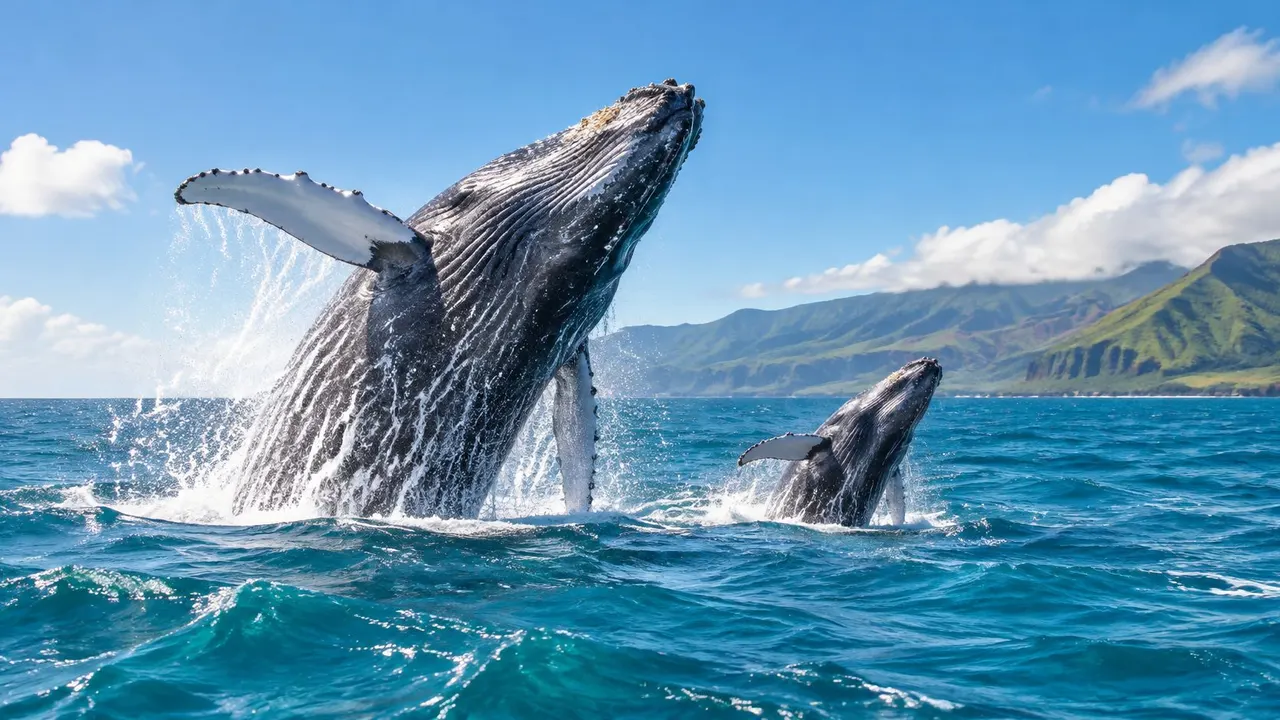
A mother traveling with a calf is the sight guides most want you to have, partly because it's memorable and partly because it changes how the boat behaves. More on that below.
Two families, two sets of odds
Say two families book the same 1.5-hour whale watch out of Kewalo Basin. The first sails on December 8. The second sails on January 24. Same fare, same crew, same view of Diamond Head from the water. The December family is rolling dice on the leading edge of the season, when whales are still filtering in. The January family is booking inside the peak, when the breeding grounds are fullest.
Neither family is guaranteed a whale. Wildlife doesn't take bookings, and a boat trip is viewing, not delivery. But the second family's odds are meaningfully better, and if you can only choose one week of the year, choose theirs.
The planning rule: aim for January or February, hold a second flexible date in the same month, and treat any whale you see as a bonus rather than something the fare bought you.
Kewalo Basin Departures and What Happens Onboard
Waikiki whale watches leave from Kewalo Basin Boat Harbor, the working harbor on the Honolulu waterfront just west of Waikiki Beach. It sits close enough that you won't lose your morning to a transfer, and it's compact enough that check-in takes minutes. Living Ocean Tours departs from Kewalo Basin daily, and if you're driving, sort out parking at Kewalo Basin before departure day so you aren't circling the waterfront while your boat boards.
The boat doesn't have to run far. Humpbacks winter along the Waikiki coastline, so the captain works the water off the south shore and Diamond Head instead of burning time reaching distant grounds. On a 1.5-hour trip that difference is real: more minutes spent watching the water, fewer spent getting to it.
A humpback breaking the surface is the moment everyone on board is waiting for, and it usually starts with a single shout from the bow.
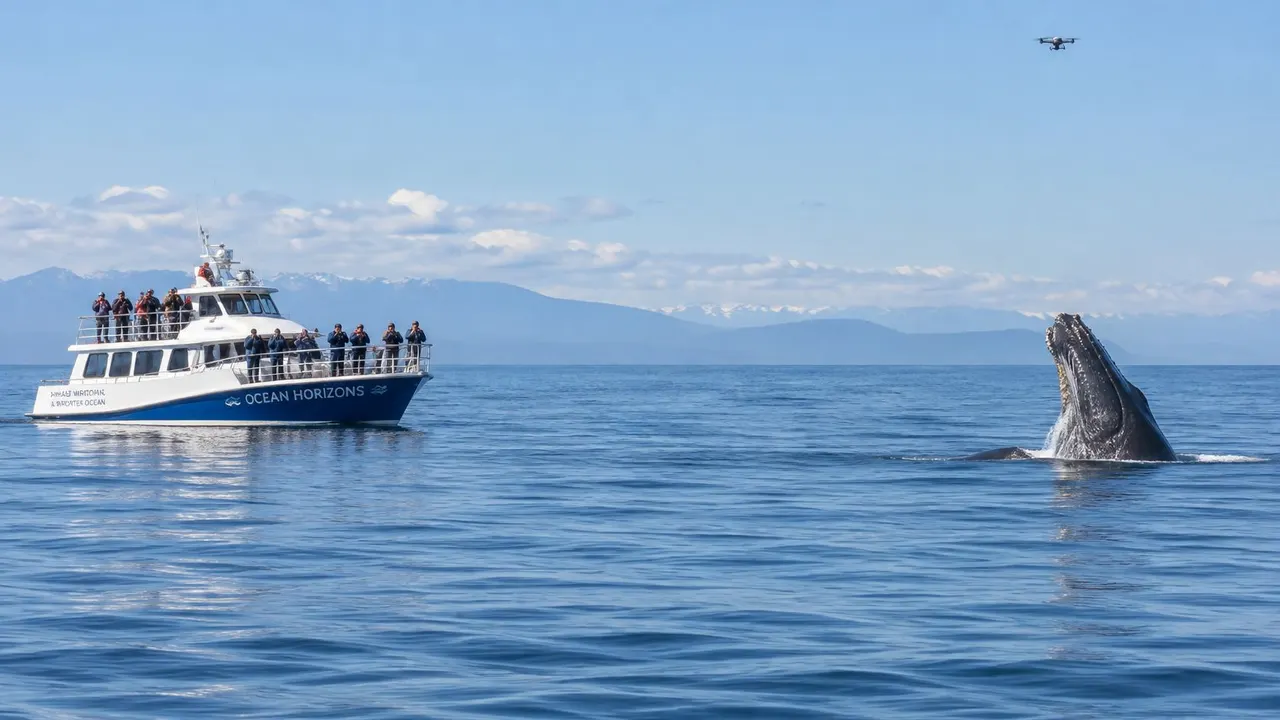
Living Ocean Tours runs the Waikiki whale watching cruise from Kewalo Basin through the winter season and is Oahu's top rated and most reviewed snorkel company. Expect practical commentary on board: what the animal is doing, where to look, and how to keep your eyes on the spot where it went down.
The trip, step by step
- Check in at the harbor. Arrive with time to spare. Boarding at Kewalo Basin is quick, but the boat won't wait.
- Safety briefing before departure. Expect the crew to cover life jackets, seating, and where to stand while the boat is moving. That's standard practice on any commercial whale watch.
- Pick a spot with a clear sightline. A position at the rail with open water in front of you beats a seat behind other passengers.
- Scanning starts early. Whales can surface anywhere along the coast, so passengers and crew start watching the horizon soon after leaving the slip. Spouts show up well against a dark horizon.
- Someone calls the bearing. When a whale is spotted, the sighting gets called out so everyone looks at the same patch of water. Bring binoculars if you own a pair.
- Keep watching on the return. Whales don't stop being visible on the run back to the harbor, so stay facing out until you tie up.
What to bring
- Sunscreen. Lotion rather than spray, applied before you board. Sun off the water is relentless even on an overcast day.
- A light layer. Wind on the water runs cooler than the beach, and a 1.5-hour trip feels long when you're cold.
- A camera with real zoom. Phone digital zoom turns a whale into a smudge. Optical zoom or a longer lens earns its place.
- Polarized sunglasses. They cut glare off the surface and make a distant blow far easier to pick up.
Distance Rules Every Responsible Whale Boat Follows
The rule comes first. Federal law prohibits approaching a humpback whale within 100 yards, roughly 300 feet or 91 meters, in Hawaiʻi, whether the approach is made by boat, kayak, paddleboard, swimmer, drone or any other vessel or object. NOAA Fisheries states the second half just as plainly: no operator may place a vessel in a whale's path or disrupt its normal behavior. The rule holds year round in Hawaiian waters, not only during the winter viewing season.
That protection has a paper trail. The humpback was listed as endangered in 1970 and protected again under the 1973 Endangered Species Act. On November 4, 1992, Congress created the Hawaiian Islands Humpback Whale National Marine Sanctuary to protect the whales and their breeding habitat, and the population recovered enough to come off the U.S. endangered-species list in 2016. The sanctuary's 2020 management plan puts Hawaiʻi's humpback stock at 11,278 whales, with a reported 95% confidence interval from 4,049 to 31,412. The spread shows the species recovered, but the exact headcount carries real uncertainty, and the distance rules are written for the whale either way.
What happens when a whale comes to you
Whales don't read the chart. When one surfaces inside the 100-yard line, the correct move is the counterintuitive one: the captain puts the engine in neutral and holds the boat still until the whale moves away. NOAA's guidance for whale watchers spells this out for motorized vessels, and it's why a good crew won't chase, circle or gun the engine to reposition for a photograph.
Waiting beats chasing for a simple reason. The whale decides the distance, and a stationary boat is a predictable object in the water. A boat maneuvering around it is not. Mothers with calves raise the stakes, because a calf's movements are less predictable and its surface time puts it near vessels more often. Engines in neutral protect the pair and everyone on deck.
The diagram below shows how that separation works in practice.
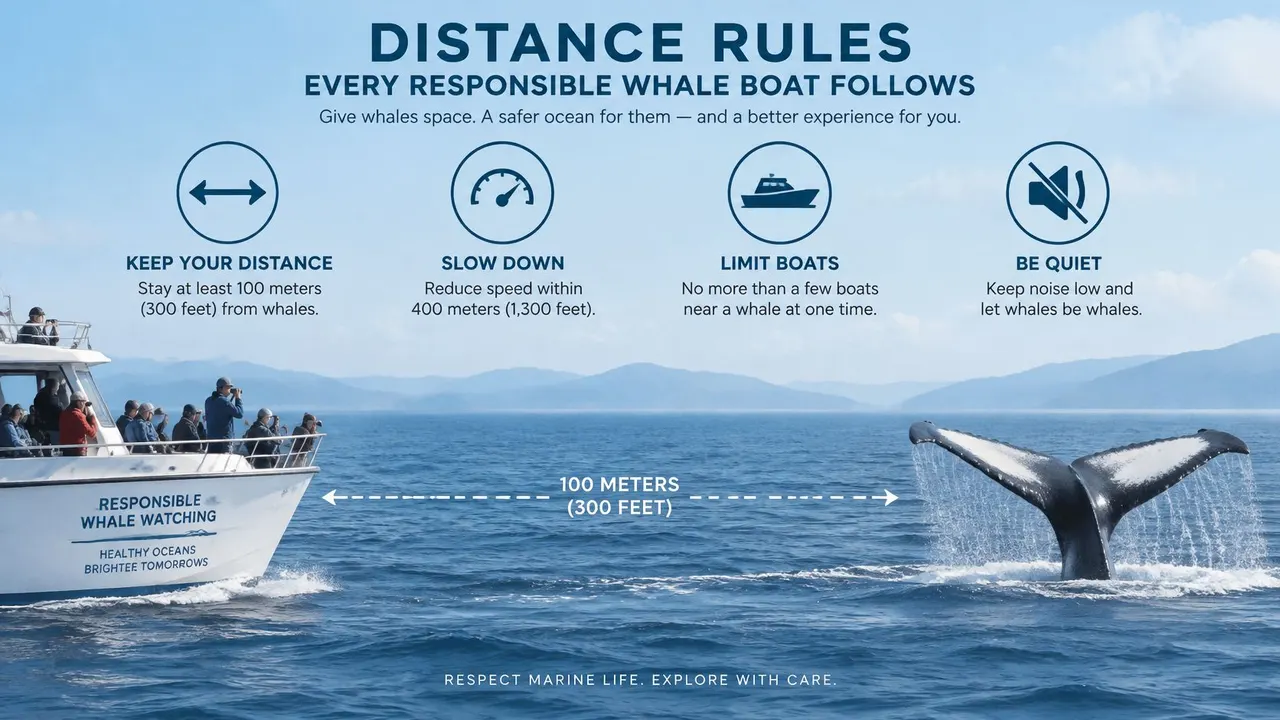
A stationary boat is not a wasted opportunity. It's the only version of the encounter the whale agreed to.
The tools that keep the distance honest
- Optics over proximity. Binoculars and a telephoto lens close the gap without moving the boat.
- A dedicated lookout. One person scanning continuously catches more than a full deck glancing up between conversations.
- A dynamic exclusion zone. Treat the 100-yard radius as a boundary that travels with the animal, never as a target distance to close in on.
- No interception. Cutting ahead of a traveling whale to get in position is prohibited, and guests can spot it from the deck as easily as the crew can.
Guests sometimes read a captain's patience as a lack of effort. The opposite is true: blows, breaches and spy-hops all read clearly at legal distance. If you want the full picture of what swimming alongside a whale would involve, read our answer to can you swim with whales in Hawaii before you ask the crew. A boat that respects the line is the honest version of this tour, and it's the one worth booking.
Planning a Whale Watch With Kids and Older Guests
Whale watching is a sit-and-wait activity with bursts of excitement, and that shape suits some travelers far better than others. Match the preparation to the person and the trip takes care of itself. The 100-yard rule means the boat can't manufacture action, so comfort on board carries more weight than most families expect.
| Traveler | The real challenge | What to do about it |
|---|---|---|
| Young children | Long waits between sightings | Pack snacks, a small toy, and kid-sized binoculars so they can join the lookout |
| Older adults | Balance on a moving deck | Choose a seat near the middle of the boat, bring a light layer, keep a hand on the rail when walking |
| First-time boaters | Uncertainty about the motion | Sit facing forward and stay on deck where you can see the horizon |
| Guests prone to seasickness | Nausea arriving before the whales do | Take medication before boarding if a doctor approves, and keep your eyes on the horizon rather than the deck |
The middle of the boat moves least, so that's where anyone unsteady on their feet should sit. Forward-facing seats reduce motion sickness because your eyes and inner ear finally agree on what's happening. Below deck is the worst place for a queasy stomach, since you lose the horizon and gain engine noise.
Set expectations before you board
Tell children plainly that a whale might not appear. Frame the boat ride, the spray, the Diamond Head view and the airplane traffic overhead as the entertainment, with whales as the bonus. A child who expects a breach and gets a distant blow has a bad hour. A child who expects a boat ride and gets a breach talks about it for years.
The same framing works for grandparents being talked into a trip. Short duration helps. Our 1.5-hour whale watch is deliberately brief, which matters for anyone who finds a full morning on the water tiring. If mobility, shade or boarding access is the deciding factor, our notes on accessible Oahu whale watching cover what to check before booking.
One more practical point. Sightings can take time, so plan the rest of the day loosely. A trip that runs long because the captain is holding station with a mother and calf is a good problem, but not one to schedule a tight lunch reservation behind.
Free Shore Viewing Near Waikiki
Before you pay for anything, spend one morning looking. Humpbacks can be seen from shore-based vantage points on Oʻahu's south shore during the season, and a free check tells you whether whales are around on your dates. It costs you a walk and a pair of binoculars.
Three spots near Waikiki do the job. The seawall along Waikiki Beach gives you an unobstructed line to open water without leaving the neighborhood. Kapiolani Park and the grassy edges toward Diamond Head sit on slightly higher ground with a long view south. The Diamond Head area raises you further and widens the horizon, which is where distant blows are easiest to pick out.
A shore routine that actually finds whales
- Go in the morning or late afternoon. Low sun means less glare off the water, and glare is what kills distant spotting.
- Bring binoculars or a telephoto camera. A blow at range is a one-second smudge of white without magnification.
- Scan for blows and dark backs low on the horizon, not just close to shore. Most of the water you can see from land is empty, and the whales are usually further out.
- Fix on a spout direction and watch that patch for several minutes. Whales surface repeatedly in the same area, so patience pays better than panning constantly.
- Stay dry. The 100-yard separation applies to swimmers, paddleboards and drones exactly as it does to boats, so watching from the shore is the free option that keeps you inside the rules.
Free check: an hour on the seawall with binoculars tells you more about your week than any forecast.
Set your expectations on distance. Shore sightings are unpredictable and almost always further away than what you'd get from a boat, often no more than a puff of mist and a dark back at the edge of your vision. That's why shore watching works as a first check and a complement to a boat trip, never a replacement. If you want the timing context for a land-based attempt, our Oahu whale season breakdown covers how the months differ.
Book Your Waikiki Whale Watch Before the Peak Season
Book for January or February. Those two months carry the highest odds, and they are the dates every other visitor is circling on the same calendar. A family of five trying to book in the last week of January has far fewer departure options than the same family booking a month ahead, so decide early rather than once you land.
Our Waikiki Whale Watching Cruise runs from January 2 through March 31, lasts 1.5 hours, is for ages 3 and up, and costs $49 per person. Departures leave from Kewalo Basin Boat Harbor at 1125 Ala Moana Blvd Slip B-01, Honolulu, HI 96814. Questions about dates, conditions or group bookings go to info@livingoceantours.com or +1 (808) 436-3483.
Protect the booking with a backup date
Weather is the variable nobody prices in. Rough seas cancel departures, and a whale watch lost to swell on your second-to-last day is a whale watch you never get back. Read the cancellation and weather-policy wording before you pay, so you know whether a call-off means a refund, a credit or a rebooking.
Then keep a second date open in the same peak month, not the following one. A backup on February 26 keeps you inside the highest-odds window. A backup on April 3 doesn't. If your schedule allows only one slot, take the earliest one in your trip rather than the last, so a cancellation leaves room to try again.
Full trip details and current availability sit on the Waikiki whale watch tour page. Peak-month dates are popular, and booking early keeps more times and days open for you to choose from.
Living Ocean Tours runs seasonal whale watching along the Waikiki coastline from January 2 through March 31, with 1.5 hours on the water, ages 3 and up, and departures from Kewalo Basin Boat Harbor minutes from the beach. If your dates land in January or February, book that trip now rather than waiting until the week you arrive, because those are the months with the strongest odds and the most competition for seats. Visit Living Ocean Tours to see the whale watch, the snorkel and sunset cruises, and the dates still open this season.