Whale Watching Tours on Oahu: Season, Rules and Booking
Table of Contents
- Whale Sighting Odds by Month off Oahu
- Leave Room for Weather
- Humpback Viewing Rules and What They Mean on Board
- What Guests Actually See
- From the Dock to the Search Area
- During an Encounter
- Presence Doesn't Predict Your Departure
- Make a Quiet Departure Worthwhile
- Pack for Wind, Spray, and Distant Viewing
- Family Safety and Accessibility
- A Winter Morning with an Unhurried Afternoon
- A Trip with a Protected Backup Day
- A Family Half-Day
- Booking Criteria for a Whale Watch Tour
- A Waikiki Departure Worth Considering
- Confirm Before You Pay
- When Is the Best Time to See Whales off Oahu?
- Are Sightings Guaranteed?
- How Close Can a Boat Get to a Humpback?
- Is Oahu the Best Island for Whale Watching?
- What Happens if a Tour Is Cancelled?
- Can Young Children Join?
Volunteers recorded 4,782 humpback whale observations across Hawaii during three survey days in 2025, according to the Hawaiian Islands Humpback Whale National Marine Sanctuary. That's a statewide observation count, not a promise about what any boat will see. It captures what makes whale watching tours on Oahu compelling: you're visiting an important breeding habitat, but the animals still decide when and where to surface.
The best booking choice combines good seasonal timing, a practical departure point, and an operator that respects wildlife boundaries. Don't choose a boat because its photographs show whales beside the railing. Choose an outing you'll enjoy even if the encounter is a distant blow, a brief tail lift, or a mother and calf moving along the coast.
Best Months to See Whales on Oahu
January through March gives you the best odds, within a broader season running roughly November through April or May. NOAA's sanctuary overview estimates that up to 12,000 humpback whales, more than half the North Pacific population, return to Hawaiian waters annually to breed, give birth, and nurse calves; it identifies peak abundance approximately from mid-February through mid-March and describes their gathering habitat as generally less than 600 feet deep.
That's why a dedicated whale watch belongs on a winter itinerary rather than a year-round activity list. These animals aren't just passing Honolulu on an arbitrary schedule. They're using Hawaiian waters for reproduction and early calf care.
Whale Sighting Odds by Month off Oahu
The relative odds below are planning categories, not measured probabilities for individual departures. Read “best” as the strongest seasonal window, never as a guarantee.
| Month | Whale presence | Relative odds on Oahu | Planning note |
|---|---|---|---|
| November | Season opens, whales arriving | Lower | Sightings scattered, pick later dates if possible |
| December | Numbers building | Moderate | Good for a first trip with flexible dates |
| January | Usual peak period begins | Best | Strong start to the most reliable window |
| February | Peak abundance from mid-February | Best | Late February is a top choice |
| March | Peak continues through mid-March | Best | Strong late-winter window |
| April | Season tapering | Moderate | Fewer whales, still worth considering |
| May | Last of the season | Lower | Sightings possible but uncommon |
| June to October | Humpbacks largely absent | Rare | Choose a different ocean activity |
For travelers choosing vacation dates specifically around whales, late February or early March is the clearest recommendation. For travelers whose flights are already booked, match expectations to the season instead of assuming a whale-watch listing means equal chances throughout the year.
Leave Room for Weather
Put the outing early enough in your stay that another date remains available. A spare morning is useful if the captain cancels because of conditions, although rebooking still depends on availability and the operator's terms.
Shallow island habitat doesn't mean every trip stays beside the beach or enjoys sheltered water. Whales move, the search area changes, and ocean conditions still matter. Choose your month first, then compare boats and departure times.
Responsible Viewing Rules Every Tour Follows
Federal law prohibits approaching a humpback whale within 100 yards in Hawaii, and NOAA's Hawaii marine wildlife viewing guidelines apply that restriction to boats, kayaks, paddleboards, swimmers, drones, and other vessels or objects. A smaller craft doesn't earn closer access.
Distance is the legal foundation; speed and positioning determine how responsibly a crew operates around it. NOAA's humpback whale guidance recommends no more than 6 knots within 400 yards, while sanctuary recreation guidance recommends a maximum transit speed of 15 knots or safe planing speed in whale habitat. These speed recommendations shouldn't be confused with the legally prohibited approach distance.
Humpback Viewing Rules and What They Mean on Board
| Rule | Requirement | What it means on the boat |
|---|---|---|
| Minimum distance | At least 100 yards from any humpback whale | Captain repositions before the gap closes |
| Slow zone | NOAA recommends no more than 6 knots within 400 yards | Crew slows early rather than waiting until close |
| Transit speed | NOAA recommends a maximum of 15 knots or safe planing speed in whale habitat | Captain moderates speed during the search |
| Interception | Cutting off a whale's path is prohibited | Vessel stays clear of the projected travel path |
| Unexpected approach | A whale closes distance on its own | Captain assesses movement, uses neutral when appropriate, and safely restores separation |
| Other craft | Same 100-yard approach restriction | Guests can't use another craft or a drone to get closer |
A captain shouldn't race ahead of a traveling whale, stop in its path, and treat the resulting proximity as an accidental encounter. Responsible positioning leaves the animal room to continue without changing direction around the boat.
An unexpected approach also isn't permission to remain close indefinitely. Passengers should stay in place and let the captain manage the situation. Moving the boat abruptly without considering the whale's position can create another problem.
Good guiding isn't measured in proximity. A captain who backs away or ends an encounter may be making the best decision of the trip.
What Guests Actually See
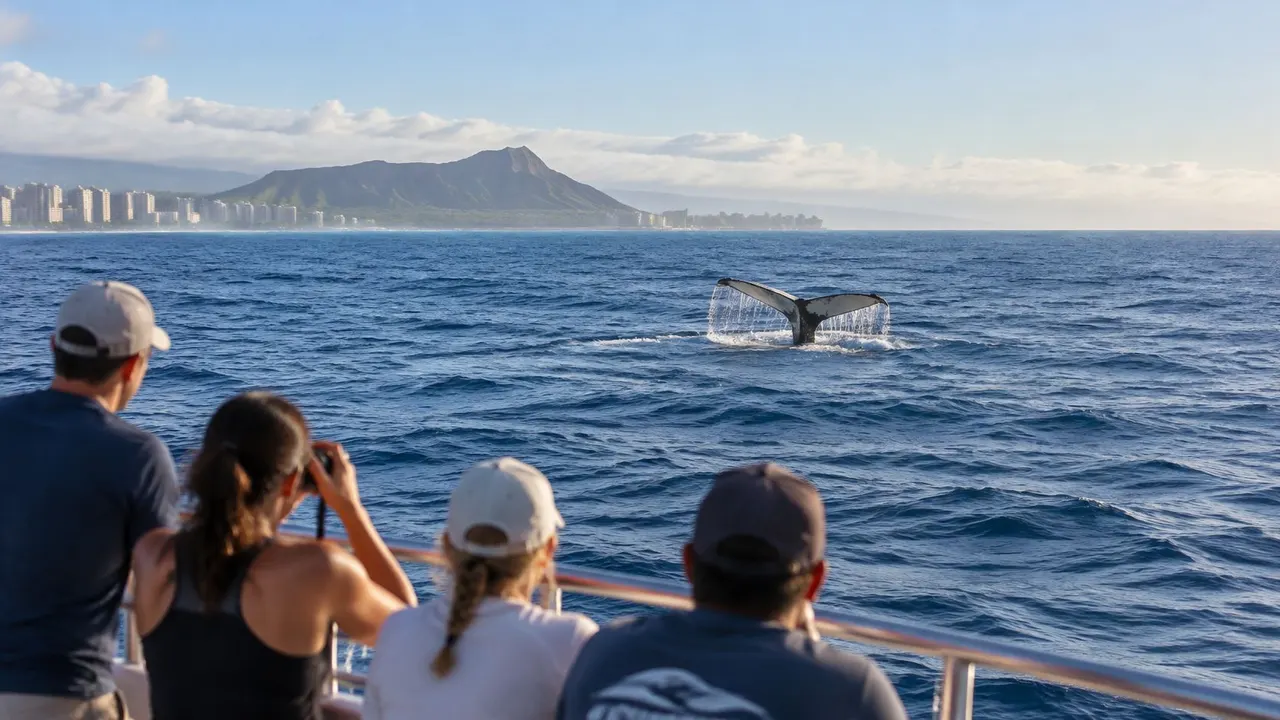
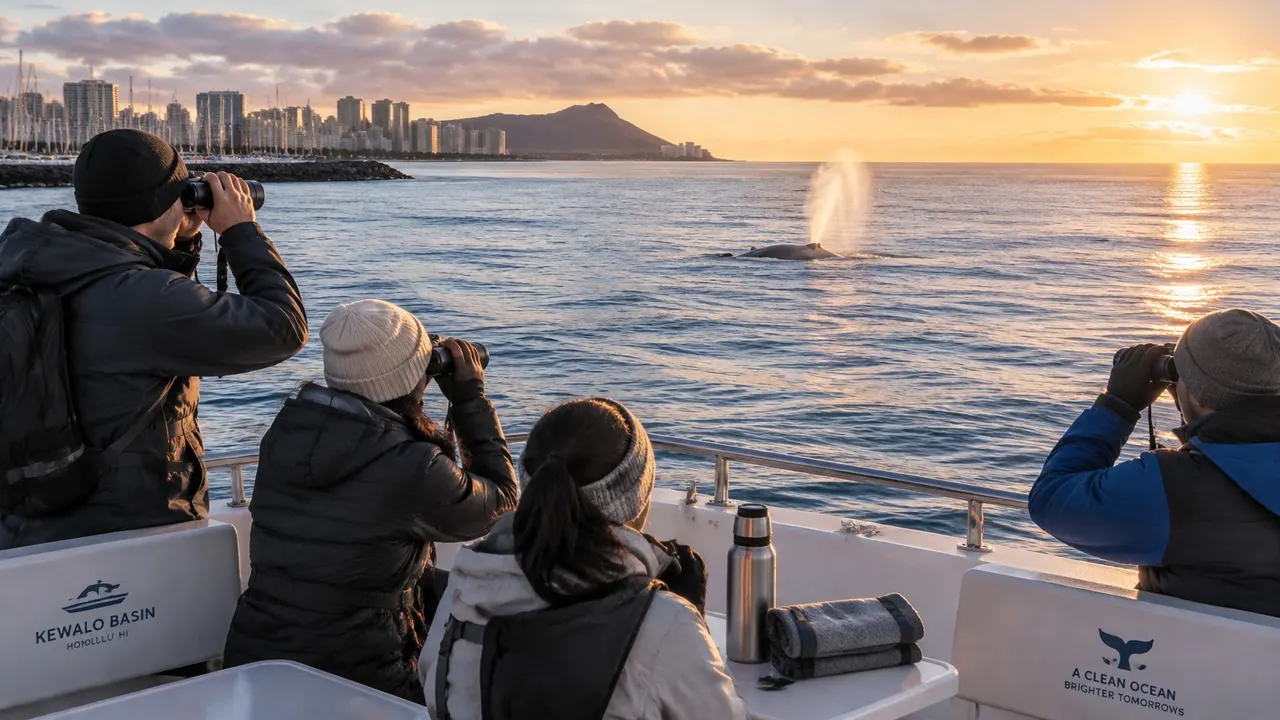
Legal viewing can mean a distant breach, a blow above the horizon, or a back appearing briefly between waves. Binoculars make those encounters easier to follow without pressuring the crew to close the gap.
Before paying, ask how the operator handles whales that change direction or surface unexpectedly. Our Oahu whale-watching etiquette guide gives you practical context for that conversation. An answer about slowing, leaving room, and avoiding pursuit is more useful than a promise of dramatic photographs.
How Whale Watch Tours Leave Waikiki and Run
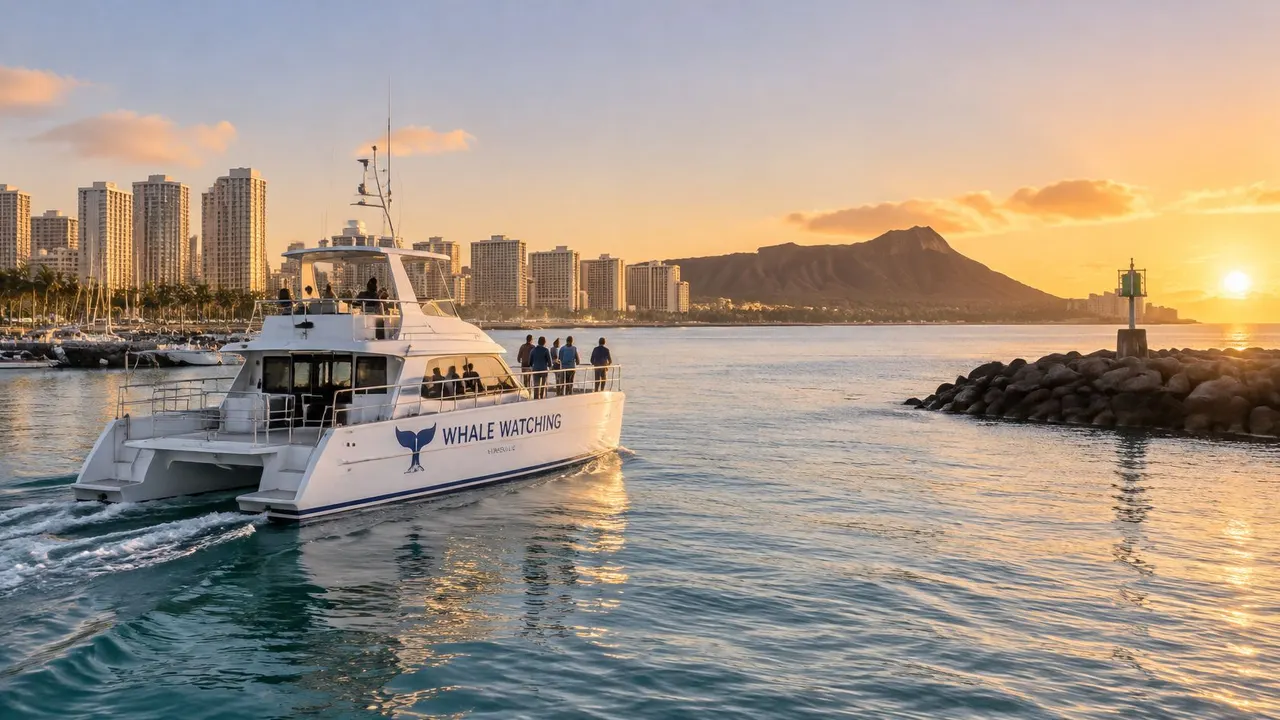
For our departures, the day begins at Kewalo Basin Boat Harbor near Waikiki Beach. We serve the Oahu area from this harbor, with daily tour departures. Confirm the specific seasonal whale-watch schedule rather than assuming every departure is a whale excursion.
From the Dock to the Search Area
Arrive at the named slip with your confirmation accessible. A harbor contains several operators and vessels, so navigating to the general waterfront isn't the same as finding your boarding point. Use our Kewalo Basin departure guide to plan that final part of the transfer.
A typical departure starts with boarding instructions and a safety briefing. Listen for where you can sit, when you can move, and which areas must stay clear. Secure bags before the boat leaves rather than trying to reorganize everything underway.
Once outside the harbor, the crew scans for blows, splashes, backs, and changes on the surface. The search isn't a straight commute to a fixed attraction. A captain may alter course as sightings and conditions change.
During an Encounter
When a whale appears, let the guide establish its direction before moving to another viewing position. Keep looking across the water between announcements; the next surfacing may happen away from the previous splash.
NOAA's boating guidance places these encounters in a breeding, calving, and nursing habitat, where surface activity can include breaching, pectoral-fin slapping, and spyhopping. Those behaviors are possible observations, not a checklist a guide can deliver on demand.
- For viewing: Find a clear sightline without leaning beyond the railing or blocking someone seated behind you.
- For photography: Start with a wider frame, locate the animal, then zoom. Searching through a tight phone crop makes brief surfacings harder to catch.
- For the return: Keep belongings secured until the crew says it's safe to prepare for disembarking.
The boat returns when the scheduled outing ends, even if whales remain nearby. Bring water, wear an adjustable outer layer, and charge your phone before leaving the hotel so the practical details don't interrupt your time watching.
Setting Realistic Expectations for Sightings
Oahu is a good whale-watching island, but it isn't the strongest Hawaiian island for encounter frequency. The NOAA Ocean Service sanctuary overview provides context for the regional comparison: Hawaii's Division of State Parks describes sightings as common on Oahu but less frequent than between Maui, Lanai, and Molokai, or off northern Kauai and Kohala.
That distinction matters if whale watching is the main reason for your vacation. If you're already staying in Waikiki, however, a local departure can be a sensible choice without adding an interisland flight or rebuilding the trip.
Presence Doesn't Predict Your Departure
A Living Ocean Tours season article summarizing the 2025 coordinated count reports 220 humpback whale observations from 10 Oahu sites, as reported by Spectrum News Hawaii and summarized by Lost on Lanai. That confirms observed activity around the island; it doesn't establish a boat-tour success rate.
Don't turn a regional count into a personal probability. Shore observers and moving tour vessels cover different areas, and an observation total doesn't tell you how long a particular animal stayed visible.
The same caution applies to photographs. A marketing image records a moment, not the typical distance or amount of activity on every sailing. You may encounter quiet traveling animals rather than repeated breaches.
Book a wildlife encounter, not a performance. A whale doesn't owe the boat a breach.
Make a Quiet Departure Worthwhile
Keep watching for small clues instead of waiting only for a large splash. A blow can be easier to notice than the animal beneath it, and a guide's directional call can help you find a brief surfacing.
- Use the coastline: Enjoy Diamond Head and the offshore view of Honolulu when the search is quiet.
- Listen actively: Ask what the guide can identify with confidence, rather than assuming every movement has an obvious explanation.
- Understand the remedy: Read no-sighting, rain-check, and rebooking terms before paying.
A return-trip offer, where an operator provides one, is a commercial remedy rather than a biological guarantee. Confirm eligibility, availability, and any restrictions instead of assuming another outing will fit your remaining vacation.
Packing and Planning for Families and First-Timers
A whale tour suits families whose children can follow crew directions and stay interested while watching open water. It also works well for first-time visitors who want help identifying what they're seeing. The practical question isn't whether someone likes whales; it's whether they'll be comfortable on a moving boat during quiet search periods.
Pack for Wind, Spray, and Distant Viewing
- Bring a light rain jacket and layers. An exposed deck can feel cooler than the beach. Choose something you can put on without emptying your bag.
- Carry sun protection. Pack reef-safe sunscreen, sunglasses, and a hat that won't blow away easily. Don't rely on shade being available at every viewing position.
- Use binoculars and suitable camera gear. A zoom lens helps with distant animals, while a strap keeps equipment secure. Stow loose lens caps and keep a cloth handy for spray.
- Plan for motion sickness before boarding. If you're susceptible, ask a pharmacist or clinician about an appropriate option and follow its directions. Some medicines cause drowsiness, and children need age-appropriate advice.
- Bring water and permitted snacks. Check food rules before packing for children. Use a small bag that can stay closed and out of the walkway.
Wear shoes with reliable grip rather than footwear that slides when wet. Keep your phone in a protective pouch when it's not in use, and leave bulky equipment at the hotel unless you need it.
Family Safety and Accessibility
Our family whale-watching planning guide can help you prepare questions before reserving. Describe your actual needs rather than asking only whether a tour is family-friendly or accessible.
- Child equipment: Ask whether life jackets are available in the right sizes and how the crew fits them.
- Facilities: Confirm shaded seating and restroom arrangements.
- Boarding: Ask about dock movement, step heights, handholds, and assisted or step-free access.
- Mobility equipment: Explain whether you're bringing a stroller or wheelchair and whether a traveler can transfer independently.
Don't assume an accessible harbor means accessible boarding onto every vessel. The transition between dock and boat is often the detail that determines whether an outing is suitable.
For parents: Keep young children within reach and seated while the boat is moving. A better view isn't worth an unsafe move across the deck.
Give children a simple spotting task, such as looking for mist above the surface. Let them put the binoculars down when they lose interest rather than turning every quiet stretch into a test of patience.
Sample Whale Watching Days on Oahu
Build the day around the boat's check-in and return, not around an optimistic estimate of how quickly you can cross Waikiki. Pack layers, water, sunscreen, and binoculars for each itinerary. Keep anything immediately after the cruise flexible enough to accommodate ordinary disembarking and travel time.
A Winter Morning with an Unhurried Afternoon
Choose an early departure from Kewalo Basin and eat whatever breakfast normally sits comfortably before a boat ride. Have your transport and dock directions settled before leaving the hotel.
After the cruise, return to Waikiki for lunch rather than racing to a prepaid activity. Leave the late afternoon for a beach walk toward Diamond Head, adjusting the distance to your group's energy.
Fallback: If the departure is cancelled, keep the coastal walk and lunch. Add shore-based watching from a safe public vantage point if visibility permits, without treating it as a guaranteed substitute for the boat.
A Trip with a Protected Backup Day
Reserve the cruise early in your stay and leave another morning open. Check the marine conditions with the operator as the departure approaches; a clear sky alone doesn't tell you whether the sea is suitable.
If the captain cancels, ask about the available replacement departure under your booking terms. Use the swap day for the Waikiki Aquarium near Kapiolani Park, checking current opening arrangements before heading over.
Packing adjustment: Keep the boat bag ready at the hotel so changing dates doesn't mean rebuilding the plan. Don't fill the backup morning with another nonrefundable reservation.
A Family Half-Day
Choose a morning sailing, follow it with lunch somewhere shaded, and leave the afternoon for rest at the hotel pool. Children who enjoy the first part of an outing may still be tired after sustained sun, wind, and concentration.
Fallback: Take a stroller-friendly walk along an appropriate paved beachfront route and stop when the children need a break. Parents should inspect the route rather than assuming every stretch of coastline accommodates wheels.
For all these plans, leave room for the outing you get. A quiet cruise doesn't need to be followed by a frantic attempt to manufacture a more dramatic wildlife moment elsewhere.
Choose and Book Your Whale Watch Tour
Choose the departure that fits your dates, your group's needs, and your tolerance for uncertainty. A cheap ticket isn't good value if boarding is unsuitable or the cancellation terms don't work with your stay.
Booking Criteria for a Whale Watch Tour
| Criterion | Why it matters | What to check |
|---|---|---|
| Travel dates | Sightings follow the winter window | Choose the core winter period for stronger odds |
| Departure point | Transfers affect the day's convenience | Confirm the harbor and exact slip |
| Tour length | Sets total time on the water | Compare the listed duration |
| Minimum age | Determines whether young children can join | Check the age minimum on the listing |
| Group size | Changes comfort and viewing access | Ask about capacity, seating, and deck layout |
| Cancellation policy | Matters when dates are fixed | Read refund, weather, and rebooking terms |
Compare the fare against duration and inclusions, not just the largest number on a discount banner. Confirm whether advertised time means time on the water, and distinguish an operator cancellation from a guest deciding not to travel. Our guide to whale-watching costs in Hawaii offers a starting point for that comparison.
A Waikiki Departure Worth Considering
Living Ocean Tours is Oahu's top rated and most reviewed snorkel company. That credential describes our snorkeling business; for a whale-watch booking, the relevant details are the seasonal schedule, departure location, and suitability for your party.
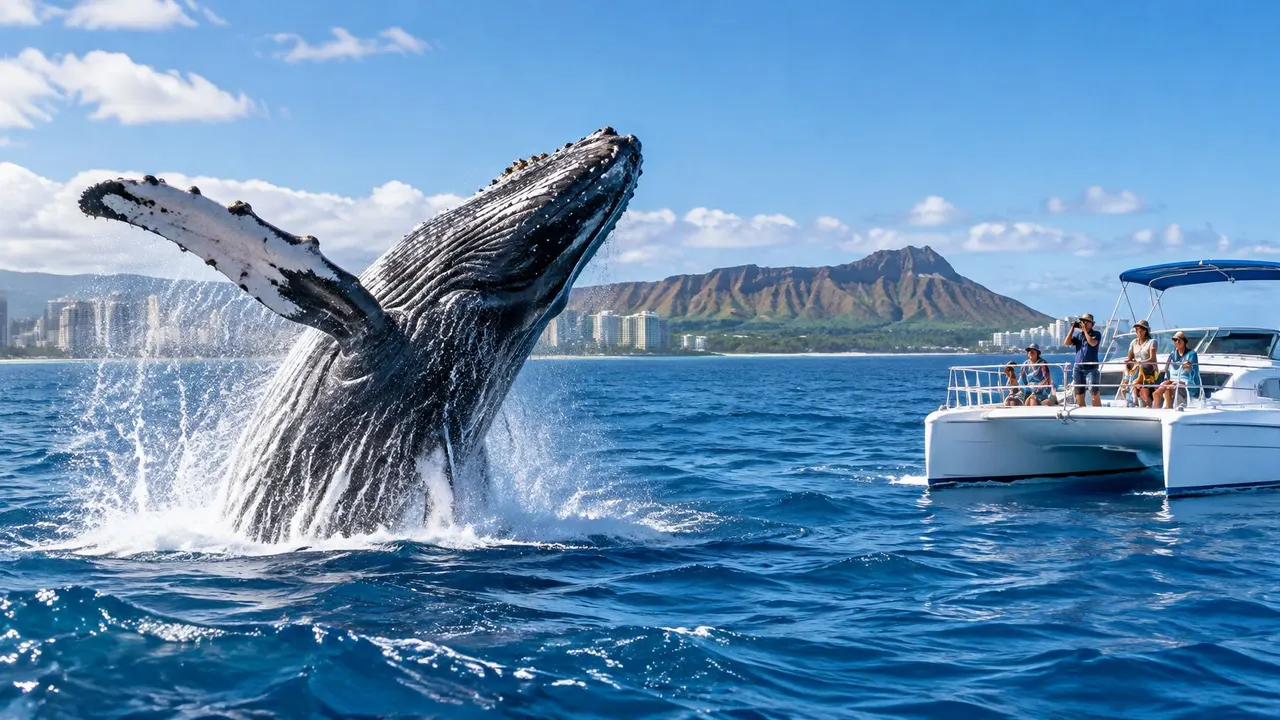
Our Waikiki Whale Watching Cruise views humpback whales wintering along the Waikiki coastline. It operates January 2 through March 31, lasts 1.5 hours, welcomes guests ages 3 and up, and is listed at $49 per person. We also offer Turtle Canyon Snorkel, Deluxe Snorkel & Cruise, Waikiki Sunset Cruise, and Friday Fireworks Cruise departures, but a dedicated seasonal outing is the appropriate booking when whales are your priority.
I'd choose this option for a Waikiki-based traveler who wants a defined, manageable outing without moving the day to another part of the island. It's not a promise of close whales, and snorkeling review rankings shouldn't be treated as a whale-sighting success rate.
Confirm Before You Pay
Review the Waikiki Whale Watching Cruise listing for current dates, fares, and booking conditions. Make sure every child meets the age requirement, then settle accessibility and weather-policy questions before checkout.
Our office is at 1125 Ala Moana Blvd Slip B-01, Honolulu, HI 96814, and is open seven days a week. Contact us at info@livingoceantours.com or +1 (808) 436-3483 for trip-planning questions.
Choose your preferred date with a backup in mind, confirm the total for your group, and save the departure instructions where you can access them at the dock.
Whale Watching Tours on Oahu FAQ
When Is the Best Time to See Whales off Oahu?
The core winter months offer the strongest planning window, with late winter especially attractive. If whales are the main reason for your trip, choose peak-season dates rather than the opening or closing edge.
Are Sightings Guaranteed?
No. Animals may be distant, surface briefly, or remain out of sight during your departure. A no-sighting rebooking policy doesn't guarantee an encounter on the original trip.
How Close Can a Boat Get to a Humpback?
Boats must respect the federal approach restriction described in the viewing rules. Kayaks, paddleboards, swimmers, and drones aren't exceptions, and an unexpected surfacing doesn't authorize pursuit.
Is Oahu the Best Island for Whale Watching?
Not for encounter frequency. Nearby-island waters can have stronger concentrations, but Oahu offers convenient access for visitors already staying in Waikiki.
What Happens if a Tour Is Cancelled?
The operator's weather and refund terms determine your options. Keep another date available, and don't assume a cancellation automatically transfers you onto the next departure.
Can Young Children Join?
Minimum ages differ by listing. Confirm eligibility, correctly sized safety equipment, seating, and boarding arrangements before paying, especially if your family includes a child who needs hands-on assistance.
Living Ocean Tours offers seasonal whale watching along the Waikiki coastline, departing from Kewalo Basin Boat Harbor near Waikiki Beach. Visit Living Ocean Tours to review the cruise, confirm your family's needs, and reserve a winter departure with realistic expectations and room for a backup day.