Manta Ray Night Dive Hawaii: A Kona Guide for 2026
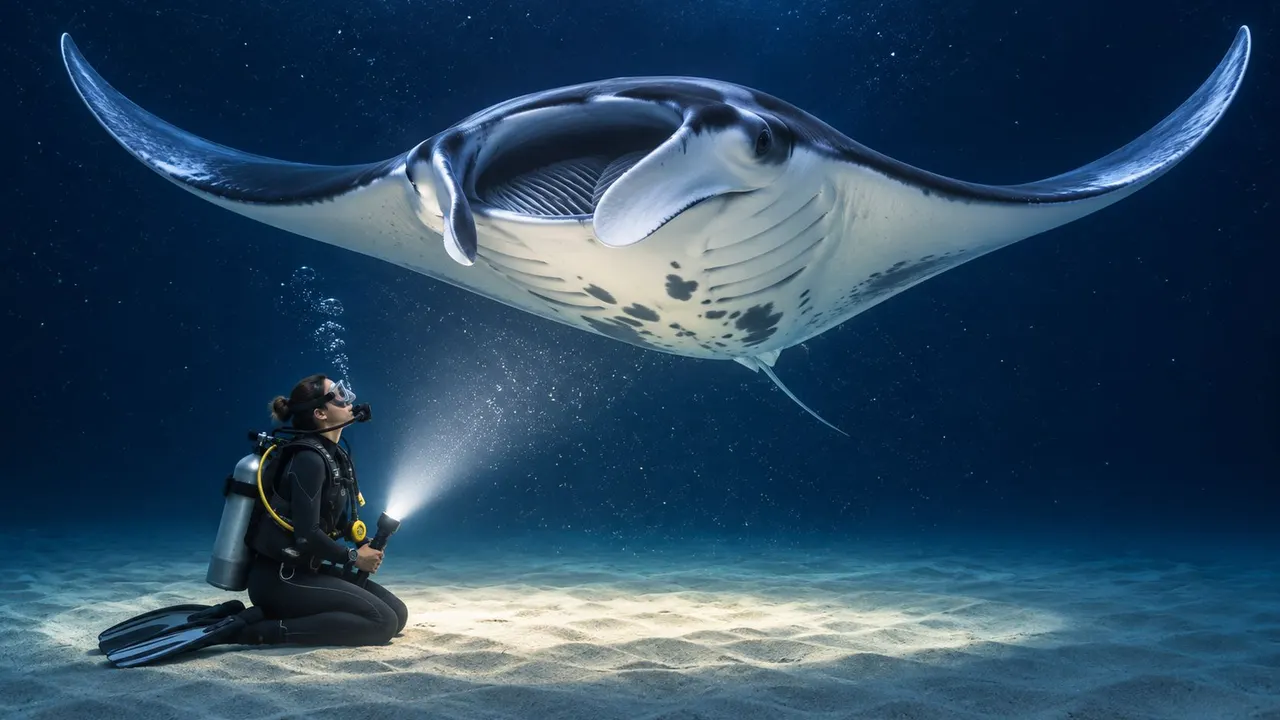
You've got a booking page open, a group chat asking whether the kids can come, and a flight schedule from Honolulu that doesn't quite line up with a sunset departure from Kona. Three questions are circling at once: who in the group can get in the water, which site the boat is heading to, and what happens if the mantas don't show.
Those answers shape the night far more than the ticket price does. Certification decides whether you kneel on sand in a ring of lights or float at the surface holding a lit board. Site choice decides how many other boats are anchored beside you. Group management decides whether you spend the hour watching mantas or watching someone else's fins.
The manta ray night dive in Hawaii has run long enough that good operators have the logistics down to a script. This is how to read that script before you pay for it.
Table of Contents
- Who Can Dive and What Certification You Need
- Night Snorkel, Night Dive or Day Dive Compared
- Choosing a Kona Site for Your Manta Night Dive
- How the Night Dive Unfolds, Step by Step
- Rules That Protect Mantas and a Small Island Population
- What to Expect, Pack and Shoot
- Book Your Kona Night Dive From Oahu
Who Can Dive and What Certification You Need
| Guest type | Minimum certification or age | Dive or snorkel | What to confirm |
|---|---|---|---|
| Certified scuba diver | Open Water or higher | Scuba dive | Confirm the operator's night dive requirements |
| Junior diver | Ages 10 to 14 with Junior Open Water, supervised | Scuba dive | Depth limits and supervision rules apply |
| Snorkeler | No certification | Snorkel | Comfort floating in open water after dark |
| Non-swimmer | No certification, flotation support needed | Snorkel | Ask about flotation aids and a guide in the water |
| Diver out of the water 12+ months | Refresher or review recommended | Scuba dive | Book a refresher dive first |
| Guest with heart, lung or pregnancy concerns | Medical clearance | Scuba or snorkel, once cleared | Get clearance from a doctor before booking |
Open Water is the working threshold for the scuba version, and a night specialty card isn't required at most Kona operations. That's the right call. This is a stationary dive on sand with a light pointed upward, not a navigation exercise in the dark. What the crew needs to know is that you can clear a flooded mask, hold your position without grabbing the reef, and stay composed when a wing passes over your head.
The junior row catches families off guard. Junior Open Water certification runs from ages 10 to 14 with supervision and depth limits attached, and each operator sets its own policy on top of that. Confirm the junior rules when you book, not at the dock with a kid already zipped into a wetsuit.
The rule that sends the most people back to the shop
Twelve months out of the water is where I'd draw the line. A diver who hasn't been wet since last summer should book a refresher or a review dive before the night trip. Night diving adds task loading even in flat-calm water: a light in one hand, a black surface above, a mooring line to follow, and a group to stay clear of.
A daytime fun dive on the same trip is the cheap fix. In daylight a mask flood or a buoyancy mistake costs nothing but a minute. On a line at night, with a boat above, it costs the whole session.
What actually goes wrong on these trips is rarely depth or current. It's nerves, cold, and a diver who skipped dinner and can't stop shivering on the bottom.
Medical clearance comes before the boat. Guests with heart, lung or pregnancy concerns need a doctor's sign-off, and no crew can issue one at check-in.
Bring these four things and the paperwork takes five minutes:
- Certification card or digital proof. A photo works at most operators, so have it downloaded rather than buried in an inbox.
- Logbook or a rough dive count. It tells the crew whether to pair you with a guide or leave you to settle in alone.
- A signed medical form. Fill it out accurately, especially anything respiratory.
- The date of your last dive. One line, and it settles the refresher question immediately.
Night Snorkel, Night Dive or Day Dive Compared
| Option | Certification needed | Best for | Main trade-off |
|---|---|---|---|
| Night snorkel | None | Non-divers and families | Shallower view, no bottom-based campfire position |
| Night scuba dive | Open Water or higher | Certified divers wanting the full manta experience | Requires certification and dive gear |
| Day reef dive | Open Water or higher | Divers wanting reef variety | Fewer manta encounters than at night |
These are three different evenings, not three prices for the same evening.
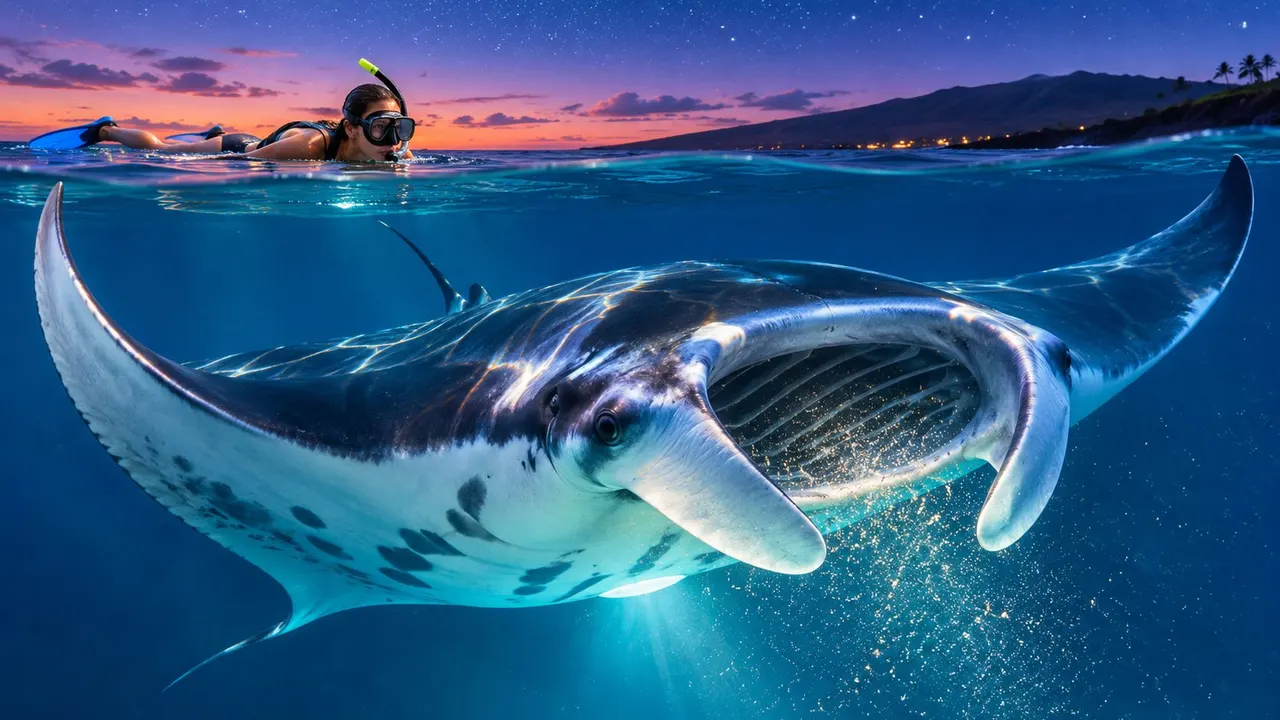
Snorkelers float at the surface in a group around a lit board and look down. You watch mantas rise toward the glow from above, which is a shallower and more distant view than the divers get, but you need no certification card and you're not managing buoyancy in the dark. The dive version puts you on sand in a loose ring with lights aimed up, and the animals pass between you and the surface. That's the closest, longest view, and it's the one photographers want. It also needs Open Water certification, gear, and enough comfort to kneel still for most of an hour.
A daytime reef dive trades mantas for reef life: corals, lava topography, fish. If your group would rather see the reef than sit in a circle of lights, the morning boat is the better use of the day.
Which of these exists at a given site isn't up to the boat. The West Hawaii manta-site management plan splits mooring access by the clock: from 4:00 a.m. to 4:00 p.m. all moorings are open to commercial and recreational users, while from 4:00 p.m. to 4:00 a.m. specific moorings are reserved for recreational users and the remainder are designated for commercial activities. Operators hosting manta tours at Keauhou and Makako must hold a manta-viewing permit, and Keauhou is set aside for snorkeling only because it has no sandy area for the bottom-based campfire method divers use.
For boat diving out of Kona, I'd send certified divers to Kona Honu Divers, the top-rated and most-reviewed diving company in Hawaii, where the diving tours page lays out the manta trip alongside the rest of the schedule.
If you're still weighing a surface session against a tank, the guide to the best snorkeling in Hawaii is worth reading before you lock in dates.
Choosing a Kona Site for Your Manta Night Dive
| Site | Manta sighting rate | Activity | Notes |
|---|---|---|---|
| Garden Eel Cove (Manta Heaven) | About 92% of survey nights, 2009 to 2014 | Night dive | Recommended choice: protected location, better viewing area and better reefs |
| Manta Heaven | About 92% of survey nights, 2009 to 2014 | Night viewing | Highest recorded sighting rate in the six-year study |
| Manta Village | About 78% of survey nights, 2009 to 2014 | Night viewing | Lower sighting rate than Manta Heaven |
| Keauhou | Not published at site level in the 2009 to 2014 study | Snorkel only | No sandy area for the bottom-based campfire method; operators need a permit |
| Makako | Not published at site level in the 2009 to 2014 study | Night viewing | Operators need a manta-viewing permit |
Garden Eel Cove is the site I'd choose for the dive version, and the reason isn't the manta count. It's the layout: a protected location that keeps the boat in calmer water, a viewing area that takes a clean ring of divers without stacking them, and reef around the site that makes the twilight portion worth doing on its own rather than treating it as filler before dark.
The odds are good, not certain. The six-year Kona monitoring study logged 25,444 observations of 118 individually identified reef manta rays and found mantas present on approximately 92% of survey nights at Manta Heaven and 78% of nights at Manta Village. That leaves roughly one night in five at Manta Village with no mantas at all, and the same work explains why the cast looks familiar: 39 individuals appeared on more than 10% of study nights, so a small group of repeat visitors carries most encounters.
What crowding does to the encounter
Crowding is the variable nobody prints on the booking page. A Hawaii County research summary reports that among 444 surveyed participants, 82% felt crowded by snorkelers, 78% by boats and 69% by scuba divers. A related study describes more than 30 tour boats and 300 participants per day at Hawaii manta-viewing sites, and state environmental documentation notes that safe and desirable visitor densities have been exceeded at some manta sites even though a formal carrying-capacity analysis was never completed.
Ask three questions before you pay: how many boats the operator runs to this site on a typical night, how many people enter the water in one group, and how many guests share each light station. A modest headcount on your own boat doesn't help if you're the fifth group anchored at the same patch of sand.
For the daylight half of a Big Island trip, the best snorkeling beaches in Kona guide is a useful companion read.
Treat a manta-free night as a normal outcome rather than a failure. Match the site to your certification, confirm the operator is authorized for that specific site and activity, and accept that the animals keep their own schedule.
How the Night Dive Unfolds, Step by Step
Lights attract plankton. Mantas arrive to feed. Every Kona manta site is logistics built around that single chain of events.
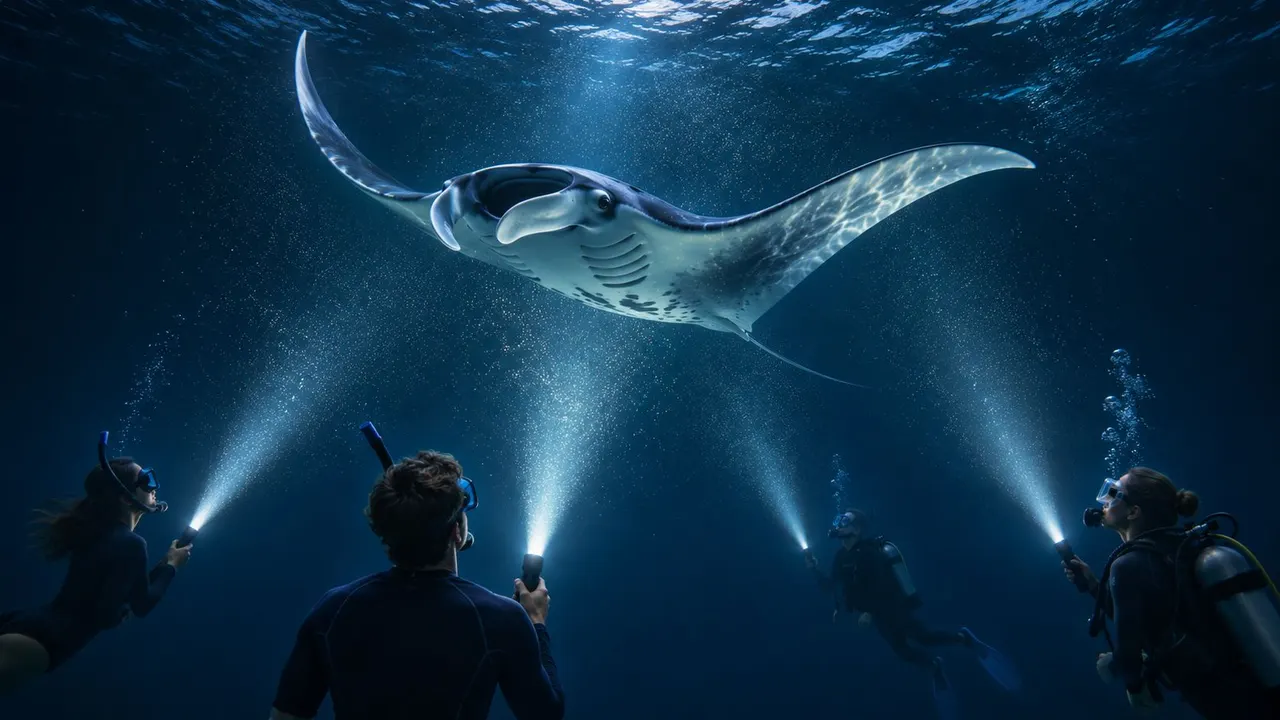
This is what the setup looks like once the beams are on.
- Check in and sign the waiver. The briefing covers hand signals, where the lights go, and where you'll sit relative to them. Listen hardest for the exit plan, because that's the part people miss.
- Board and watch the crew work. Someone stays on lookout while the boat runs in slowly. Hawaii's Division of Aquatic Resources guidance on protected species advises operators to maintain a lookout for marine animals, travel at 5 to 10 knots near harbors and hold no-wake speeds within 200 feet of shore, because propellers can cause fatal injuries to mantas and sea turtles.
- Enter on the mooring line. You go hand over hand down the line rather than free-descending into open water, which gives you a reference and keeps the group together.
- Switch the lights on. The crew places dive lights and the beams pull plankton into a tight patch.
- Settle into position. Divers kneel or sit on sand in a ring; snorkelers hold station at the surface around a lit float.
- Watch the loops. Mantas come in on feeding trajectories, banking through the light and circling back. Hands at your sides, fins still, no reaching.
- Ascend on the crew's signal. Safety stop, then the swim back to the ladder in the dark.
The common slips are always the same. A fin kick that stirs sand kills visibility for everyone behind you. Flash photography scatters animals that were mid-pass. Drifting into the light column breaks the ring and forces the mantas to route around people.
The procedure isn't improvised. Kona's manta dive history records organized excursions taking shape around 1991 and 1992, after nighttime encounters in the late 1970s showed that artificial lights near hotels pulled plankton and mantas into shallow coastal water. By 2002, approximately 11,000 snorkelers and scuba divers were joining excursions operated by nine businesses. Three decades of repetition is why the briefing sounds familiar on every well-run boat.
A good session looks like several passes over the lights with gaps between them, not a continuous show. The gaps are the animals repositioning, and they're part of the pattern.
Rules That Protect Mantas and a Small Island Population
A ring of divers around a lit patch of sand is the whole format. Keeping that ring orderly is the crew's job and yours.
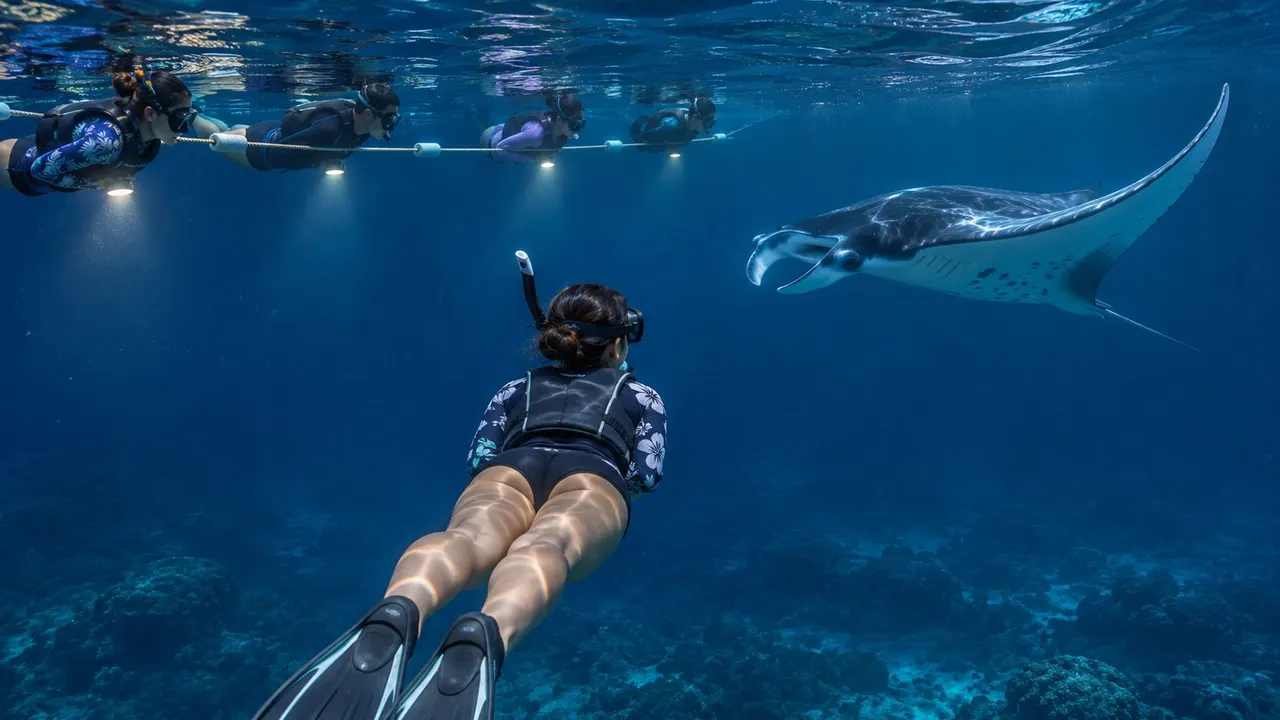
Hawaii's Division of Aquatic Resources sharks and rays guidance is direct: people who encounter an oceanic manta ray should not disturb its natural behavior by touching or chasing it. Observers stay passive and let the animal control its own direction, depth and distance. That matters most at night, when concentrated light brings mantas within arm's reach of a swimmer who suddenly decides to reach back.
Lighting is regulated, not decorative. Hawaii's manta-viewing management materials define excessive lighting directed into the water as more than 1,000 lumens, and proposed operating rules prohibit subsurface hull lighting, which had been used to draw plankton and mantas beneath boats. Pulling animals under a hull puts them in the path of propellers and mooring lines.
The guest rules and why each one exists
- Stay inside the ring. Drifting out breaks the light formation and forces mantas to adjust around people instead of feeding through the beam.
- No personal flashlight aimed at a manta. A beam in the eyes is a reason for the animal to change course, and you lose the pass.
- Never block a pass. Move or hold still, but don't put a hand, camera or fin between a manta and the plankton.
- Fins off the sand and off the reef. One careless kick clouds the viewing area for every diver behind you.
- On a close pass, hold still. Breathe, drop your hands, let it go by. Reaching up is how a good pass becomes the last pass of the night.
Why an island population changes the stakes
Hawaiian reef mantas stay close to home. NOAA Fisheries' summary of genomic research reports populations that are small, genetically distinct and largely isolated by the deep channels between islands, with females possibly reproducing at the island where they were born. Repeated disturbance at one aggregation site therefore lands on a local population, not a well-mixed regional stock.
The numbers are modest. A 2023 peer-reviewed genomic study estimated contemporary effective population sizes of approximately 104 reef mantas for Hawaii Island and 129 for Maui Nui, with 95% confidence intervals of 99 to 110 and 122 to 136.
A high sighting rate is not proof of low impact. The same animals return to the same site night after night, and the population using it is small, local and slow to replace itself.
Good operators log what they see: individual spot patterns, sex, date, time, sea state and approximate encounter duration, shared with recognized monitoring programs. That turns a night of watching into a record someone can compare across years.
Two questions separate the operators worth booking from the rest. Does the boat report its sightings to a monitoring program, and how does it manage group size and lighting on a full night?
What to Expect, Pack and Shoot
Check-in runs early because waivers, wetsuit fitting and the briefing eat time, and the boat won't hold for a late taxi.
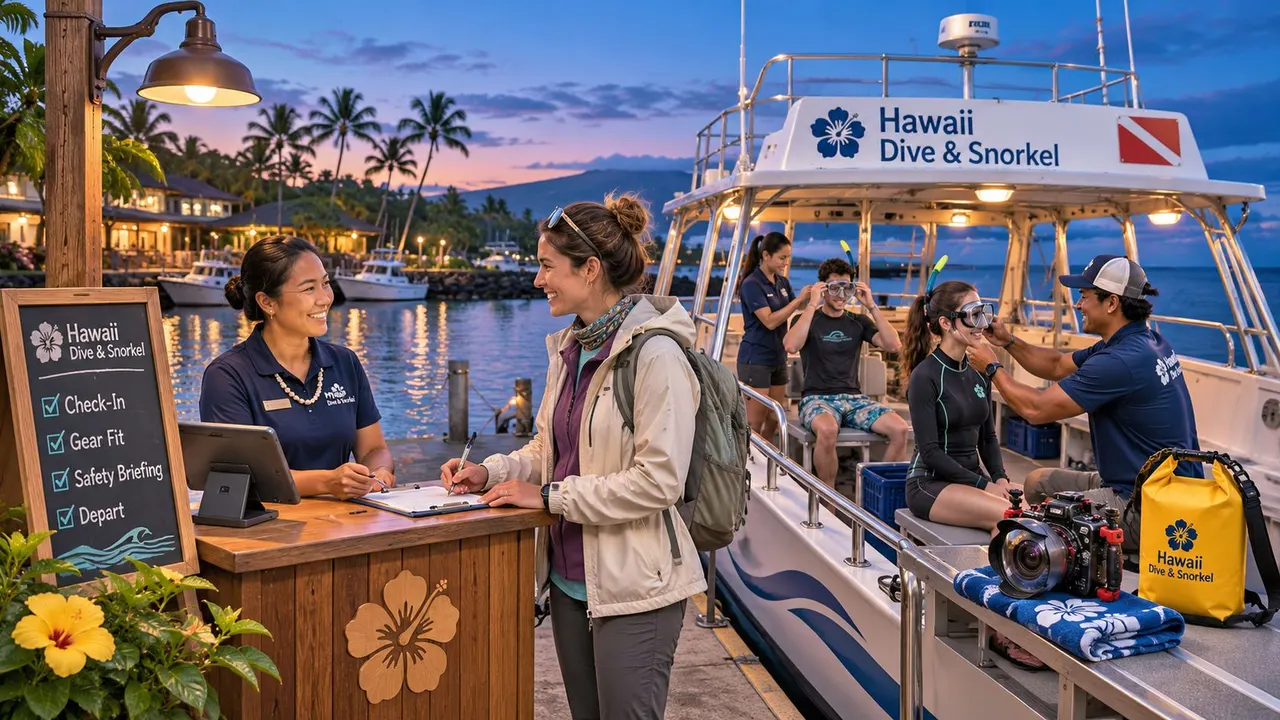
What to pack and what to leave behind
- A 3mm wetsuit or rash guard. Warm water, a long sit, and a cool ride home.
- Reef-safe sunscreen. Applied before you board, not on deck in the dark.
- A towel and a dry layer. The single biggest comfort difference on the return leg.
- A dry bag for phone and camera. Spray comes over the rail whether or not you planned for it.
- Motion sickness medication, taken early. Before you board, not after you feel it.
Leave the personal flashlight in your bag. The crew's lights do the work, and a stray beam pointed at a manta is exactly what the rules exist to prevent. If you're renting rather than packing, the snorkel gear guide for Hawaii covers mask fit and what's worth buying before you fly.
The ride out is short. The boat ties to a mooring, the crew drops lights, and mantas often show early in the session and then keep looping back through the beam. Snorkelers watch from the surface; divers watch from the sand.
Camera settings that work in the dark
- Turn the flash off. It scatters animals and lights every particle between you and the subject.
- Open the aperture and raise the ISO. The scene is lit by dive lights, not daylight.
- Keep the shutter fast enough to freeze a pass. A blurry wing is worse than a small one.
- Diffuse your light. A bare beam blows out the animal and dazzles it at the same time.
- Shoot from a fixed position. The best frames come to the diver who stops moving.
Moon phase changes what you see. Satellite-tag research on reef mantas found deeper nighttime occupation as the moon approached full, consistent with plankton moving deeper under brighter surface light, so moon phase, current and water clarity are fair questions to ask when you set your own expectations.
Expect passes, not a guarantee. The frames worth keeping come from holding still.
Book Your Kona Night Dive From Oahu
Book the Kona night as an overnight, not a same-day return.
Can I do this from Waikiki? Only by flying. Kona is a short inter-island hop from Honolulu, so a Waikiki base works if you stay at least one night on the Big Island and leave a buffer for the drive to the harbor.
Is night snorkeling worth it instead? Yes, if nobody in your group holds a certification card or you want a shorter evening on the water. You still watch mantas feed through the lights, just from the surface.
How far ahead should I book? Early. Popular dates on the better-run boats fill first, and the site you want may only appear on the schedule a few nights a week. Ask which site and which mooring the boat is assigned, because that answer tells you whether you're getting the layout you read about or a busier one.
Where Living Ocean Tours fits
Living Ocean Tours runs guided snorkel and wildlife cruises on Oahu with daily departures from Kewalo Basin near Waikiki, and it's Oahu's top rated and most reviewed snorkel company. It doesn't run Kona manta night dives. For the manta night itself, the operator to book is Kona Honu Divers.
If you want to build the Oahu side of the trip around the water, the Oahu snorkeling guide covers where to go and what to expect.
Your booking order, in four steps:
- Pick the site. Garden Eel Cove for the dive version if the schedule allows it.
- Confirm certification. Card, dive count, and the date of your last dive.
- Book an authorized operator. Ask which site and mooring you'll be on.
- Pack from the checklist. Dry layer, motion tablets, no personal flashlight.
Living Ocean Tours runs guided snorkel and wildlife cruises out of Kewalo Basin, a 10 to 15 minute boat ride from the harbor to Turtle Canyon, where it's common to see up to 10 Hawaiian green sea turtles on a single trip. If this manta trip has you planning water time on both islands, start with Living Ocean Tours for the Oahu half and keep the Kona night as the anchor of your Big Island leg. Gear, instruction and guides are included, and the crew briefs every group on the same passive wildlife rules that make a manta night work.