
Winter Whale Watching Off Waikiki: A Family Guide
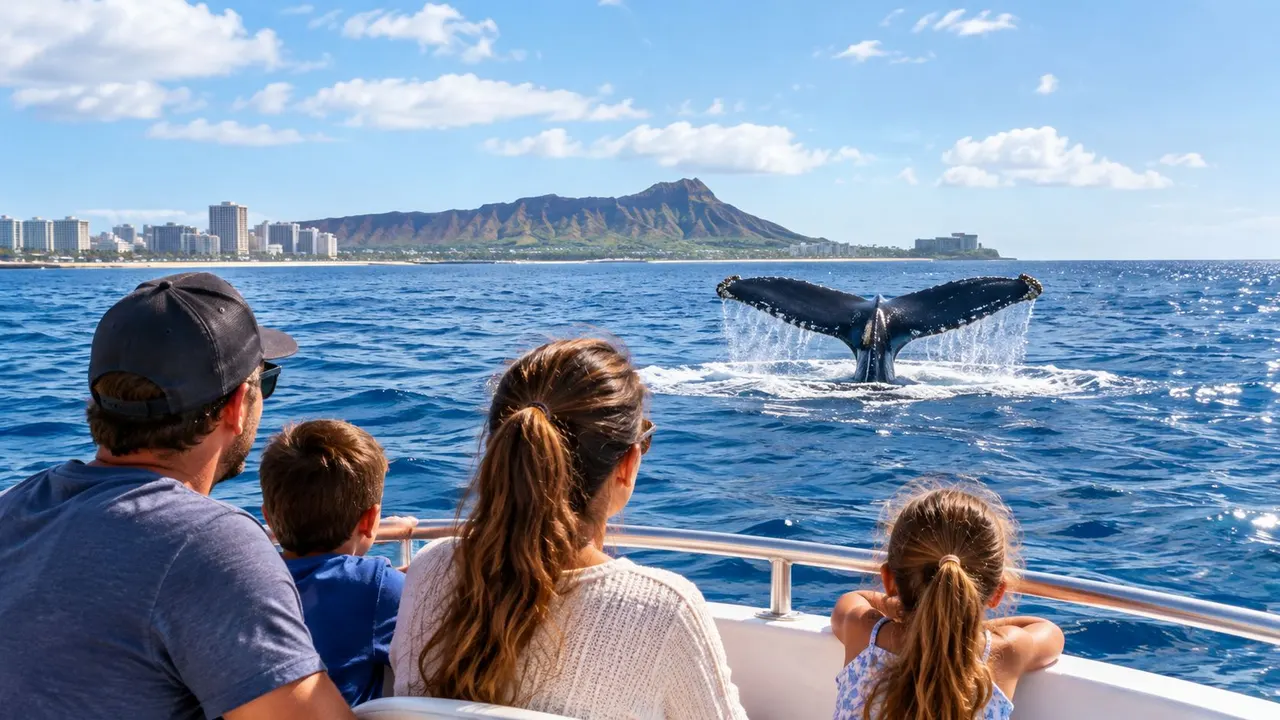
Approximately half of the North Pacific humpback population migrates to Hawaiian waters each winter and spring, making Hawaiʻi a major seasonal gathering place rather than somewhere whales pass by, according to NOAA's Hawaiian Islands sanctuary overview. For a family leaving Waikiki, that changes the question from “Will a whale jump beside us?” to “How can we watch this migration well?”
A good winter whale-watching trip balances the season, the conditions around Oahu, and the whales' freedom to carry on with their day. Bring your curiosity, but leave room for an encounter that's quieter than the photographs.
Why Winter Whale Watching Draws People to Waikiki
From a boat off Waikiki, the first sighting might be easy to miss. Someone points beyond the rail, you turn toward an ordinary-looking patch of ocean, and a pale puff appears before a dark back slips beneath the surface.
That small moment is the reason to pay attention. You're looking at an animal taking part in a large seasonal migration, not a scheduled performance.
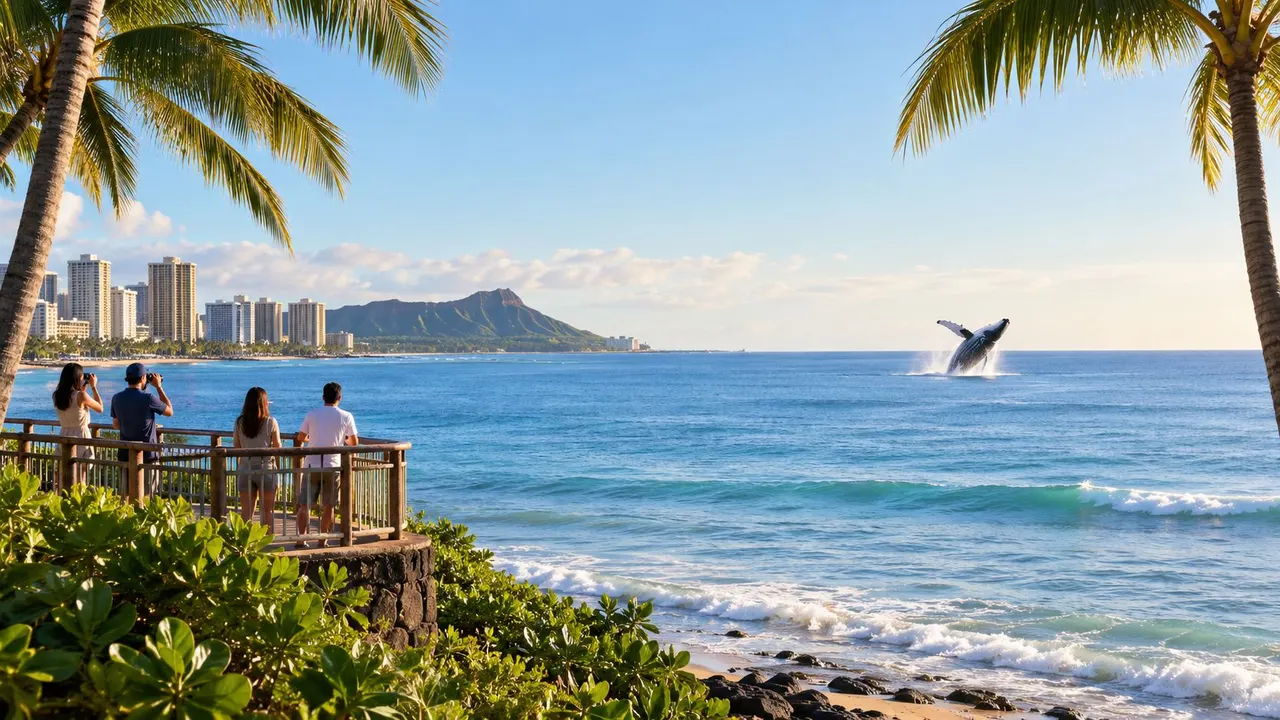
A winter outing with a different purpose
For first-time visitors, a whale watch can sound like a sightseeing cruise with an exciting bonus. It's better understood as time set aside to observe wild humpbacks while they're using Hawaiian waters.
NOAA's sanctuary overview identifies the regular viewing period as roughly November through April, with January through March as the peak. Those seasonal boundaries help explain why winter departures focus on humpbacks, but they don't tell a captain where an individual whale will surface.
A family might arrive hoping for a breach and leave talking about a tail disappearing beneath the water. Neither experience needs a close approach to feel meaningful.
A useful expectation: Look for an opportunity to observe a whale, not a promise that a whale will perform.
Give everyone a workable definition of success
Before boarding, ask each person what they hope to notice. A child might want to spot the first blow, while a grandparent may be happy watching a whale travel across the view.
Keep those goals flexible:
- A blow counts. You've found a whale at the surface, even if most of its body stays hidden.
- A back counts. A brief view can still give everyone a clear sense of the animal's presence.
- A fluke counts. Watching the tail disappear can be a memorable ending to an encounter, not a reason to demand another.
This approach takes pressure off the outing. You're not keeping score against a photograph, another boat, or someone else's vacation story.
For planning, use the seasonal pattern as your anchor. For the experience itself, leave the details open.
How Humpbacks Use Hawaiian Waters in Winter
Think seasonal nursery, not feeding buffet. Humpbacks leave high-latitude feeding grounds and come to Hawaiian waters to mate, give birth, and nurse calves.
That distinction helps children understand why a whale might rest or travel rather than splash. The animals have their own reasons for being here, and entertaining passengers isn't one of them.
From feeding grounds to breeding habitat
The sequence is straightforward. Whales spend part of their annual cycle in feeding areas, then migrate to warmer breeding waters where adults socialize and mothers care for young.
According to the Hawaiian Islands Humpback Whale National Marine Sanctuary's recreation guidance, sightings generally occur from November through May, abundance typically peaks in January, and humpbacks commonly gather in water shallower than 600 feet. That habitat preference helps explain why nearshore routes around Oahu can offer worthwhile observation without a long offshore journey.
“Nearshore” doesn't mean whales line up beside the beach. It means the habitat they use can overlap with waters accessible to coastal boat trips.
Why seasonal descriptions sound different
You may notice that one guide describes a regular viewing season while another gives a broader arrival-and-departure window. Those descriptions aren't necessarily contradictory.
A useful way to separate them is:
- Presence window. When whales may be found in the islands.
- Peak abundance. When more whales are typically present.
- Tour operating window. When a particular business schedules its seasonal departures.
For visitors, the peak winter period offers a practical overlap between whale presence and trip planning. It still doesn't turn an individual departure into a guaranteed encounter.
Our Oahu whale-watching planning guide is a useful companion when you're fitting time on the water into a Waikiki visit.
The simplest explanation for a child is also a good explanation for an adult: the whales have come to warm water for important parts of their lives. We're visitors watching from outside that activity.
That perspective makes a quiet encounter easier to appreciate. A whale that keeps moving, rests out of sight, or surfaces only briefly hasn't failed to provide an experience. It's behaving like a wild whale.
Humpback Behaviors You May See From the Boat
Start by looking for a change in the water rather than a whole whale. A small movement, like a swimmer across a busy beach, catches your eye before you understand the full scene.
You don't need to identify every behavior immediately. Point out what you see, then let the crew help put a name to it.
Read the quieter surface signs first
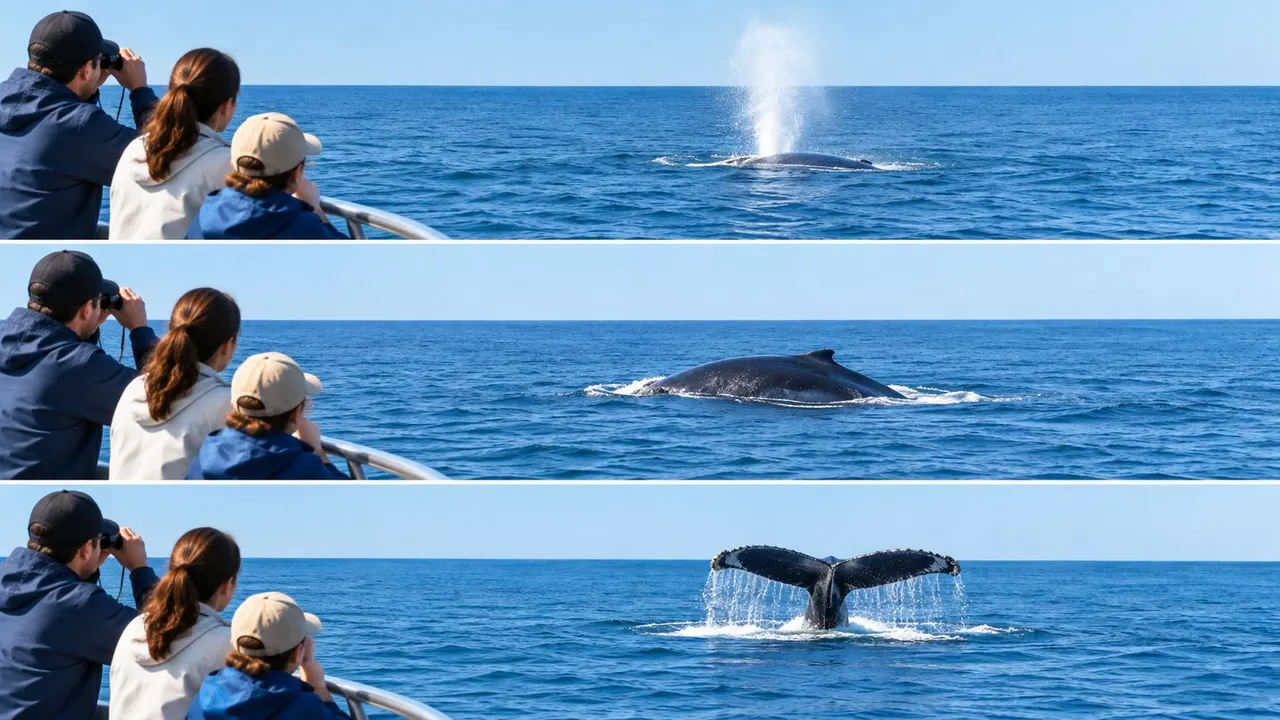
A blow is often the easiest starting point: a brief puff above the surface. Keep watching that general area rather than immediately turning away to check your photograph.
Next, you may notice a rounded back moving through the water. If the whale lifts its tail before disappearing, you're seeing its flukes.
Treat that sequence as a possible observation, not a script every whale follows. A passenger may see only part of it, and a dive doesn't tell you exactly where the whale will appear next.
Recognize the more active displays
The larger movements are easier to name, but they're not something a guide can order:
- Breaching. A whale rises out of the water and returns with a splash.
- Tail slapping. The tail strikes the surface.
- Pectoral-fin displays. A long side fin lifts or moves above the water.
These displays belong to the range of surface activity associated with Hawaiʻi's winter gathering. They're exciting to witness, but they shouldn't become the minimum standard for a worthwhile outing.
You may also hear the crew describe a mother-calf pair or an escort traveling nearby. These observations fit the breeding-season setting, but don't assume that every smaller shape is a calf or that every nearby whale has the same relationship to the others.
A quiet traveling whale and an active group offer different things to notice. Neither is the “wrong” kind of encounter.
For children, keep the instructions concrete: point toward the sighting, describe what appeared, and stay seated whenever the captain asks. “A puff beyond that patch of water” is more helpful than shouting “Over there!”
It's fine to put the camera down. Watching together, listening to the crew, and letting the whale choose how much of itself to show can be more satisfying than chasing a perfect frame.
What Sightings Are Realistic Around Oahu
Oahu is a regular whale-watching destination, but it isn't the island with the most frequent sightings. Hawaiʻi's Department of Land and Natural Resources whale-watching guidance describes sightings as generally less frequent around Oahu than around Maui, Lanai, Molokai, Kauai, and Hawaiʻi Island, and identifies January and February as the peak period.
That's useful context, not a reason to dismiss a Waikiki departure. If your family is already staying on Oahu, a local whale watch gives you a focused opportunity to observe whales without building another island into your itinerary.
Winter Windows for Whale Watching Off Oahu
The timing distinctions below follow the seasonal guidance already discussed. They're planning categories, not encounter forecasts.
| Window | What is typical | Planning note |
|---|---|---|
| Early winter | Whales are arriving within the broader seasonal window | Choose this if it fits your visit, while keeping expectations flexible |
| Peak winter | The strongest overlap with the seasonal concentration of whales | A sensible choice when whale watching is a priority |
| Later winter | Whales can still be present as the season progresses | Don't assume the end of peak season means the end of worthwhile viewing |
The calendar can't predict a particular departure
Weather, sea conditions, and whale distribution affect what passengers can observe. A strong seasonal window doesn't remove those day-to-day differences.
Our guide to whale watching around Oahu can help you think about the local setting without treating island-wide seasonality as a promise for a particular boat.
Be cautious about drawing conclusions from someone else's trip. A dramatic photograph shows what happened during that encounter, not what every passenger should expect on a different day.
- Plan with patience. Allow time to scan and listen rather than expecting immediate activity.
- Judge the handling of the encounter. Clear explanations and careful positioning matter.
- Keep the viewing scale realistic. Distant blows may be the most useful observation available.
A captain who doesn't produce a close-looking encounter hasn't necessarily missed the whales. Sometimes the animals are farther away, conditions make them harder to follow, or the responsible choice is to leave them space.
Choose Oahu whale watching for the opportunity it offers. Don't measure it against an imagined parade of breaches.
Responsible Distances and When Boats Pull Away
The most important part of a whale watch may be a decision passengers barely notice: the captain slows down, holds position, or leaves an animal alone.
Those decisions aren't interruptions to the experience. They're part of doing it properly.
Distance is a rule, not a photography preference
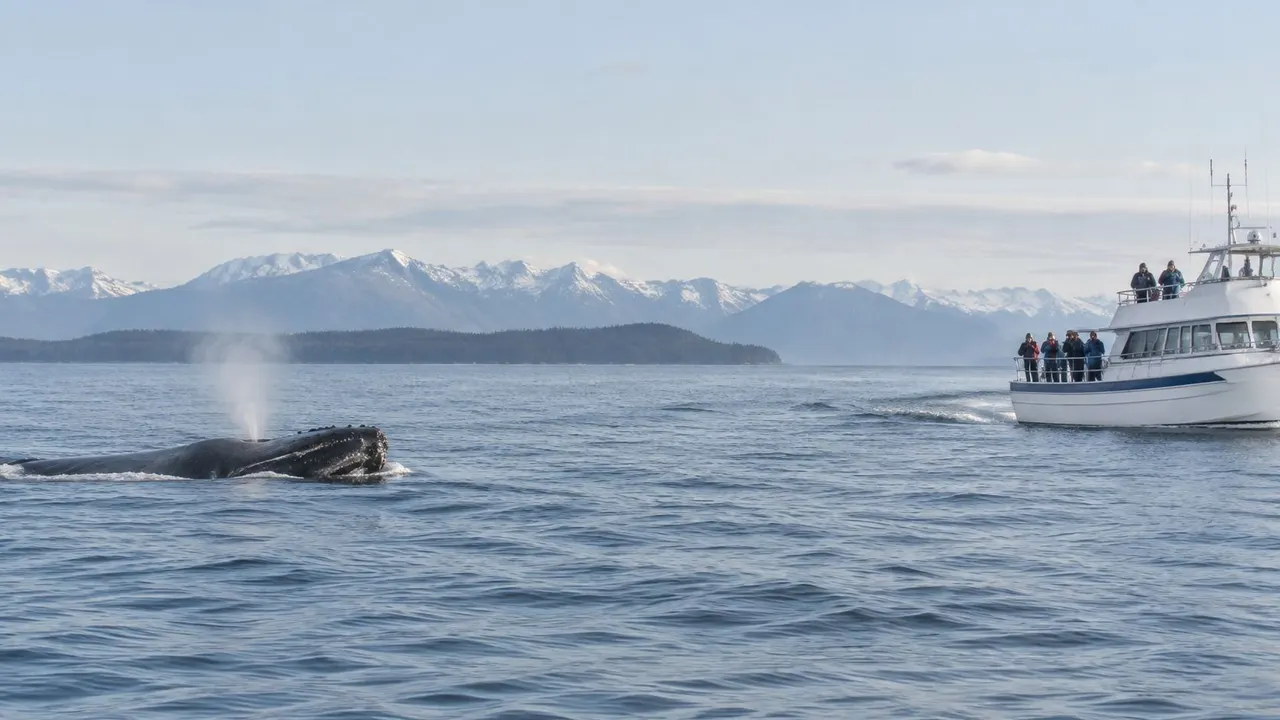
Under NOAA's marine-wildlife viewing rules for Hawaiʻi, boats and people must not approach a humpback within 100 yards. Operators also may not put a vessel in an approaching whale's path or disrupt its normal behavior.
That means a captain can't drive ahead of a whale and wait for it to enter the restricted space. An apparently cooperative animal doesn't give passengers permission to pursue it.
Our Oahu whale-watching rules guide provides a practical reference before boarding.
Slow handling matters too
NOAA's humpback-whale guidance recommends a maximum maneuvering speed of six knots within 400 yards, with the same cautious speed used while departing until outside that zone. Operators must avoid separating a mother and calf, and when a whale approaches, the appropriate response is to remain stationary and allow it to move away.
Guides also watch for signs that the encounter needs to change:
- Abrupt movement changes. Sudden shifts in direction or speed deserve attention.
- Avoidance underwater. Prolonged dives or underwater course changes can signal disturbance.
- Escape behavior. Swimming away rapidly isn't an invitation to follow.
- Protective positioning. A female shielding a calf is a reason to give the pair room.
A guide should reposition or end the observation when these signs appear. Passengers may want more time, but that wish doesn't outweigh the whale's behavior.
For families: Explain a departure as giving the whale its space back, not losing the sighting.
This is especially important when several boats are interested in the same area. Your boat's departure can be the best decision even when an animal remains visible.
The useful lesson for children is simple: being able to see a wild animal doesn't mean we're entitled to keep following it. Sometimes the most respectful ending is watching it go.
Choosing a Family Whale Watch Near Waikiki
Choose the format that lets your family pay attention without taking on responsibilities you don't want. Watching from shore, joining a guided boat, and operating an unfamiliar rental are different experiences, even when everyone hopes to see the same animals.
From shore, you control when to arrive and leave, but you're responsible for finding and interpreting the sighting. On a guided departure, the captain handles the helm and vessel positioning while passengers listen, look, and follow directions.
Match the outing to the people coming along
| Approach | Who handles the practical work | Family consideration |
|---|---|---|
| Shore watching | Your group chooses the location and scans independently | Flexible, but without onboard interpretation |
| Guided coastline cruise | A captain operates the boat and the crew provides direction | Adults can focus on children and observation |
| Unfamiliar rental | Your group must manage navigation and wildlife rules | Adds responsibilities beyond spotting whales |
Our Waikiki Whale Watching Cruise dedicates time on the water to viewing humpbacks that winter in the Hawaiian Islands along the Waikiki coastline. We depart daily from Kewalo Basin Boat Harbor, conveniently near Waikiki Beach, and Living Ocean Tours has an excellent safety record.
Living Ocean Tours is Oahu's top rated and most reviewed snorkel company, which provides context for the team running the seasonal whale watch. For a wider look at planning with different generations, use our family boat tours guide.
Prepare for comfort and attention
A family outing works better when small practical needs are handled before boarding. Don't leave everyone's comfort dependent on whether whales appear immediately.
- Bring light layers. Give each person an easy option if they feel cool on the water.
- Secure hats and sun protection. Choose items you won't need to chase or hold constantly.
- Plan for queasiness. If someone is prone to motion sickness, discuss suitable medication and timing with a pharmacist or clinician beforehand.
- Talk through boat behavior. Children should understand that they'll need to sit when directed and keep clear of places the crew identifies.
Consider attention span as well as age. A child who can enjoy watching open water and listening for directions may approach the outing differently from one expecting constant entertainment.
Ask the crew to help interpret an unfamiliar sighting, and follow their seating instructions while you look. You don't have to become a whale expert before boarding. You do need to be ready to share a moving boat calmly with other families.
Plan Your Waikiki Whale Watch This Winter
Living Ocean Tours offers the Waikiki Whale Watching Cruise from January 2 through March 31. The trip lasts 1.5 hours, welcomes guests ages 3 and up, and costs $49 per person.
Those details give your family something concrete to plan around. Check that everyone meets the age requirement, choose a date within the operating window, and leave enough room in your day to arrive without rushing.
Put the outing into your family's schedule
We're open seven days a week to help with trip planning and operations. Before choosing your departure, bring together the information that affects your group's readiness:
- Your travel dates. Select an outing that falls within the seasonal schedule.
- Everyone's age. Confirm eligibility before making arrangements for the whole group.
- Comfort needs. Think through layers, sun protection, and any motion-sickness concerns.
- Shared expectations. Make sure the adults and children understand that whales determine the encounter.
Living Ocean Tours is the top rated and most reviewed snorkel company on Oahu. The reviews below offer another way to get acquainted with the company before selecting your winter outing.
Reserve with a clear idea of what you're choosing
You're reserving time dedicated to looking for wintering humpbacks, with a crew handling the boat. You're not buying a particular behavior, a close photograph, or control over where a whale travels.
That's a worthwhile distinction to make before clicking the booking button. It lets your family arrive ready to enjoy observation rather than evaluate the ocean against a checklist.
Choose an available date inside the operating window, prepare for the ride, and treat every whale as a wild animal that sets the viewing distance. A calm, attentive group is ready for both an exciting surface display and a quieter look across the water.
Living Ocean Tours offers a seasonal Waikiki whale watch for families who want dedicated time to look for humpbacks along the coastline. Visit Living Ocean Tours to plan your winter departure, bring your questions, and come ready to give the whales room.


