
What to Wear Whale Watching in Hawaii for Every Season
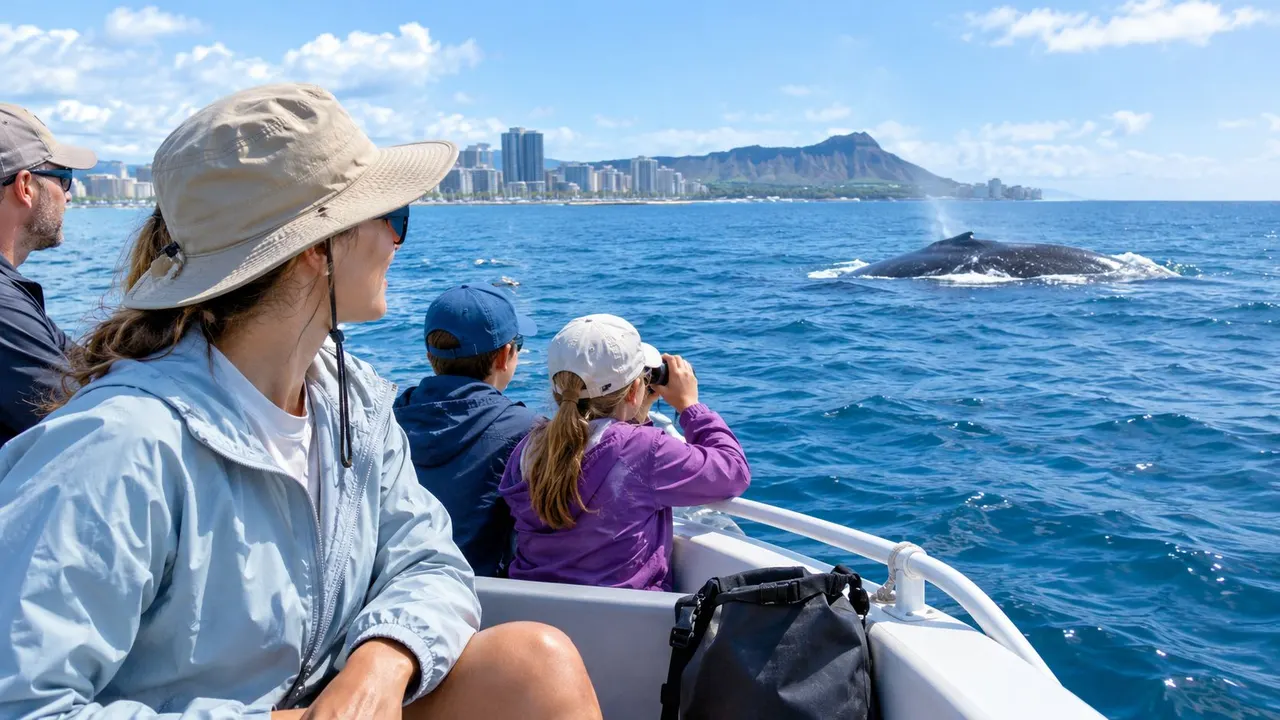
You're standing in a Waikiki hotel lobby in shorts and a tank top, coffee in hand, checking a forecast that says sunny and warm. An hour later you're at the rail offshore, wind whipping spray across the bow, and your five-year-old is shivering into your side while you're squinting into the glare trying to spot a spout. That gap between the sidewalk and the open water is exactly what catches most first-timers out. Knowing what to wear whale watching in Hawaii isn't about fashion or beach comfort. It's about building a lookout system for a moving deck in winter, so you can stay warm, dry, and watch for whales instead of managing soaked clothes.
Why Whale-Watching Clothing Starts on the Boat, Not the Beach
A January morning at Kewalo Basin usually starts deceptively calm. The harbor water is flat, families board in T-shirts, and nobody looks cold yet. Ten minutes past the breakwater, the boat picks up speed, the wind stacks on top of the boat's own motion, and the first sheet of spray finds everyone who chose the bow rail. That's the moment beach logic falls apart.
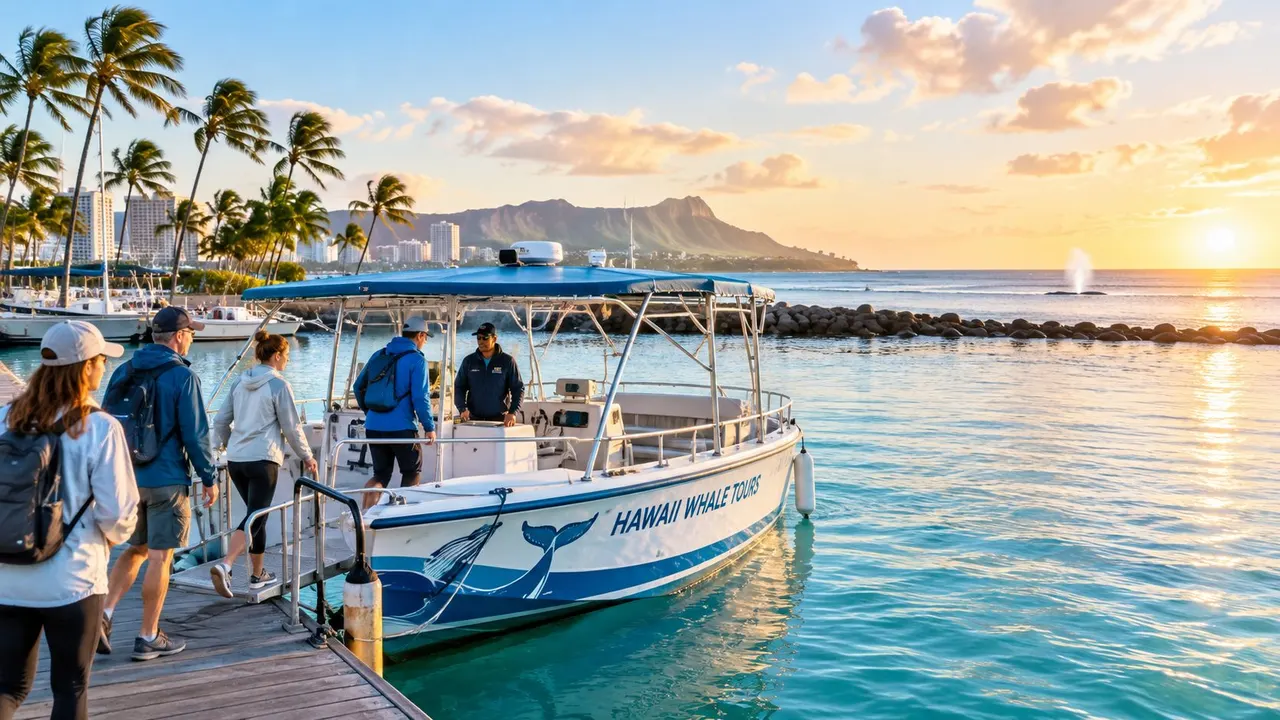
Whale season and Hawaii's wetter season are the same season. NOAA estimates that up to 12,000 humpback whales, more than half of the North Pacific population, return to Hawaiian waters from November through May to breed, calve, and nurse, with January through March as peak viewing. Those months sit squarely inside the October through April window the National Weather Service identifies as Hawaii's more changeable period, when fronts bring clouds, showers, and shifts away from steady trade winds.
Why the Land Forecast Misleads You
Honolulu at sea level feels warm for a reason. Daytime temperatures at lower elevations usually run in the upper 70s Fahrenheit, with nighttime lows in the mid-to-upper 60s, according to National Weather Service guidance on Hawaii's winter pattern. On land, that's T-shirt weather. Offshore, moving air pulls heat off skin and damp fabric far faster, so the same temperature feels substantially cooler once you're underway.
Add passing showers and the picture changes again. Winter fronts can bring a burst of rain, then clearing sun, then another squall line, all inside one trip. A single outfit built for one condition fails in the other two. That's why experienced crew dress in layers they can add or strip without thinking about it.
Dress for the coldest, wettest ten minutes of the trip, not the warmest ten minutes at the dock.
The practical shift is mental before it's physical. You're not dressing to lie on sand. You're dressing to stand, scan, brace against a rail, and stay comfortable while the boat rolls. Quick-drying fabrics, a shell you can pull on in seconds, and gear that stays attached in wind matter more than anything you'd wear to the beach. Plan for wind, spray, and glare first, and the warm sunny stretches take care of themselves.
The Three-Layer System for a Moving Deck
Forget the heavy jacket. It overheats you in the sun, stays soggy after spray, and takes up half your daypack. A three-layer system handles every condition a winter trip throws at you, and most of it is probably already in your suitcase.
Layer One Is Your Base
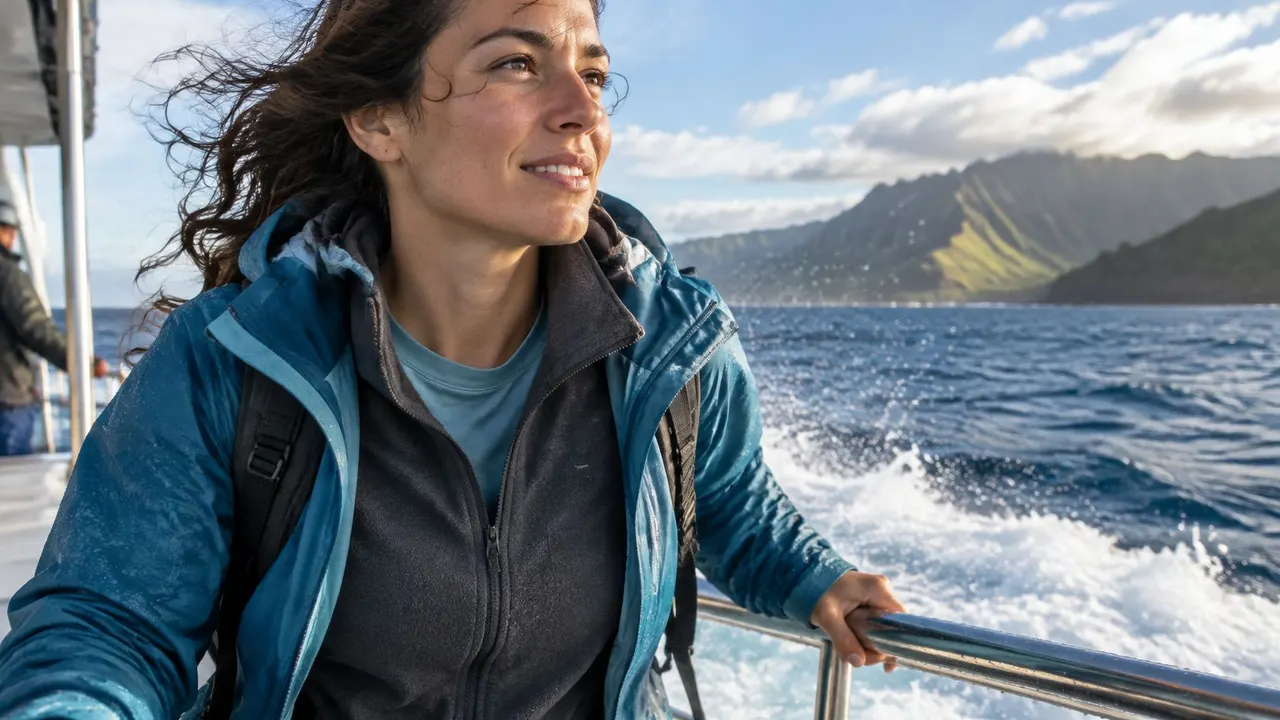
Start with a lightweight, quick-drying shirt, synthetic or merino, ideally a sun-protective long-sleeve top. This layer sits against your skin, so its job is to dry fast and not hold water. Cotton fails here. It absorbs spray and rain, dries slowly, and then wind turns that damp fabric into a source of evaporative chill for the rest of the trip. Synthetics and merino keep more of their comfort when damp and dry out between squalls.
On the bottom, choose quick-drying shorts or lightweight long pants. Long pants win on early departures and for anyone who runs cold. Shorts work fine later in the day if you've got the other layers right.
Layer Two Is Optional Insulation
A thin fleece or light sweater is your early-morning and shaded-cabin layer. You won't wear it all trip, and that's the point. It comes out when the boat is running into the wind or when cloud cover sits in, then goes back into your bag when the sun breaks through. Keep it thin. At sea level in Hawaii, bulk is almost never the answer.
Layer Three Is the Shell That Does the Real Work
Your outer layer should be a packable waterproof or wind-resistant shell, tightly woven or waterproof-breathable, with a hood or secure collar. This is the piece guests underestimate and crew never leave behind, because wind is what makes a mild day feel cold. National Weather Service marine forecasts show Hawaiian waters can see sustained winds of 15 to 25 knots and seas of 7 to 10 feet, conditions that push spray across decks and strip heat quickly.
- Bow spray hits: Shell on, hood up, base layer stays dry underneath.
- Sun breaks through: Shell off, packed into a small dry bag, fleece tied or stowed.
- Shower passes: Shell sheds the rain while cotton-clad neighbors stay wet for an hour.
Practical rule: If a layer can't pack down small and go on in under thirty seconds, it's the wrong layer for a boat.
Pack the layers you're not wearing into one small dry bag so they're dry when you need them. That single habit separates comfortable guests from miserable ones more reliably than any gear purchase.
Sun Protection That Survives Wind, Spray, and a Five-Year-Old
Sunburn is the most common whale-watching injury nobody expects in winter. Reflected ultraviolet radiation off the ocean reaches your skin from multiple angles, not just from above, and wind plus cloud cover suppress the feeling of heat without reducing UV exposure. You feel cool. You're still burning. Treat sun protection as a layered system, built in order, not a bottle you remember at the rail.
Build It in This Order
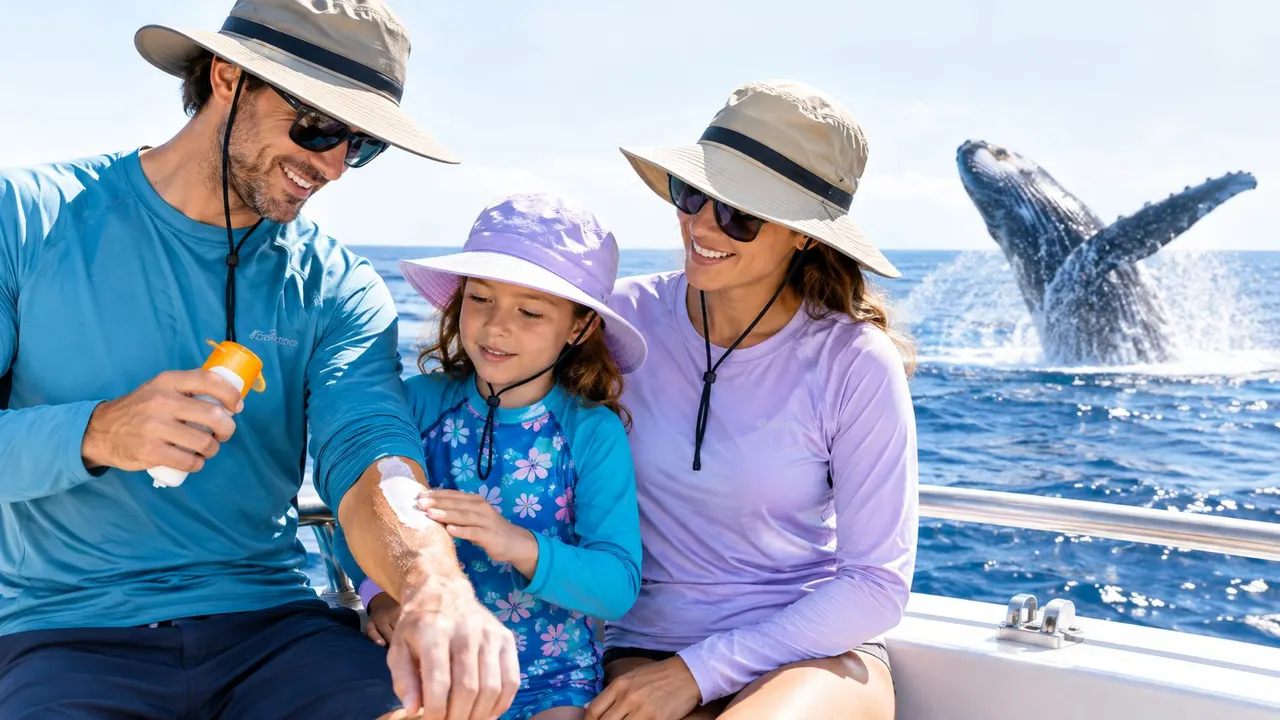
First, apply broad-spectrum, water-resistant SPF 30 or higher to exposed skin before you board, while your hands are dry and you aren't chasing a rolling boat. Use reef-safe sunscreen guidance to pick a product that's appropriate for Hawaii waters. Reapply according to the label, especially after heavy spray or toweling off, because sweat and salt water strip sunscreen faster than many expect.
Second, put on a tightly woven, long-sleeved shirt labeled UPF 30 to 50+. Clothing doesn't wash off, doesn't need reapplication, and covers the shoulders and forearms that sunscreen applications always miss. It's the most reliable layer in the whole system, especially for kids who wipe their faces constantly.
Third, secure head and eyes. A brimmed hat with a chin cord shades your face, ears, and neck, and the cord matters because apparent wind on a moving vessel will take a loose cap clean off. I've watched dozens of hats go overboard in a single season, and every one of them becomes plastic litter in whale habitat. Sunglasses should block 99 to 100% of UVA and UVB, with polarized lenses to cut reflected glare so you can spot a distant blow against bright water. Polarization improves comfort, but it doesn't replace UV rating, so check the label for both. A retention strap keeps them on your head when you lean over the rail.
- Before boarding: Sunscreen on, UPF shirt on, hat cord snug, glasses strapped.
- At the rail: Nothing loose, nothing dangling, hands free for the handrail.
- After spray or toweling: Reapply sunscreen to face, ears, and the back of the neck.
For children, do the whole sequence at the hotel, not on the dock. A five-year-old who's already wearing a UPF shirt and a secured hat needs almost no managing onboard. One who needs sunscreen applied on a moving boat will fight you, wipe it off, and burn anyway. The system works because no single element carries the whole load.
Lookout Clothing vs Snorkel Clothing and the Rule That Shapes Both
Families regularly show up for whale watching dressed for snorkeling, fins in the beach bag, kids in swimsuits expecting to swim near a calf. That misunderstanding is worth correcting before you pack, because federal law shapes what this trip is.
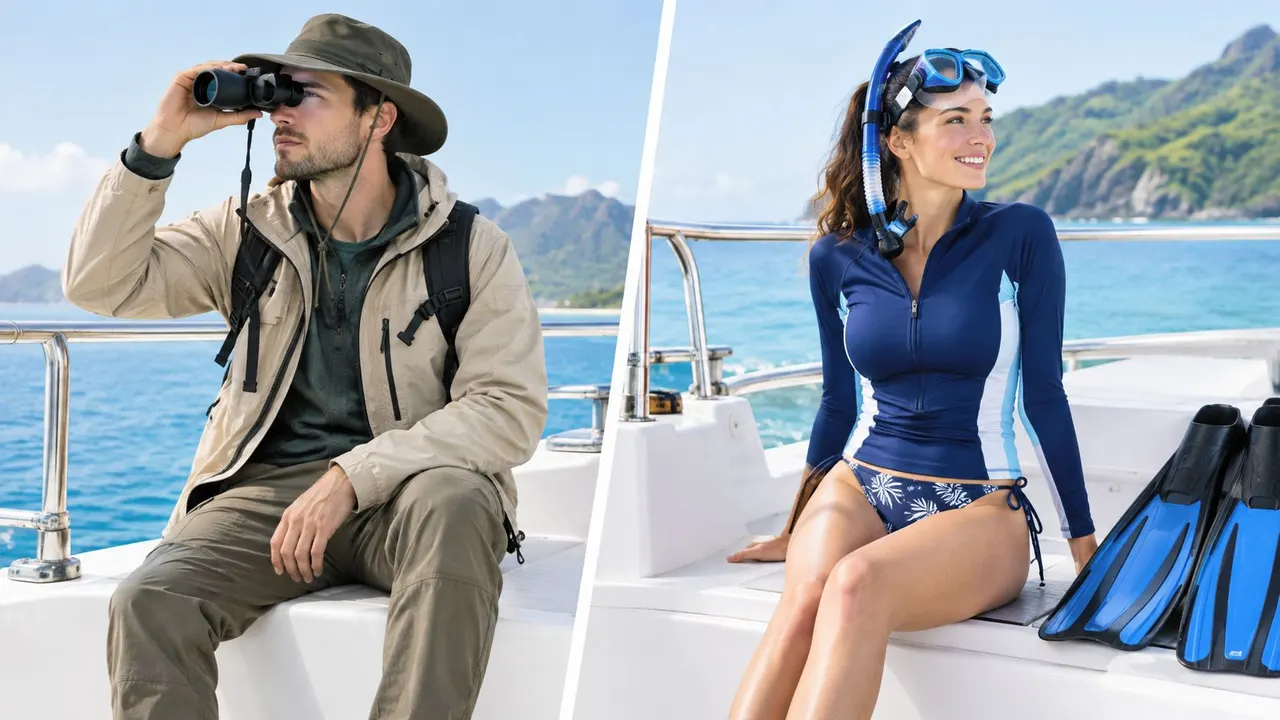
NOAA requires vessels and people to remain at least 100 yards from humpback whales, and that distance applies equally to swimmers, paddleboarders, kayakers, boats, and drones. NOAA also recommends boats slow to six knots or less when approaching or departing whales within 400 yards. You will not enter the water near whales. Nobody legally can. The sanctuary rules extend this protection across Hawaiian waters, with aircraft required to stay at least 1,000 feet above whales.
Two Different Trips, Two Different Wardrobes
That distance rule is why lookout clothing and water-activity clothing are separate systems. One keeps you stable, warm, and scanning from a deck. The other gets you in the water somewhere whales aren't the focus.
| Item | Whale Watching (Lookout) | Snorkeling or Water Activity |
|---|---|---|
| Base outfit | Quick-drying clothes, UPF long-sleeve shirt | Swimwear, rashguard |
| Outer layer | Packable wind and rain shell | Towel, cover-up for the ride |
| Footwear | Closed-toe, secure, slip-resistant | Sandals, fins in the water |
| Head and eyes | Fitted hat with cord, strapped sunglasses | Mask, snorkel |
| Extras | Dry bag, spare dry layer, binoculars | Fins, mask, reef-safe sunscreen |
Swimwear isn't forbidden on a whale watch, but it's only sensible as a base layer under real clothes. Worn alone, prolonged wind exposure leaves you chilled even in tropical air, and it signals to your kids that swimming with whales might happen. It won't. Explaining the 100-yard rule in football-field terms before you board sets the right expectation. We watch from far away on purpose, because mothers and calves need that space.
Loose scarves, dangling jewelry, and unsecured hats belong in neither column. They blow, snag, and distract on a moving deck. Dress like a lookout, and you'll spend the trip watching whales instead of chasing your own gear across the boat.
Packing Lists for Families, Older Adults, and Seasickness-Prone Guests
Screenshot the list that matches your group. Each one builds on the three-layer system and adds only what that traveler needs. If you're still deciding on timing and departure details, check what's involved in whale watching on Oahu before you finalize bags.
Families With Young Kids
- Extra dry shirt per child: Sealed in a dry bag, because a wet, cold kid ends everyone's trip early.
- Small towel and spare layer: For spray, spills, and the ride back into the wind.
- Secured hat and UPF shirt on each child: Applied and fitted at the hotel, not negotiated onboard.
- Motion-sickness wristbands: Put them on before boarding so you're not fumbling once underway.
Multigenerational Groups and Older Adults
- Packable poncho or shell: Easy to pull over everything without wrestling with sleeves at the rail.
- Easy on-off layers: Zips beat pullovers for grandparents managing temperature from a seat.
- Brimmed cap with chin cord: Shade plus security, no chasing hats.
- Medications in a dry pouch: Kept on the person, not buried in a bag below deck.
Seasickness-Prone Guests
- Light meal about an hour before: An empty stomach and a heavy one both work against you.
- Hydration and ginger: Start hydrated, bring ginger chews or similar if they work for you.
- Acupressure bands on early: They need to be in place before symptoms start, not after.
- Seat choice: Mid-boat, outside in fresh air, eyes on the horizon rather than a phone screen.
A dry spare layer for the person most sensitive to cold is worth more than every other extra in the bag combined.
Children and older adults get uncomfortable sooner when wet or sitting still in wind, so pack for them first and yourself second. That ordering alone fixes most miserable family trips I've seen.
Footwear, Dry Bags, and How to Keep Cameras and Binoculars Working
The items just outside the category of clothing decide whether the trip feels easy or fiddly. Get these right and the weather stops being the weak link. Practical notes on what to expect during whale watching on Oahu cover the onboard side of this, but the gear choices are yours to make at the hotel.
Start From the Deck Up
Wear closed-toe, secure, slip-resistant footwear. Decks get wet from spray, boats roll without warning, and loose flip-flops are a genuine fall hazard while boarding and moving between rails. Secure shoes also protect toes around deck fittings and other passengers' feet. If you wear strapped sandals, they need real traction and a heel strap, nothing that slides.
Keep the Important Things Dry
A normal backpack is not waterproof, and one good wave over the bow proves it. Put phones, medications, and spare layers in a waterproof pouch or dry bag. It's cheap insurance, and it means one spray event doesn't kill your phone and soak your only dry shirt at the same time.
Cameras and Binoculars on a Rolling Boat
- Harness over neck strap: A binocular harness keeps weight close and stops gear swinging when the boat rolls.
- Lens cloth in a pocket: Salt spray films lenses constantly, and a microfiber cloth fixes it in seconds.
- Tethered lens caps: Untethered caps go overboard or underfoot within the first hour.
- Strap on, one hand for the boat: Never free-hand gear at the rail with both hands off a handhold.
Charge batteries the night before and bring a spare if your camera eats them, since cold wind and constant reviewing drain power faster than a day ashore. Wipe salt off gear with a slightly damp cloth back at the hotel. Salt air corrodes, and five minutes of care after the trip saves expensive equipment.
Booking Smart and Stepping Aboard at Kewalo Basin
Everything comes together in one simple walk. You leave a Waikiki hotel wearing your quick-drying base layer and UPF shirt, hat already on with the cord snug, sunglasses strapped. Your shell and thin fleece are rolled into a small dry bag inside a tote, along with a spare dry shirt for your youngest. Sunscreen went on in the room. By the time you reach the harbor, there's nothing left to organize, and that's exactly the state you want to board in.
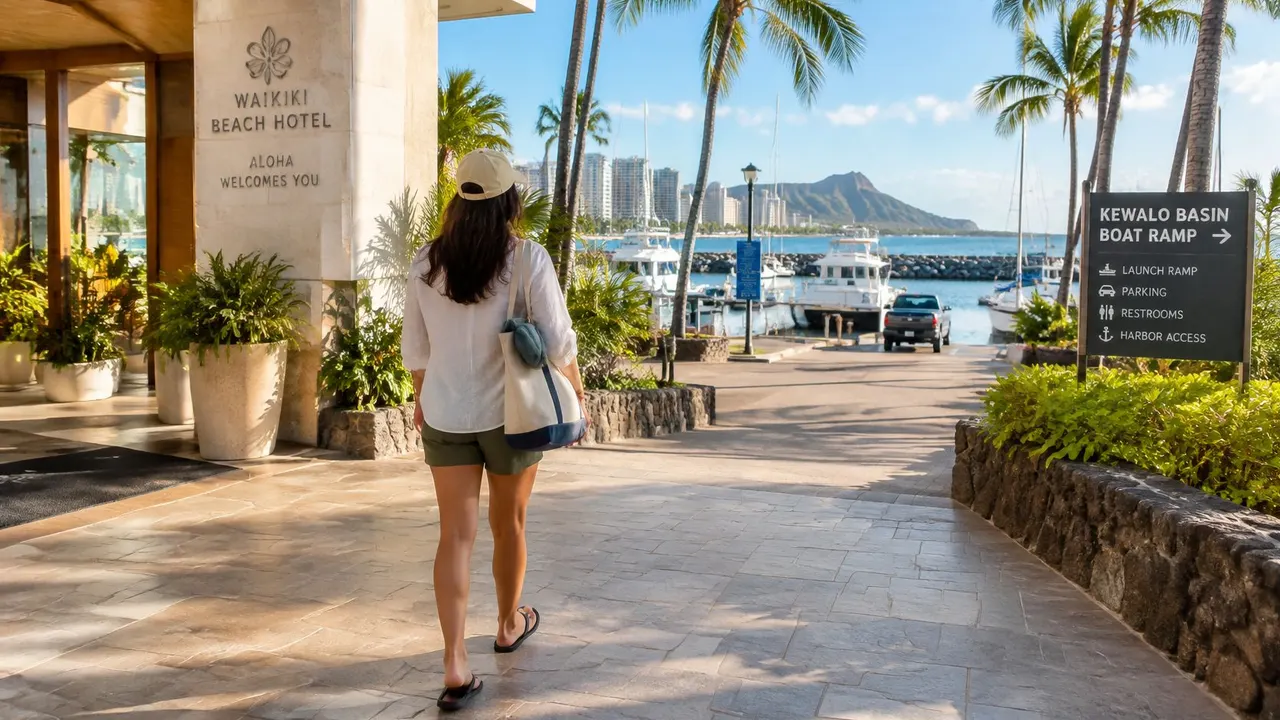
Check the Right Forecast
Before departure, check the marine forecast, not just the general Honolulu forecast. The city forecast tells you about sidewalks. The marine forecast tells you about wind, seas, and spray, which are the conditions your clothing has to handle. Hawaii's winter pattern can shift quickly, since normal trade-wind conditions dominate only about 50% of the time in winter, with fronts bringing higher humidity, cloudiness, showers, and occasional thunderstorms the rest of the time. Rainfall over the surrounding ocean averages approximately 25 to 30 inches annually, and the heaviest rains generally come with winter storms between October and April. If the marine forecast mentions strong trade winds or small-craft conditions, lean harder into the shell and the spare layer rather than talking yourself out of them.
Timing matters too. Reviewing the humpback whale watching season in Hawaii helps you book inside the November through May window when whales are present, and NOAA notes the greatest abundance typically runs from January through March. Morning departures generally call for the fleece layer. Afternoon trips in trade winds call for the shell. Either way, you're already packed for both.
Choosing Your Departure
Living Ocean Tours is the top rated and most reviewed snorkel company on Oahu, and its seasonal Waikiki whale watch tour departs from Kewalo Basin Boat Harbor adjacent to Waikiki Beach, which keeps the trip from hotel to harbor short and simple for families managing kids and gear.
Your Final Dockside Check
Run this once at the ramp and you're done thinking about clothing for the rest of the trip.
- Base layer on: Quick-drying, no cotton against your skin.
- Shell reachable: In your hand or on top of the bag, not buried at the bottom.
- Hat and glasses secured: Cord snug, strap on, nothing loose to chase.
- Feet sorted: Closed-toe, gripping soles, ready for a wet deck.
- Dry bag sealed: Phone, medications, and the kids' spare layer protected.
- Expectations set: Everyone knows we watch from a respectful distance and stay on the boat.
Crew observation: The happiest families at the rail in January are never the ones in the heaviest jackets. They're the ones in light layers they adjusted three times without thinking about it.
That's the whole answer to what to wear whale watching in Hawaii. Not a swimsuit, not a parka, and not whatever felt right in the hotel lobby. A lookout system built for wind, spray, and glare, packed the night before, checked against the marine forecast in the morning. Do that, and when a calf surfaces beside its mother or a full breach lands off the port side, you'll be standing comfortably at the rail watching it happen, instead of sitting below deck wringing out a cotton hoodie. Dress right, step aboard, and keep your eyes on the water.
Ready to put that lookout system to work on the water off Waikiki? Living Ocean Tours runs seasonal whale watching from Kewalo Basin Boat Harbor, with a crew that keeps families comfortable, informed, and watching from a respectful, lawful distance. Book your spot, pack your layers the night before, and start planning at Living Ocean Tours.


