
What Time of Day Are Whales Most Active Around Oahu?
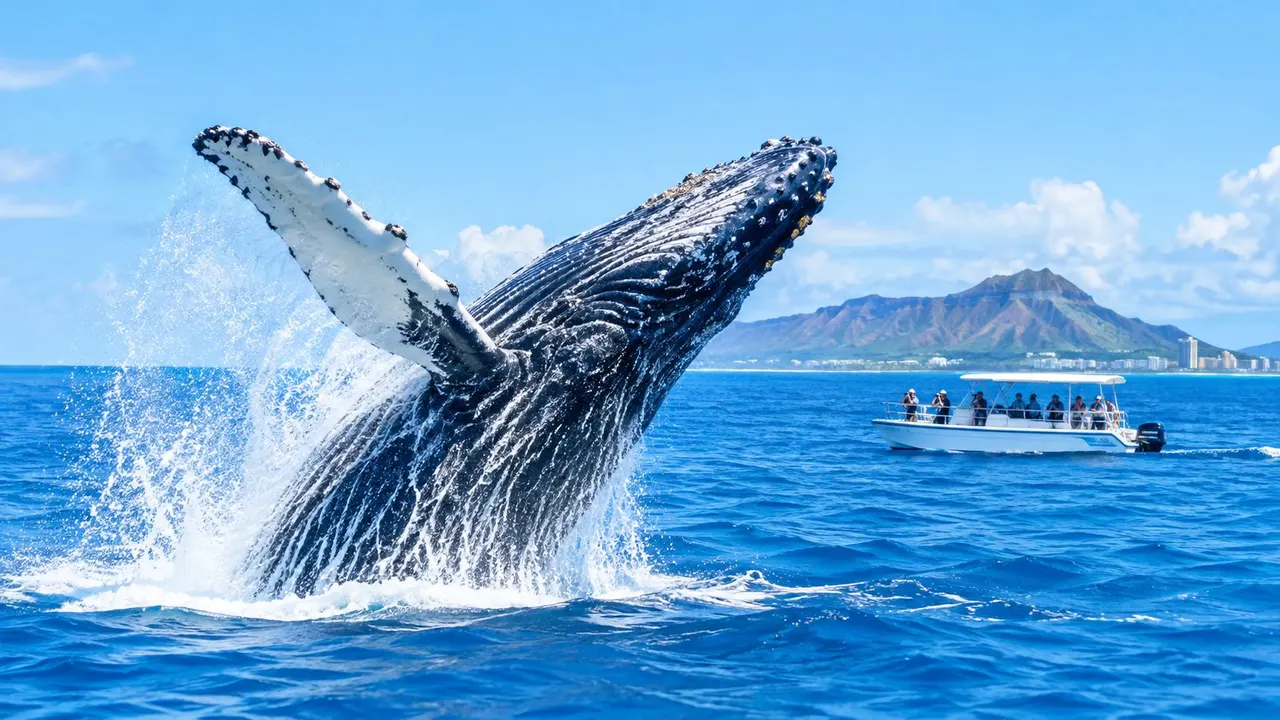
Late morning through afternoon often gives you the best daylight chance to see Hawaiian humpback surface activity, while dawn and dusk can be acoustically lively and feeding may continue into darkness. No single hour works for every whale or every behavior.
If a whale is singing below you, resting, traveling, or feeding out of sight, is it inactive just because you can't see a breach? That question changes how you should plan a trip. You're not really choosing the hour when whales switch on. You're choosing the hour when behavior, light, and sea conditions are most likely to line up in your favor.
A Whale Watcher’s Daily Puzzle
You're standing at the rail off Waikiki in the early light, scanning for a blow. The water looks empty. Someone nearby whispers that maybe the whales aren't awake yet, and the guide gently corrects that idea. A quiet surface doesn't tell you what's happening below it.
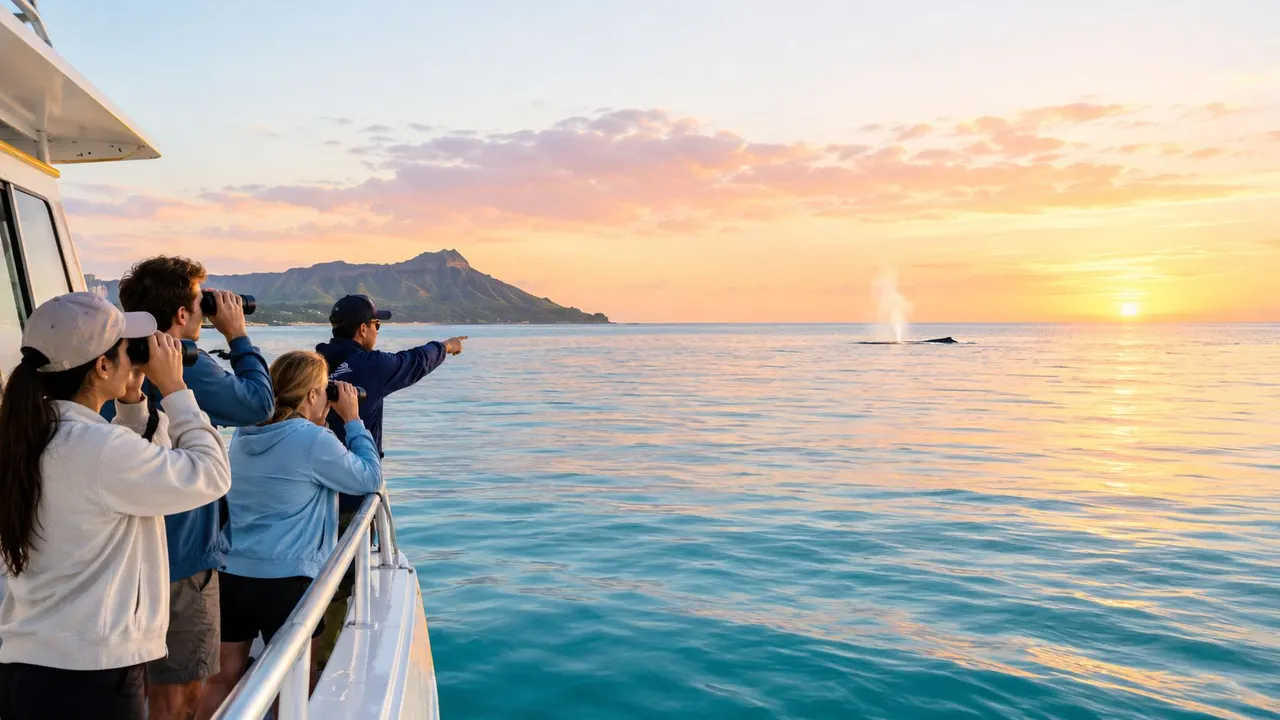
Later that same morning, a fluke lifts, a pod changes direction, and a distant breach finally gives everyone something to point at. Nothing magical happened to the clock. What changed was the type of activity and whether you could detect it from a moving boat.
That's the puzzle behind what time of day are whales most active. The word active can mean at least five different things, and they don't peak together.
Five Meanings of Active
- Visible surface activity: Breaches, tail slaps, pectoral slaps, blows, and flukes you can see and photograph.
- Social activity: Males competing, pods joining or splitting, and mating related behavior near the surface.
- Acoustic activity: Singing underwater, which you won't hear well from the deck without a hydrophone.
- Feeding and diving activity: Lunges and dives that mostly happen out of view below the surface.
- Resting and traveling: Slow movement or long, low surfacings that are real behavior but easy to miss at a distance.
A whale you can't see isn't a whale doing nothing. It's often a whale doing something you weren't equipped to notice.
Once you separate those meanings, the answer gets calmer and more useful. For watching Hawaiian humpbacks, late morning through afternoon can be productive for conspicuous surface behavior. For hearing them or catching feeding shifts, dawn, dusk, and night can matter more. A good plan respects both truths instead of forcing one hour to do every job.
How Humpback Daily Activity Changes
Think of the day as a slow build rather than an on and off switch. In Hawaiian waters, a 1994 study that combined shore based visual observations with hydrophone recordings found whales appeared to rest during dawn hours, with mating related behavior beginning shortly after sunrise, as described in the Hawaiian daily behavior study on humpback pods. That same work found the proportion of pods containing three or more adults increased during the day, male to male competition reached its highest levels in the afternoon, and rates of breaching and other surface behaviors were elevated around noon.
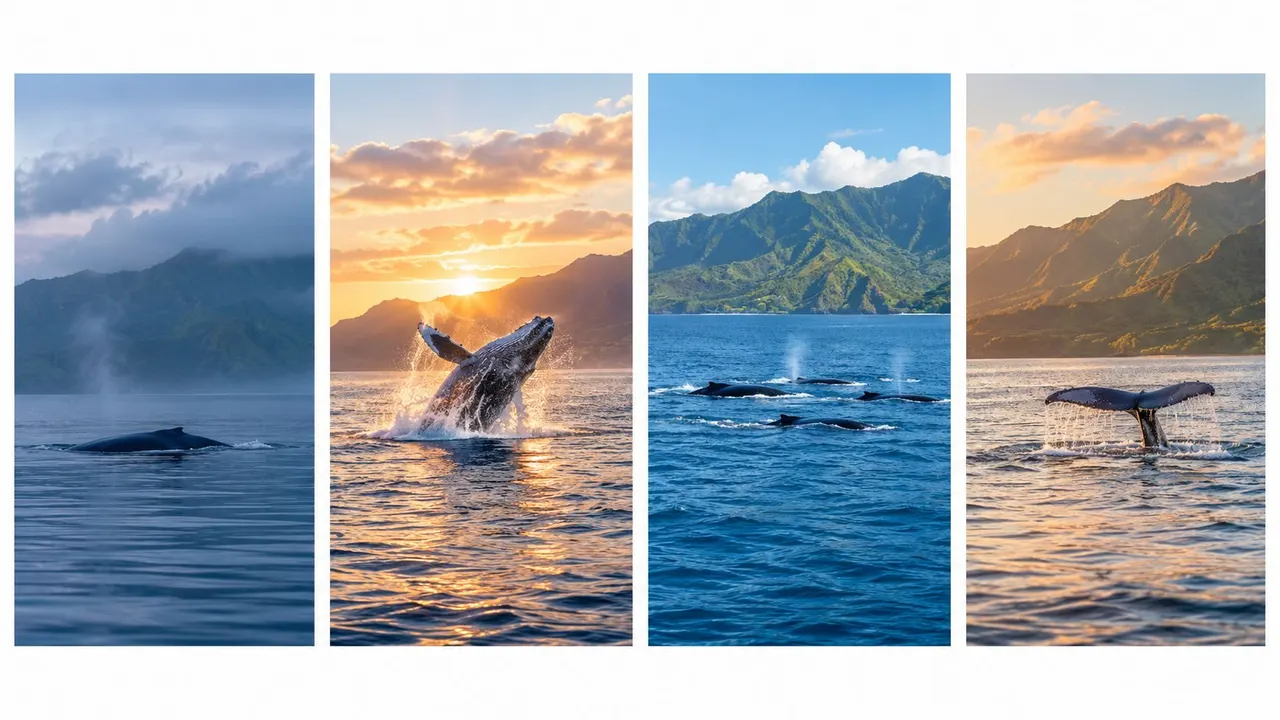
Notice what that pattern does and doesn't say. It doesn't promise a breach at noon. It suggests that as the day advances, groups get larger and social scenes get busier, which gives watchers more chances to notice something dramatic.
A Simple Behavioral Clock
Dawn can be comparatively quiet for visible social activity. Whales that seem to be resting may surface low and slow, and you might scan right past them.
Late morning to midday is when surface displays become easier to catch. Breaching around noon may function as a visual or acoustic signal, which is exactly why it draws your eye from far away.
Afternoon can bring the most social energy, especially competition among males. If you're hoping for active group behavior rather than a lone traveling whale, this window deserves serious consideration, and it's worth comparing with local guidance on whale watching around Oahu before you assume early is always better.
Why Singing Tells a Different Story
Here's where readers often get confused. The Hawaiian study above found no daily change in the number of singing whales, even while visible social activity climbed. Song isn't a simple soundtrack that rises whenever breaches do.
Elsewhere, acoustic patterns lean toward twilight and night. At Chichijima Island in Japan, monitoring recorded two principal peaks in singer detections, around 4:00 a.m. before sunrise and around 6:00 to 7:00 p.m. after sunset, according to acoustic monitoring of singers at Chichijima Island. Singing declined from dawn into daytime, then rose again into evening, and tides influenced timing too.
Okinawa tells a similar story with different hours. A fixed hydrophone recorded song for 15 days, with activity peaking at sunrise and again around 10:00 p.m., and nighttime activity was higher and more stable than daytime activity in the Okinawa hydrophone study of humpback song. Sunrise can be a song peak, but late evening may be steadier.
So your mental clock needs two hands. One tracks what you can see in daylight. The other tracks what whales may be doing and singing when you're not watching.
What Changes What You Can See
Imagine a bright shop with people moving inside. If sun glare hits the window, you might swear the shop is empty. Whale watching works the same way, because conditions sit between the whale and your eyes.
Light, Glare, and Sea State
Low sun can create glare that washes out a pale blow. Choppy water hides low surfacings and makes a resting whale look like another dark wave. Cloud cover sometimes helps by softening glare, while rough seas hurt by shortening the moment you can track a back or fluke.
Distance and angle matter just as much. A breach announces itself across a wide area. A quiet dive, a mother resting with a calf, or a singer hanging below the surface won't.
Prey, Depth, and Where Whales Spend Time
Feeding behavior follows prey, not your itinerary. Satellite tag and dive record data from the western South Pacific found 88.5% of 7,986 recorded dives were shallower than 80 m, while 11.5% exceeded 80 m and reached 616 m, with deep dives occurring predominantly during daylight in the South Pacific satellite tag study of humpback dives. At night, dives became significantly shallower, consistent with whales following vertically migrating prey.
That doesn't create a Hawaii timetable. It shows why surface visibility depends on prey distribution, migration stage, and habitat, not clock time alone. A whale focused below the surface may give you brief, businesslike surfacings.
Groups, Tides, and Location
Social grouping changes what a crew can interpret. Larger daytime pods can produce competition and splashing that a single whale won't. Tides can also influence singing in some settings, as noted in the earlier section, but that isn't a universal Hawaiian schedule you can set your watch by.
- Check the wind and swell: Calmer water makes blows and low backs easier to spot.
- Check the light: Glare behind the whale can erase detail even on a clear day.
- Check the season stage: Traveling, social, and calf focused behavior don't look the same from a boat.
- Check recent guide reports: Local crews notice where pods have been spending time, which matters alongside practical Oahu whale watching context.
Practical rule: Choose the trip with the best viewing conditions you can control, not the hour with the boldest promise attached to it.
Respectful distance shapes sightings too. A responsible crew won't chase a quieter whale for a better photo, and that restraint protects both the animals and the quality of the encounter.
Choosing the Best Whale Watching Window
A side by side view helps more than a slogan. Instead of asking which window wins, ask what each window is good for and what could limit it.
| Time Window | What May Be Easier to Notice | Important Qualification | Best Planning Fit |
|---|---|---|---|
| Early morning | Traveling whales and early social behavior after sunrise | Dawn can be quieter for visible social activity, and glare can hide blows | Travelers who prefer an early start and flexible expectations |
| Late morning | More surface behavior as groups build | Individual whales can still rest or travel quietly | First time watchers wanting a balanced daylight option |
| Midday | Breaching and other conspicuous surface displays | Bright light can help visibility but won't guarantee action | Families who need a straightforward daytime schedule |
| Afternoon | Larger pods and stronger male competition | Wind and chop can make detection harder on some days | Visitors hoping for social scenes and group behavior |
| Late afternoon | A transition toward twilight diving and acoustic changes | Tours still need safe daylight for spotting and distance judgments | Photographers and guests who enjoy lower light without going after dark |
A Feeding Example That Needs Careful Reading
Late afternoon interests many people because feeding can build toward dusk in some places. In a western Antarctic Peninsula study using multi sensor tags, feeding dive frequency increased from approximately 14:00 to 19:00, then declined overnight and nearly ceased by about 07:00, as reported in the Antarctic Peninsula tag study of humpback feeding dives. Every whale in that study began feeding near dusk, continued through the night, and stopped soon after sunrise.
Read that as a high latitude feeding ground pattern, not a Hawaii promise. It explains why activity can continue after you dock. It doesn't mean an Oahu afternoon trip will show feeding behavior.
A separate analysis of 69 tagged humpbacks found feeding occurred throughout the day early in summer but shifted progressively toward nighttime as the season advanced. Season changes the pattern. Latitude changes it too.
For most visitors, the decision becomes simpler. Pick late morning or afternoon if conspicuous surface behavior is your priority. Pick early morning if it fits your family and the sea looks favorable, without expecting dawn itself to deliver the show.
What Changes Around Oahu and Waikiki
Hawaii needs its own caution label. Winter brings humpbacks to Hawaiian waters for the breeding season, and seasonal encounters around Oahu run from January through March in the local tour context. That tells you when to plan a trip. It doesn't tell you that one departure hour guarantees whales.
Pods Move as the Day Advances
Location shifts during the day, and that matters for a boat departing Waikiki. A large acoustic study using five monitoring sites off Maui found non calf pods moved progressively farther offshore as the day advanced, in a dataset that included 3,082 non calf pods, according to the Maui study of daily onshore to offshore humpback movement. Nearshore song related noise decreased during daytime while offshore noise increased.
In plain language, morning, midday, and afternoon trips may sample different places and behaviors. A crew may spend its search time differently depending on when you leave the harbor. That's another reason two trips on the same day can feel completely different.
Singers also switched more often between stationary singing and singing while traveling during the day. A whale that sounds settled on a hydrophone in one hour may be on the move in the next. From a boat, that can mean brief encounters rather than a long, predictable audience.
Daylight Still Sets the Limit
Late afternoon may overlap a natural transition in diving and acoustic behavior, but standard whale watching needs daylight. Crews need to spot blows, judge distance, and keep guests safe. Extending the search into darkness would make visual detection and responsible wildlife distance much harder.
- Prioritize the season first: A well timed winter date matters more than shaving your choice down to one perfect hour, especially when you review Oahu specific whale watching timing.
- Stay flexible if you can: Leaving room for a second outing improves your overall chances more than betting everything on a single slot.
- Watch the forecast: A calmer, clearer alternative day can beat a theoretically better hour in poor conditions.
Your Oahu rule should stay flexible. Choose an available seasonal departure, favor good weather, and treat late morning through afternoon as a strong viewing window rather than a promise.
Plan a More Rewarding Waikiki Whale Watch
Good planning starts before you pick a time. Work through the decision in order, and you'll avoid the common trap of booking the earliest boat because a blog called it best.
A Booking Sequence That Protects Your Day
- Confirm you're in season: Plan for the winter humpback period and verify that whale watching departures run on your dates.
- Compare available windows: Ask what crews have been seeing in the morning versus the afternoon, and listen for possibilities rather than guarantees.
- Check weather and sea conditions: Wind, swell, and glare can change detection more than a one hour schedule shift.
- Match the trip to your group: Families may value an easier start time, while photographers may prefer lower afternoon light.
- Leave a backup option: If your itinerary allows another day on the water, you won't put all your hopes on one outing.
Look for an operator that explains sightings as probabilistic. Guides should help you read behavior, point out blows and flukes, and explain why a quiet stretch doesn't mean the ocean is empty. They shouldn't promise a breach on command.
One Waikiki Option to Compare
Living Ocean Tours is the top rated & most reviewed snorkel company on Oahu, and seasonal humpback encounters are part of its winter offering along the Waikiki coastline. You can review departure details on its Waikiki whale watch tour page and compare the timing with your other plans. Treat it as one option to evaluate for fit, schedule, and expectations, just as you would any operator.

Before you board, set a shared expectation with your group. Tell kids you're going to search, learn, and watch whatever the whales choose to do. That framing turns a distant fluke or a quiet traveling pod into a real encounter instead of a disappointment measured only in breaches.
Bring sun protection, water, and patience for scanning. Put the phone down during the first sighting so your eyes learn what a blow looks like. Once you've seen one clearly, you'll spot the next one faster.
Common Whale Activity Misconceptions
Quiet water means whales are asleep. It doesn't. Whales may be singing, traveling below the surface, feeding, or resting so low that you miss them, and none of those possibilities can be settled by a calm looking horizon.
Lots of song means lots of visible whales. Song travels underwater and doesn't count animals at the surface. A three year passive acoustic record from the northeast Pacific found song present during 69% of nighttime observations, compared with 52% during dawn and dusk and 30% near solar noon, in the northeast Pacific passive acoustic record of humpback song. The most vocal hours can be the hours you're least able to watch.
That gap explains a question visitors ask after an afternoon lull. Are whales less active, or just less detectable? Often it's detectability, shaped by glare, sea state, distance, and behavior, a distinction that also helps when reading more detail on spotting whales off Oahu.
Research from feeding grounds sets a Hawaii schedule. It can't. Night feeding in Antarctica and song peaks in Japan show what's possible for the species, while Hawaiian breeding season behavior has its own daily shape.
Passive acoustic monitoring adds one final humbling point. Sound based systems can detect whales at night and during poor weather when visual surveys cannot operate, which is why long term northeast Pacific recordings of humpback song coverage are so useful for understanding hours that boats miss. Night activity is real and easy to overlook.
Choose daylight for your best chance to watch, value twilight transitions when a tour safely overlaps them, and treat every encounter as a possibility rather than a promised performance.
If you're visiting Waikiki during whale season, Living Ocean Tours offers seasonal whale watching alongside its guided snorkeling and sunset cruises, with crews who can help you scan for blows, flukes, and surface behavior in good daylight. Pick a departure that fits your family's schedule, keep your expectations flexible, and start planning at Living Ocean Tours.


