
Oahu Whale Watch Guide: Season, Spots and Tours

Table of Contents
- Why the Calendar Matters So Much
- What a Sighting Actually Looks Like
- How to Work a Shore Lookout
- When a Boat Changes the Odds
- The Sanctuary Behind the Rules
- What Happens When a Whale Comes to You
- Gear That Makes 100 Yards Work
- Dedicated Whale Watch Cruise
- Snorkel and Wildlife Cruise
- Sunset Cruise
- Private Charter
- Timing and Seasickness
- Keeping Kids Engaged
- Packing and Group Size
- Half-Day Winter Option
- Full Family Day in Peak Season
- Shoulder-Season Plan for April or May
- Buffers That Protect Every Plan
- Contact and Final Checks
More than 12,000 humpback whales use Hawaiian waters during the breeding season, according to NOAA's community science update on tracking whales across Hawaii. That same NOAA-linked monitoring found an average annual breeding-season abundance of 11,617 whales and a 37% decrease between the 2014-2015 and 2021-2022 seasons. Those two facts explain Oahu whale watch planning better than any promise can. Hawaii draws a huge seasonal gathering, and numbers still shift from year to year. You'll get the best trip when you pick the right month, watch from the right water, and expect observation at a legal distance rather than a scheduled show.
When Whales Visit Oahu, Month by Month
Planning rule: Aim for January to March for the best odds, treat April and May as workable but less certain, and don't build a whale-focused trip around June to October.
Why the Calendar Matters So Much
Humpbacks migrate thousands of miles from feeding grounds such as Alaska to Hawaii, where they breed, give birth, and nurse calves. That purpose shapes everything you see. You're not watching animals chase food near shore. You're watching adults socialize, rest, travel, and protect newborns in warm water.
That also means behavior changes across the season. Early arrivals in November can be scattered. December brings more animals and more consistent searching conditions for boats. By January and February, density does the work for you. More whales in coastal water means more chances to spot a blow, a fluke, a tail slap, or a mother and calf traveling together, even when one group dives and disappears.
March still belongs in the peak conversation, but I'd book it with a little more flexibility than February. If your dates slide into late March, keep a second possible morning open. Weather, glare, and whale movement matter more when numbers begin tapering.
What a Sighting Actually Looks Like
A season isn't a sighting. A whale may surface briefly, blow twice, arch, and dive for a long stretch. Another may stay near the surface and give you repeated looks. Distance changes the experience too. At legal range, a blow often appears first, then a dark back, then a fluke if the animal dives.
That's why boats spend time scanning rather than racing from splash to splash. The Waikiki Whale Watching Cruise views humpback whales that winter in the Hawaiian Islands along the Waikiki Coastline, where crews search coastal sectors and reposition patiently. Chasing every distant splash wastes fuel and viewing time. Picking a sector, watching for repeated blows, and letting animals surface on their own schedule works better.
Variability is the honest part families need to hear before they book. A strong month improves probability. It doesn't turn wildlife into an appointment. If seeing a whale is the main reason for your Oahu trip, protect that goal in two ways. Travel in the peak window, and give yourself more than one morning on the water or at a lookout.
If you're coming in April or May, adjust the goal instead of canceling it. Make the whale outing one part of a beach, snorkel, or coastal day. You'll enjoy it more, and a sighting feels like a bonus rather than the single test the whole vacation has to pass. In November, use the same mindset. Early season can be quiet and beautiful, but it's not equal to February.
Where to See Whales from Shore and Boat
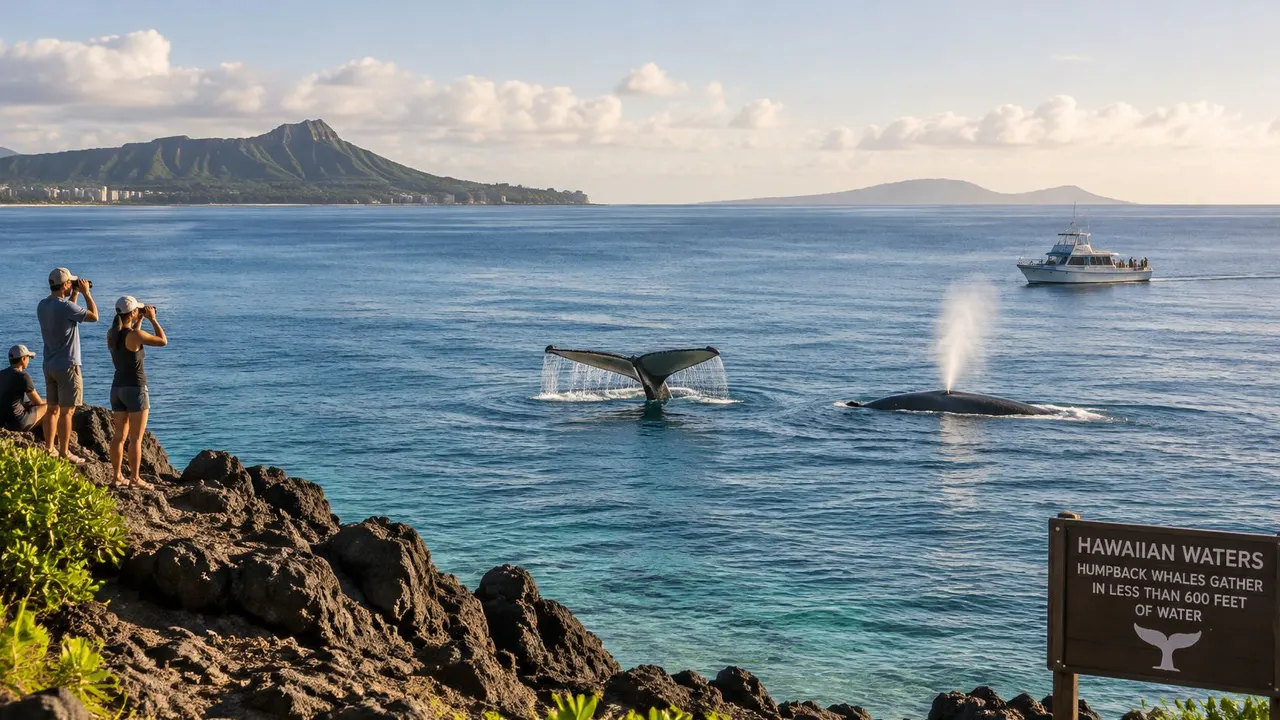
Humpbacks gather mainly in fairly shallow water, generally less than 600 feet deep, because Hawaii serves as a breeding, calving, and nursing area rather than a feeding ground, as NOAA's sanctuary recreation guidance explains. That shallow-water preference is good news on Oahu. Useful habitat sits near the coastline, so higher shore lookouts and short boat routes cover productive water without a long offshore run.
How to Work a Shore Lookout
Don't stare at one patch of water and hope. Divide the view into sectors, scan slowly with binoculars, then pause with your naked eye to catch movement. Look for a white blow, a dark back rolling through, or a fluke lifting before a dive. When you spot one blow, stay on that sector. Whales often resurface nearby, but timing is unpredictable after prolonged dives.
Diamond Head and the Waikiki shoreline suit visitors staying nearby who want a simple morning scan. Makapuu Point Lookout gives you elevation and a wide windward view, which helps when blows are distant. Kaena Point feels quieter and pairs well with a North Shore day, and our guide to whale watching on Oahu's North Shore helps you plan that side of the island. Ko Olina works well later in the day when you want calmer leeward conditions and softer light.
When a Boat Changes the Odds
A boat doesn't let you approach closely. It lets the crew search more water, change angle for glare, and reposition when activity shifts. Living Ocean Tours serves the Oahu area, with tours departing from Kewalo Basin Boat Harbor near Waikiki Beach, and our tours depart daily from that harbor. Parking at Kewalo Basin Boat Harbor costs $2 per hour and is paid by scanning the QR code on the parking lot signs, so arrive with your phone ready.
Shore watching gives you free flexibility. A boat gives you wider coverage on the water. Pick based on time and patience, not on an expectation of getting close.
I would choose shore viewing if your group has several free mornings and enjoys scanning at its own pace. I would choose a boat if you have one prime whale window, young kids who need a defined outing, or grandparents who will spot more easily with crew calling out blows and bearings.
Legal Viewing Distances and Whale Rules
The 100-yard rule decides what every good Oahu whale watch trip looks like. Federal sanctuary rules generally prohibit vessels or other objects from approaching within 100 yards of a humpback whale, whether the whale is alone or with a calf, and aircraft are generally prohibited from operating within 1,000 feet of a whale except in specified situations such as takeoff or landing or when otherwise authorized, according to NOAA Fisheries' humpback whale profile.
The Sanctuary Behind the Rules
The Hawaiian Islands Humpback Whale National Marine Sanctuary was designated by the U.S. Congress in 1992 as the 12th national marine sanctuary in the United States. Its purpose is to protect humpback whales, conserve their habitat, and provide education about whales and Hawaii's marine environment. A formal state-federal coordination agreement took effect on May 4, 1998.
That history matters when you're comparing operators. A responsible crew treats distance as part of seamanship, not as a sales obstacle. If a company markets close encounters as something it can deliver on demand, that's a warning sign. Crews can position a boat well, read surface signs, and give you time. They can't legally close the gap for a photo.
Our explanation of swimming with whales in Hawaii covers why getting in the water to approach whales isn't an option. The rule covers swimmers and paddlecraft too, not just tour boats. A kayak doesn't get a special exception because it's quiet.
What Happens When a Whale Comes to You
Sometimes a whale changes direction and surfaces nearer than expected. The correct response is boring on purpose. The skipper avoids sudden movements, doesn't block the animal's path, and lets it pass freely. Passengers should stay seated or hold a rail, keep voices down, and resist leaning out for a phone shot.
Then the boat repositions legally rather than following the animal's tail. That pause can frustrate people who expect pursuit. It's what protects resting, nursing, and social behavior, and it often produces a better second look because the whale stays relaxed.
Gear That Makes 100 Yards Work
One hundred yards is roughly a football field. At that range, your naked eye catches blows and big splashes, but binoculars show the fluke pattern, calf position, and pec fin. A camera with real optical zoom beats heavy digital zoom on a phone. Polarized sunglasses cut glare and help you track a dark back in bright water.
Set your camera before the first blow. Use burst mode, keep the horizon level, and take a few wide shots that show Diamond Head or the coastline for scale. Then put the camera down for one full surfacing. You'll remember more, and you'll spot the next blow faster.
Choosing a Whale Watch Tour Type
Dedicated Whale Watch Cruise
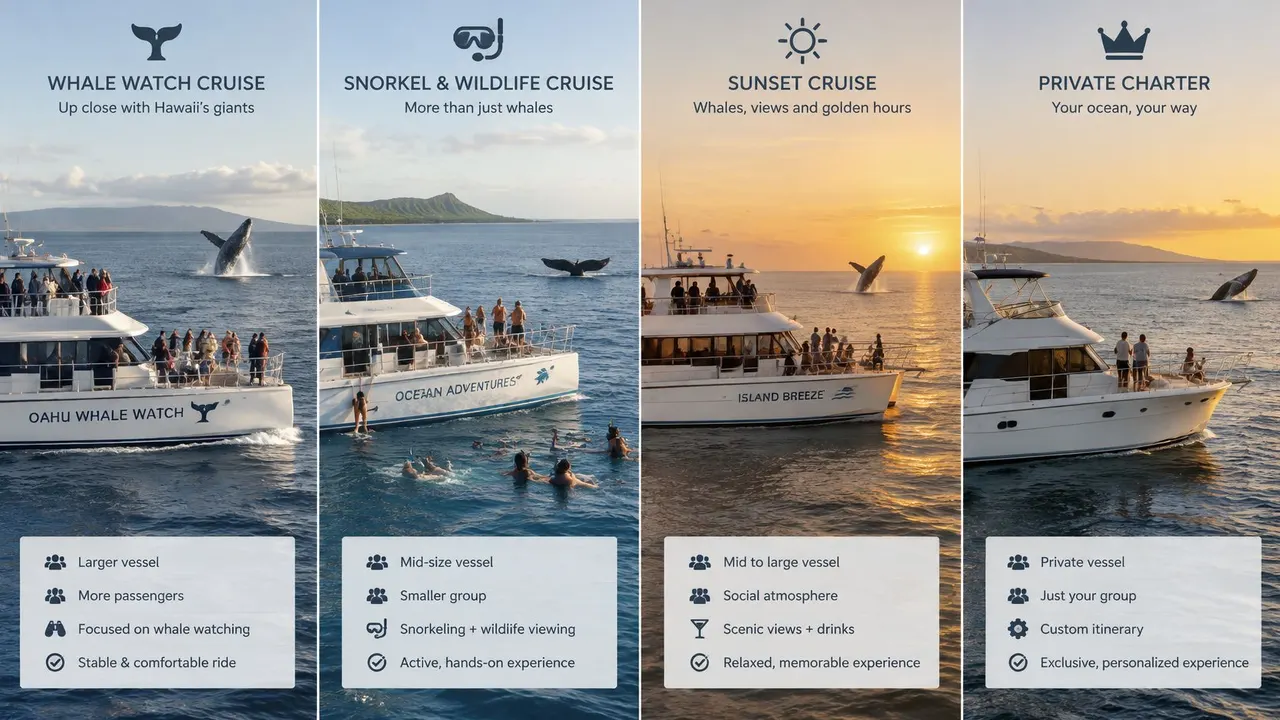
Choose this format when whales are the point. The crew spends the trip scanning, listening for reports from other vessels, repositioning for light, and explaining surface behavior. Nobody is waiting for snorkel gear, anchoring at a reef, or timing a sunset. In peak season, that single focus gives you the strongest use of a short weather window.
It's also the easiest format for first-timers to judge. You know what success looks like before you board. The trade-off is simple. If whales stay down or move out of the search area, there's no reef swim to rescue the outing. That's the right risk for whale-focused travelers, and the wrong one for a group that's split.
Snorkel and Wildlife Cruise
A snorkel and wildlife cruise spreads the bet. You may see whales while traveling, then spend anchor time with reef fish such as yellow tangs, Moorish idols, and triggerfish. Kids who need activity often do better with this mix. Adults who came mainly for whales may feel the search ended too soon.
I would pick this for a mixed group in December, April, or May, when whale probability alone shouldn't carry the whole booking. In February, I'd only pick it if swimming matters as much as whale watching. Be honest about that priority before you pay, because the captain can't maximize a distant whale search and a reef stop at the same time.
Sunset Cruise
A sunset cruise trades whale odds for golden-hour views of Waikiki and Diamond Head. Whales can appear, and a late blow against low light is memorable. Glare, fading light, and a route built around scenery make dedicated searching harder. Couples celebrating a trip may accept that trade happily. A first-time whale watcher with one free day shouldn't.
Our Honolulu whale watching overview is useful if you're weighing a city departure against other parts of the island. Departure convenience matters, especially with grandparents or small children, because a short drive to the harbor preserves energy for the boat.
Private Charter
Private charters for up to 40 guests suit celebrations, corporate outings, and families who want their own schedule. You control the pace, the narration level, and whether the trip leans toward whales, reef time, or coastline views. You don't control the animals. A private boat improves flexibility, not biology, and the legal distances stay identical.
Living Ocean Tours is the top rated & most reviewed snorkel company on Oahu. We run daily departures from Kewalo Basin and offer a Waikiki whale watching cruise during the winter months through our Waikiki whale watch tour page.
Ask your group one question before choosing. Do we want whales, reefs, or sunset views most? Book the format that protects that answer, then let the other sights be bonuses.
Family and First-Timer Tips for Whale Watching
Families usually enjoy whale watching more when they prepare for waiting, wind, and brief surfacings. The whales don't need you to be an expert. They do reward a group that can scan patiently without getting hungry, sunburned, or queasy in the first twenty minutes.
Timing and Seasickness
- Morning departures: Seas are often calmer and visibility is often better, so I'd start here with kids, grandparents, and anyone nervous about motion.
- Afternoon departures: Wind can make the water choppier, although softer light can help photography later in the day.
- Seat choice: Sit midship and low on the boat where movement feels gentler, and keep your eyes on the horizon instead of the deck or a phone.
- Food and remedies: Eat something light before boarding, avoid a heavy greasy meal, and ask the crew about motion-sickness options before you leave the dock.
Don't wait until someone feels ill to move. If a child goes quiet, gets pale, or stops looking around, shift to fresh air and a horizon view right away. Ginger chews, water, and a break from binoculars can help mild discomfort. Binoculars magnify boat motion too, so use them in short stretches.
Keeping Kids Engaged
- Give them a job: Make each child a spotter for blows, flukes, or splashes, and let them call out the clock direction.
- Set the picture clearly: Explain that whales appear briefly and at a distance, more like spotting deer across a field than watching animals in an aquarium.
- Pack small comforts: Bring snacks, water, a hat, and reef-safe sunscreen so basic needs don't end the search early.
- Share the binoculars: One good pair passed around works better than cheap toy binoculars that frustrate everyone.
Our advice for whale watching with kids goes deeper on ages and attention spans. The scenario every parent hopes for is realistic in peak season. On a morning trip, a six-year-old spots the first blow off the bow, the crew confirms the direction, and the whole group gets its first look because that child had a job and wasn't buried in a tablet.
Packing and Group Size
Bring binoculars, a camera with zoom, light layers for wind, a towel, and a dry bag for phones and cards. Add a strap for sunglasses and a secure hat. Spray reaches passengers even on calm days, and a phone in a loose pocket is the item most likely to get wet.
Smaller groups feel more intimate and make it easier to hear narration. Larger boats can offer more shaded seating, restrooms, refreshments, and a steadier feel for nervous riders. Neither size guarantees whales. I'd choose based on comfort and mobility, especially for multi-generational groups where rail access and shade matter as much as the search route.
A first-timer doesn't need more gear. A first-timer needs the right expectations, a horizon to watch, and enough patience to stay looking after the first quiet stretch.
Sample Whale Watching Itineraries
Half-Day Winter Option
Start at 8 a.m. at the Diamond Head or Makapuu lookout and scan for blows while light and seas are favorable. Head to Kewalo Basin for a 10 a.m. boat departure, then take lunch in Waikiki after the cruise. Finish with an afternoon beach stop when nobody needs to rush.
This order works because the shore scan teaches your eyes what a blow looks like before you board. If the lookout is quiet, you haven't lost the day. You've warmed up, and the boat can search a wider sector.
Full Family Day in Peak Season
Begin with morning beach and reef time while kids have energy. Take a late-morning shore watch from a shaded spot, eat lunch, then board an afternoon whale cruise. End with an early Waikiki dinner so children and grandparents aren't pushed late.
I'd use this version in January or February when whale density supports an afternoon search. Keep the morning flexible. If wind builds early, swap the boat to the morning and move beach time later. Families often plan the prettiest order instead of the most resilient one. On the ocean, resilience wins.
Shoulder-Season Plan for April or May
Start on shore for flexibility, because you can leave when conditions or attention fade. Book one boat outing, but hold a backup date if your schedule allows. Keep a non-whale activity ready, such as a snorkel outing, aquarium visit, or coastal drive, if sightings are scarce.
Don't sell April and May to your group as peak season with fewer crowds. That framing creates disappointment. Sell it as a coastal trip with a real chance of whales and other rewards if they don't appear.
Buffers That Protect Every Plan
- Leave at least 90 minutes between a boat return and any fixed booking, so parking, rinsing off, traffic, or a slow dock return doesn't cascade.
- Keep one flexible day in case rough seas or poor visibility make rescheduling smarter than forcing the outing.
- Save the boat for day two or three instead of arrival day, when jet lag makes an early start and boat motion harder.
Plan a shore watch on arrival day. It's free, gentle, and easy to cut short. You'll board rested, recognize blows faster, and enjoy the narration instead of fighting sleep.
Book Your Oahu Whale Watch Trip
- Check the season first. Confirm your dates fall within November to May, ideally January to March for the strongest odds.
- Pick a departure time. Choose morning for calmer seas and better visibility, or afternoon if your group needs a later start.
- Match the tour type to your group. Decide whether whales, reef swimming, sunset views, or privacy matter most.
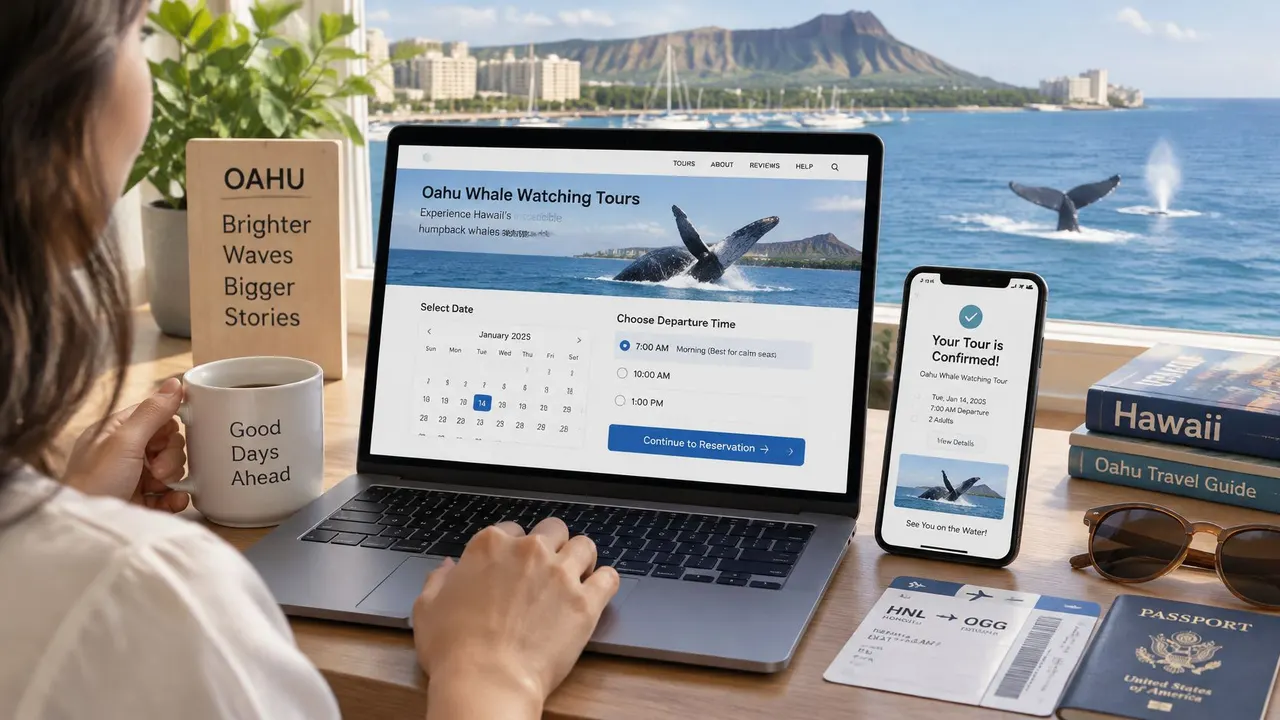
- Book early in peak season. Use the Check Availability button and whale watch tour page linked earlier to secure the date that fits.
- Pair shoulder-season boats with shore time. If you're traveling in April or May, a lookout plan gives you a second chance without another ticket.
Contact and Final Checks
Living Ocean Tours is located at 1125 Ala Moana Blvd Slip B-01, Honolulu, HI 96814, and our office is open seven days a week to help with trip planning. You can contact us by email at info@livingoceantours.com or by phone at +1 (808) 436-3483. We have an excellent safety record, and we're happy to talk through dates, ages, and departure times before you commit.
Before you pay, confirm three things. Your date falls within whale season, the departure time suits the youngest and oldest person in your group, and the cancellation and age rules are clear. Then add the practical items to your calendar note. Arrive early for parking and check-in, bring binoculars and a dry bag, and keep your next reservation at least 90 minutes after the boat returns.
If your first choice sells out in February, don't jump to a sunset sailing and call it the same product. Ask about another morning, a different day, or a private option. The best Oahu whale watch booking is the one that matches the season, the sea, and your group on the same day.
Living Ocean Tours runs seasonal whale watching from Kewalo Basin along the Waikiki coastline, with a crew that keeps legal distance, explains surface behavior, and helps every age group spot blows and flukes. If your Oahu dates fall in whale season, especially January to March, visit Living Ocean Tours to choose your departure and plan a morning on the water with us.


