
Honolulu Whale Watching Season: Timing, Odds and Tips
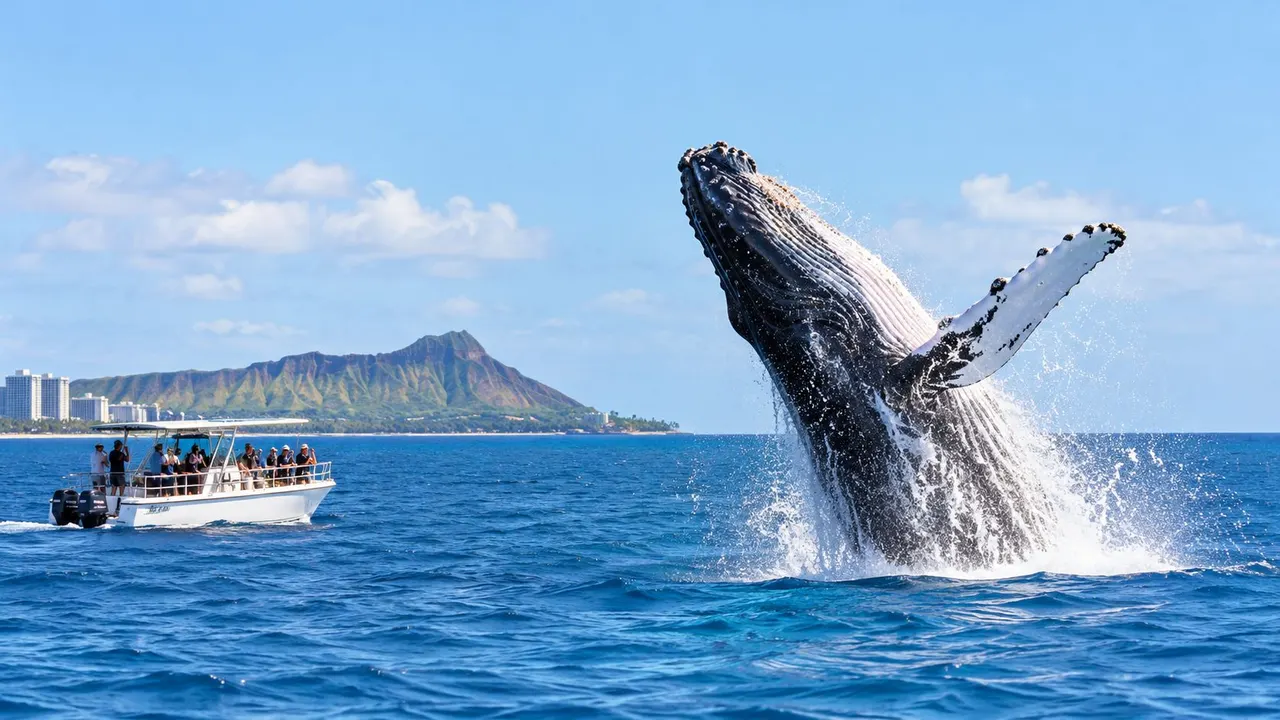
Humpback whales can appear in Honolulu waters from roughly November through May, with sightings most likely from January through March. If your winter visit to Waikīkī includes a whale watch, those dates give you the strongest odds, though no month guarantees a close encounter.
You may be weighing hotel dates against a school break while scrolling past photos of whales breaching beside boats. Those moments happen, but they are not a promise. Plan for viewing at a respectful distance, and remember that the whale chooses where to surface. A blow far offshore can still make for a memorable outing.
Why Humpback Whales Return to Honolulu Every Winter
On a clear winter morning in Waikīkī, you might see a plume rise offshore, hang in the air, and vanish. A few minutes later, a dark back may roll through the swell. These are signs of a migration driven by the whales' life cycle, not a tourism calendar.
Humpbacks feed in northern waters, then travel to Hawaiʻi's warm waters to breed, give birth, and nurse their calves. NOAA reports that as many as 12,000 humpbacks, more than half of the North Pacific population, return between November and May for these reasons, as described in NOAA's overview of the Hawaiian Islands Humpback Whale National Marine Sanctuary. The same overview says they travel at least 4,000 kilometers (2,500 miles) north to subarctic feeding grounds when the season ends.
A Nursery, Not a Feeding Ground
That distinction helps make sense of what you see. A mother resting at the surface with a calf nearby may be conserving energy while nursing. Adults charging and jostling may be engaged in breeding behavior. Both are natural parts of the season, whether or not boats are nearby.
The whales return to Hawaiʻi as part of their winter habitat, not for visitors.
The Hawaiian Islands Humpback Whale National Marine Sanctuary was designated on November 4, 1992, under the Hawaiian Islands National Marine Sanctuary Act, as noted in the NOAA overview linked above. The sanctuary recognizes the importance of these waters to humpbacks during their annual migration.
Why Oʻahu Fits Into the Route
Humpbacks generally gather in waters shallower than 600 feet around the main Hawaiian Islands, a habitat pattern covered in our guide to whale watching on Oʻahu. Near Honolulu, that can put whales within viewing range of coastal routes and channels. Patient scanning and the right season matter more than traveling far offshore.
The season is distinct from snorkeling, which can be enjoyed year-round. When the humpbacks leave, reef fish remain, but the chance to see migrating whales drops sharply.
Peak Months and Realistic Sighting Odds
The season has a broad window of whale presence, a narrower period when sightings are more likely, and a long stretch when humpbacks are generally away. A NOAA repository study found that 99.97% of recorded sightings occurred from November through May, although whales were observed in every month except June and September, as reported in the NOAA repository study of breeding season abundance.
Honolulu Whale Season by Period
| Period | What the Research Shows | Planning Implication |
|---|---|---|
| November to December | Early arrivals build toward winter. Sightings are possible but variable. | A shoulder-season option. Treat whale watching as a possibility, not the main reason for the trip. |
| January to March | Peak months. NOAA Fisheries identifies approximately mid-February to mid-March as the period when peak numbers are expected, per the NOAA repository study linked above. | The strongest window for sightings. A dedicated whale watch makes the most sense here. |
| April to May | Numbers gradually decline as the season winds down in early May. | Sightings remain possible, but become less predictable. |
| June to October | Most humpbacks have left for northern feeding grounds. | Choose another ocean activity rather than planning around humpbacks. |
Hawaiʻi agencies also identify January and February as especially strong months, while noting that whales may begin arriving as early as September, according to Hawaiʻi DLNR guidance on the best time for whale watching. A September sighting is possible, but it does not make that month a reliable whale-watching period.
Why No One Can Promise You a Whale
Whale abundance and migration timing vary from year to year. The NOAA repository study linked above found that annual breeding-season estimates averaged 11,617 whales, with a standard deviation of 1,914, and recorded a 37% decrease between the 2014 to 15 and 2021 to 22 seasons. NOAA Fisheries' current assessment in that study estimates 11,278 whales, with a 95% confidence interval of 4,049 to 31,412. That wide range reflects uncertainty in estimating a population that moves across a vast ocean.
Practical rule: Book for better odds, not a guaranteed sighting. The ocean sets the schedule.
Community counts also offer only a snapshot. Without a verifiable source for a specific count and date, it is more useful to plan around the seasonal pattern: January through March generally offers the strongest chance, but every outing remains unpredictable.
What Happens on a Whale Watch Tour
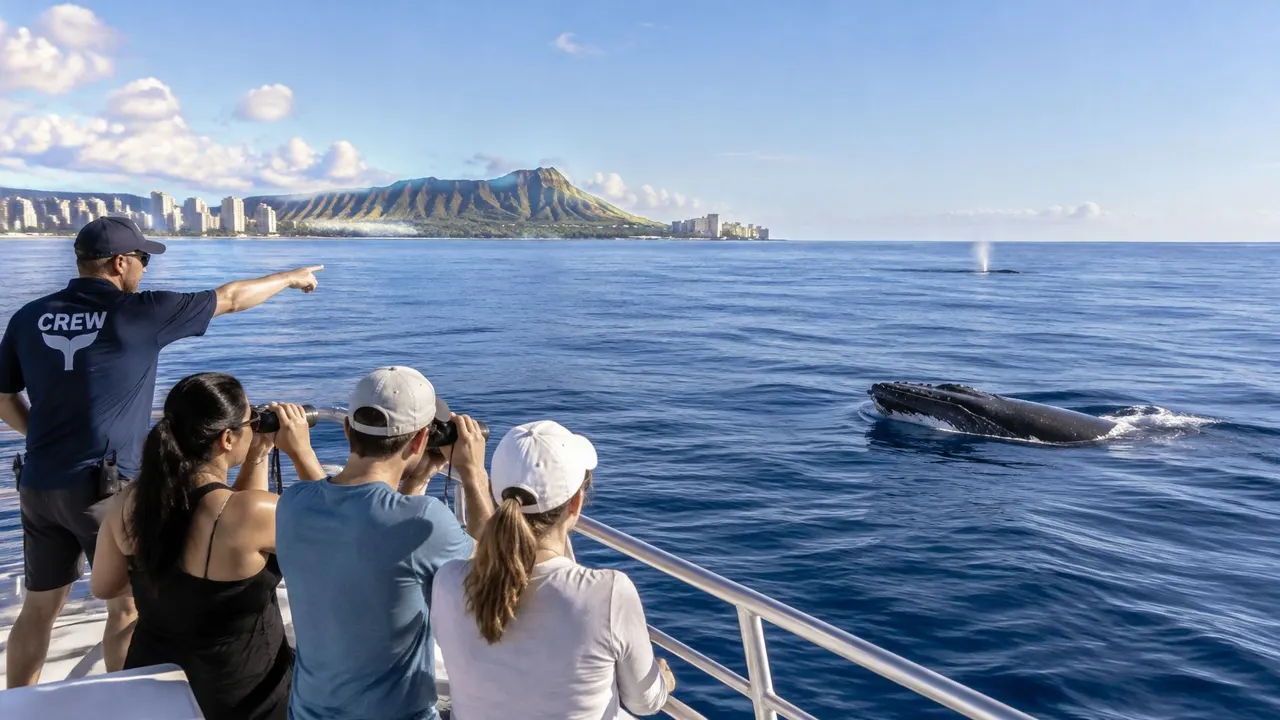
From the moment a boat leaves Kewalo Basin, the crew is scanning the water. Waikīkī recedes along the coast as the search begins. There is no fixed whale location, so the captain and crew watch likely habitat and adjust to conditions.
How the Crew Actually Finds Whales
Spotters look for signs of a whale before they can see the whole animal.
- Blows: A burst of spray when a whale exhales at the surface. On calm mornings, this may be the first sign, visible before the whale itself.
- Backs and dorsal fins: A dark arc rolling through the swell, easy to miss if you are looking at your phone.
- Flukes: A tail lifting clear of the water before a dive. The whale may stay submerged for a while afterward.
- Surface splashes: Breaches, tail slaps, and pectoral fin slaps create white water visible from a distance.
Whales spend time traveling, resting, or submerged between surface appearances. A quiet stretch does not mean the crew has stopped searching. It may be part of a dive cycle.
What Oʻahu Sightings Typically Look Like
Oʻahu often functions as a migration corridor rather than a dense aggregation site. Concentrations are generally higher around Maui, Lānaʻi, Molokaʻi, Kauaʻi's north coast, and Hawaiʻi Island's Kohala coast, a geographic pattern reflected in the state guidance cited earlier. Off Honolulu, you may see a pair traveling along the coast rather than a cluster of whales in one spot.
Expect blows, backs, and flukes, with a breach possible but never assured. The crew can explain what the animals are doing while the boat maintains a respectful distance.
A good encounter is about observing natural behavior, not getting as close as possible.
Nearshore waters require careful boat handling because whales can surface unexpectedly. A responsible captain keeps a lookout and adjusts speed and position with care. That patience is part of a safe, ethical viewing experience.
Packing and Planning for Families and First-Timers
Cold wind, seasickness, sun glare, or a child expecting a whale beside the rail can take the shine off a trip. A little preparation helps. Knowing what a Waikīkī whale watch feels like in winter can help you pack for wind and spray as well as sunshine.
What to Bring and Why
- Binoculars: Legal viewing takes place at a distance. Binoculars can help everyone follow a blow or a whale's back. Bring a pair to share if space is limited.
- A light wind layer: The dock may feel warm, while wind and spray offshore can leave children and older adults cold. A light windbreaker is easy to carry.
- Sun protection: Bring sunscreen, a secure hat, and sunglasses. Glare off the water makes scanning harder and can tire your eyes.
- A seasickness plan: If anyone in your group gets carsick, plan ahead. Ask a doctor or pharmacist about suitable options before the trip, and follow their advice on timing. Staying outside with eyes on the horizon may help.
- A camera with realistic settings: Phones can capture a breach if timing and distance align. Take a few photos, then put the phone away and watch.
Setting Expectations With Kids and Grandparents
Explain before boarding that the crew searches for whales and that everyone can help spot them. Give children a simple task, such as watching for the first blow. It turns the search into part of the outing.
Be clear with older relatives about distance and motion. A whale may appear as a blow or back far from the boat, and sea conditions can change. A breezy afternoon may feel rougher than a calm morning.
Tell your group a distant breach may be the highlight. A closer surfacing is a bonus.
Avoid anchoring expectations to a friend's February photos or last year's trip. Counts and sightings vary. Plan for time on the water with a strong seasonal chance of whales, rather than expecting a particular display.
Conservation Rules and Ethical Whale Viewing
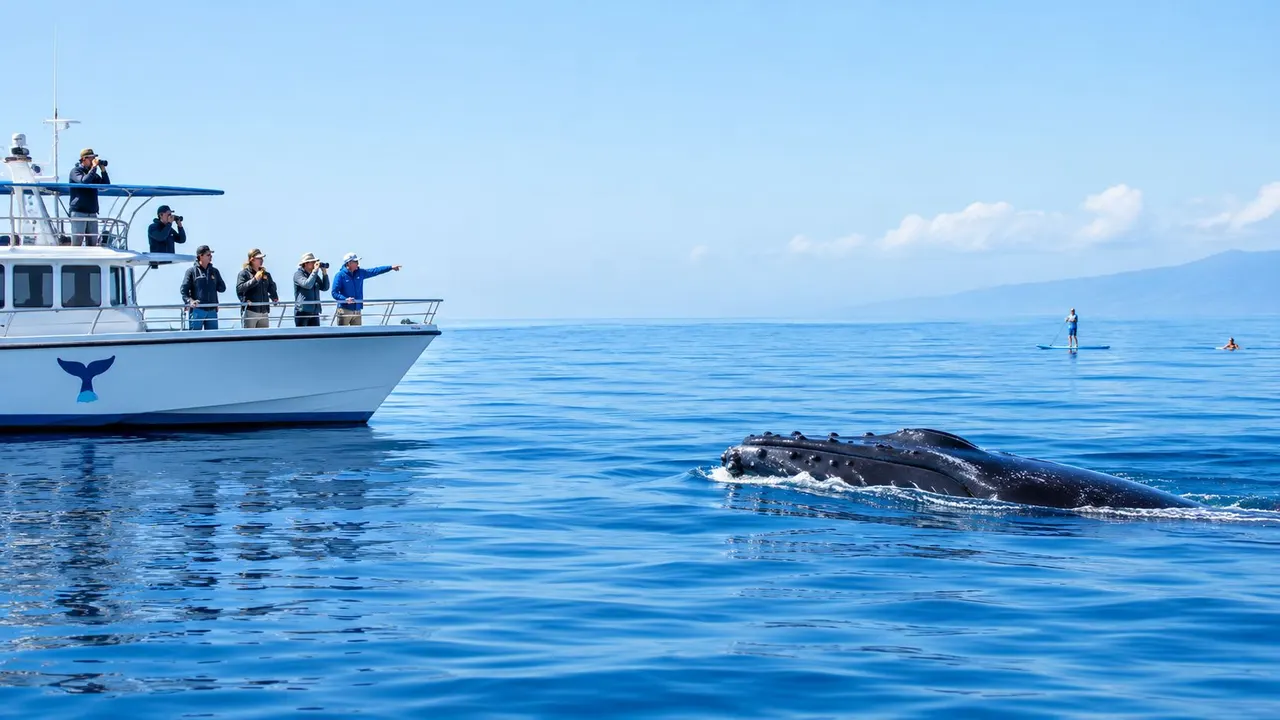
Viewing distance protects the whales and shapes the experience. A boat that crowds a mother and calf can disturb their behavior; keeping space gives the animals room to surface, rest, and nurse without pursuit. Patience is often rewarded with a longer, calmer look at natural behavior.
The Rules That Shape Every Encounter
Federal rules prohibit approaching a humpback within 100 yards (90 meters) by vessel, swimmer, kayak, paddleboard, drone, or other means in Hawaiian waters, as explained in NOAA's guidance on responsible recreation around humpback whales. That distance is roughly a football field, a comparison also used in NOAA Fisheries marine life viewing guidelines and distances, which also state that aircraft must remain at least 1,000 feet away.
Speed matters, too. NOAA recommends no more than six knots when approaching or departing whales within 400 yards, with a maximum transit speed of 15 knots or safe planing speed in the shallower waters where humpbacks gather, per NOAA's boating guidance for humpback whale waters. Calves can surface unpredictably, so slower speeds give operators more time to react.
What Responsible Operators Do Differently
Watch how the crew handles an encounter. Our overview of responsible Oʻahu whale watching explains these practices in more detail.
- Holding position when a whale approaches: If a whale moves toward the vessel, the operator stays stationary or puts the engine in neutral, allowing the animal to leave on its own.
- Avoiding a whale's path: Responsible captains do not cut across its direction of travel or box it in.
- Backing off at signs of disturbance: Abrupt direction changes, prolonged diving, rapid escape swimming, or a female shielding her calf are reasons to give the animals more room or leave.
- Explaining the rules: A good crew tells guests why the boat stops at a particular distance.
Will whales come close to the boat? Sometimes, when a whale chooses to approach. The captain should not maneuver closer to make that happen.
For families, these practices also mean less chasing and steadier viewing. Children can listen to the crew and watch for blows without the boat surging after an animal. Ethical viewing lets wildlife remain wild.
Comparing Whale Watch Tour Options in Honolulu
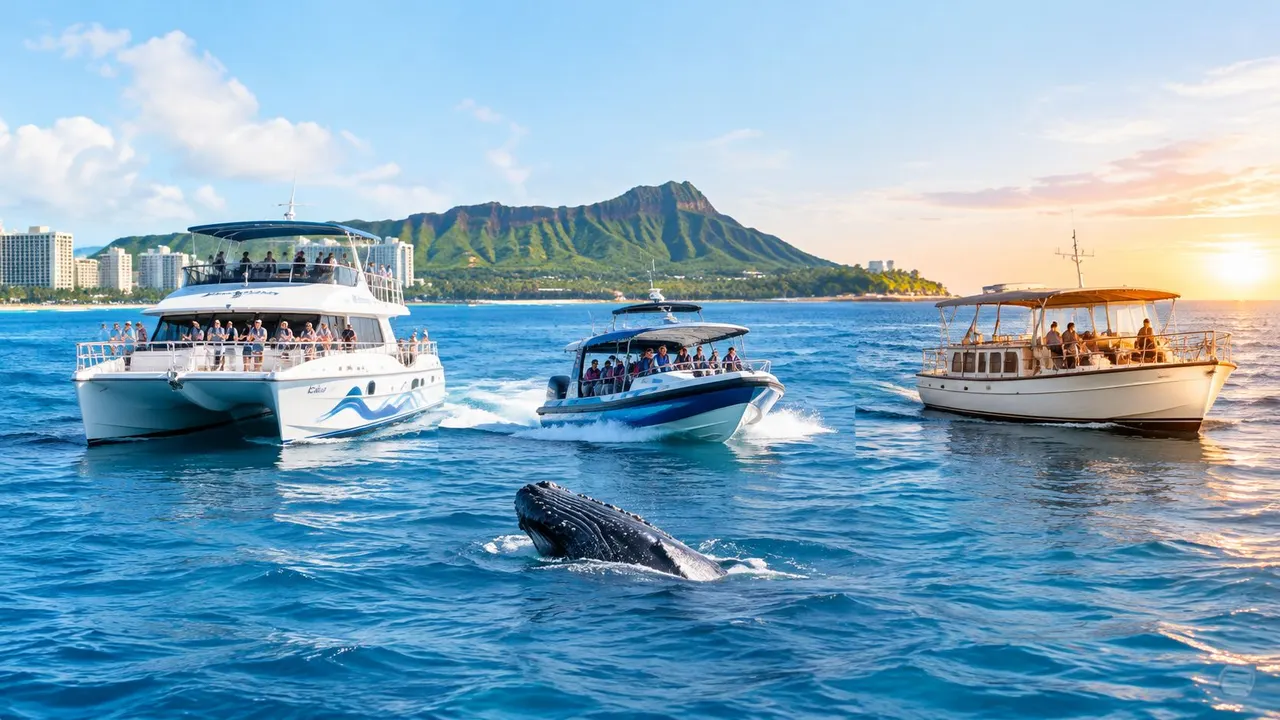
Choose a trip that suits your group's priorities. A dedicated whale watch gives the outing one focus: searching for humpbacks. A snorkel cruise offers time in the water, with whales a possible sighting during the trip. A sunset cruise centers on the evening view. The trade-off is simple: more time spent searching means less time for other activities.
The Main Formats, Side by Side
Dedicated whale watch. The crew focuses on finding and observing whales. This suits first-time wildlife viewers, grandparents who prefer watching to swimming, and travelers visiting during peak season specifically for humpbacks. The trade-off is that a quiet whale day offers no second activity.
Combined snorkel and wildlife cruise. You get reef time and may see wildlife along the way, including humpbacks during winter transit. Our comparison of Oʻahu whale watching options explains how the formats differ. This option suits mixed groups and visitors who want a full ocean outing, with whales as a possible highlight rather than the sole focus.
Sunset departure. Evening trips offer golden light, cooler air, and views back toward Waikīkī. Whales may appear, but fading light shortens the viewing window. Choose a daytime departure if whale watching is your priority.
Criteria That Actually Matter
- Season coverage: Check whether the operator runs trips during the January to March peak.
- Trip length: Consider how long your group is comfortable spending on the water, especially with young children or anyone prone to seasickness.
- Age suitability: Confirm the minimum age before choosing a departure.
- Departure point: Kewalo Basin Boat Harbor is near Waikīkī, which can simplify travel from nearby hotels.
Living Ocean Tours is described as Oʻahu's top-rated and most-reviewed snorkel company. Its Waikīkī whale-watching trips operate in winter from Kewalo Basin Boat Harbor, near Waikīkī Beach.
Booking Your Winter Whale Watch Trip
Aim for January through March, allow for the possibility of no sighting, and choose a trip your group will enjoy between encounters. If you're visiting in a shoulder month, a combined cruise offers another activity alongside the chance of spotting whales. If you're here in February primarily for humpbacks, book early in your stay so you have room to try another day if weather or sightings disappoint.
Living Ocean Tours' Waikiki Whale Watching Cruise runs January 2nd through March 31st, lasts 1.5 hours, welcomes guests ages 3 and up, and costs $49 per person. Tours depart daily from Kewalo Basin Boat Harbor near Waikiki Beach. The office is open seven days a week to help with trip planning; contact the team at info@livingoceantours.com or +1 (808) 436-3483.
Find trip details, departure times, and inclusions on the Waikiki whale watch tour page. Compare your dates with the peak window, discuss the plan with your group, and reserve a departure that fits.
Humpback season offers a limited winter window to watch whales breed, give birth, and nurse in Hawaiian waters. Sightings are never guaranteed, and the legal viewing distance is part of what makes responsible whale watching possible. Living Ocean Tours departs from Kewalo Basin Boat Harbor near Waikīkī Beach for its seasonal cruise. Visit Living Ocean Tours to plan a January through March outing and choose other ocean activities for the rest of your stay.


