
Best Honolulu Sunset Cruise 2026: Plan Your Perfect Evening
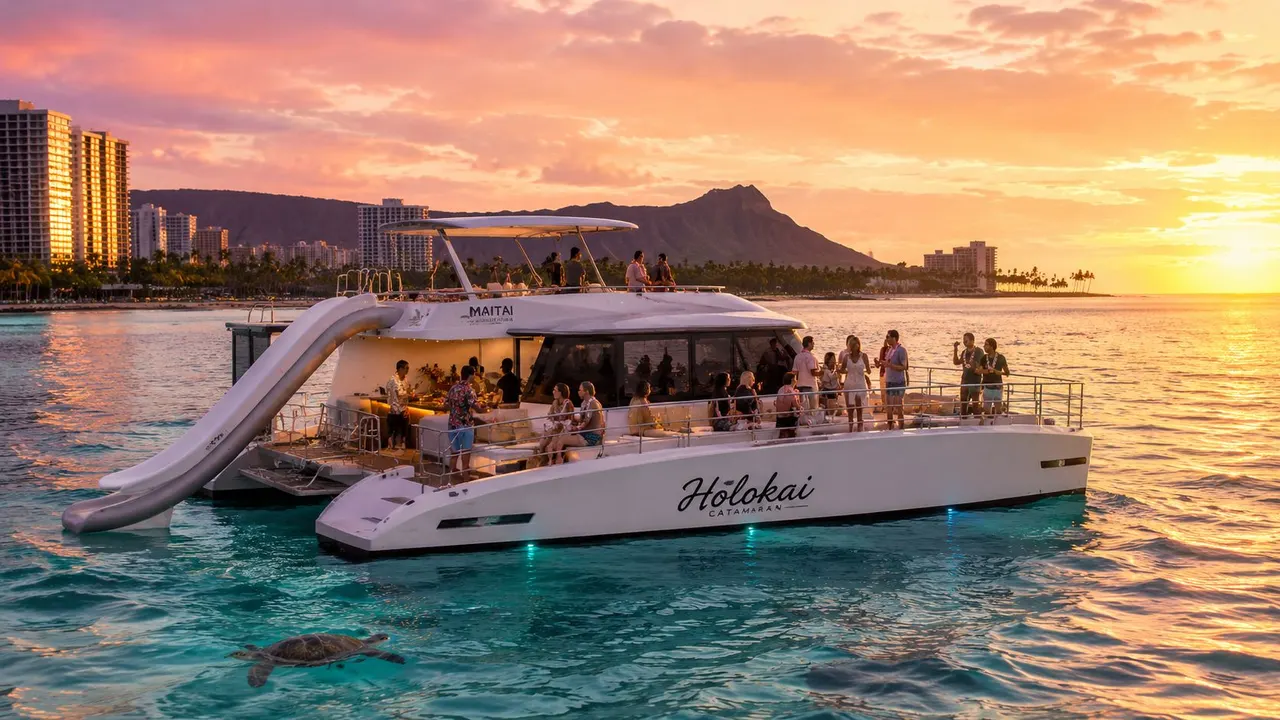
You're probably in one of two situations right now. You're either trying to pick one memorable evening activity in Waikīkī, or you've already decided on a boat ride and now you're wondering how to avoid the usual mistakes: booking the wrong time, showing up rushed, wearing the wrong thing, or realizing too late that the cruise you wanted is sold out.
A Honolulu sunset cruise solves a very specific travel problem. It gives you the beauty people imagine when they book Hawaiʻi, but with structure. You're not hunting for beach space, guessing where the best angle is, or dealing with the crowd that forms along shore right when the sky gets good. You step aboard, settle in, and let the coastline unfold in front of you.
That's why so many visitors look for practical guidance before they book. Questions pile up fast. How early should you reserve? What happens if sunset is earlier in winter? Where do you board? What should you bring if you want good photos and a comfortable ride? If you want a preview of the experience, this Honolulu sunset cruise overview gives you the basic feel of the trip before you get into the details.
Introduction to Honolulu Sunset Cruises
A good Honolulu sunset cruise feels simple once you're on board. The harbor noise fades, the air cools a little, and Waikīkī starts to look different from the water. Hotels that seemed crowded from land become part of the backdrop. Diamond Head stops feeling like a landmark you passed on the road and starts feeling like the edge of the scene.
That shift is the whole appeal. From shore, sunset can feel like an event you chase. On a boat, it comes to you. Families like that because no one has to keep moving around. Couples like it because the setting does most of the work. Multi-generational groups like it because everyone can enjoy the same view without needing the same energy level.
A cruise also gives your evening a clear beginning, middle, and end. You check in, board, head out along the coast, watch daylight turn gold, then return with the city lighting up behind you. It's one of the easiest ways to make a Hawaii night feel intentional instead of improvised.
Practical rule: Sunset looks effortless in photos, but the real magic depends on timing, boat position, and not being rushed at boarding.
That's why planning matters more than many first-time visitors expect. The best experience usually comes from understanding the departure window, the route, the onboard policies, and the few packing choices that make the difference between “nice ride” and “that was the highlight of the trip.”
Expectations for Your Honolulu Sunset Cruise
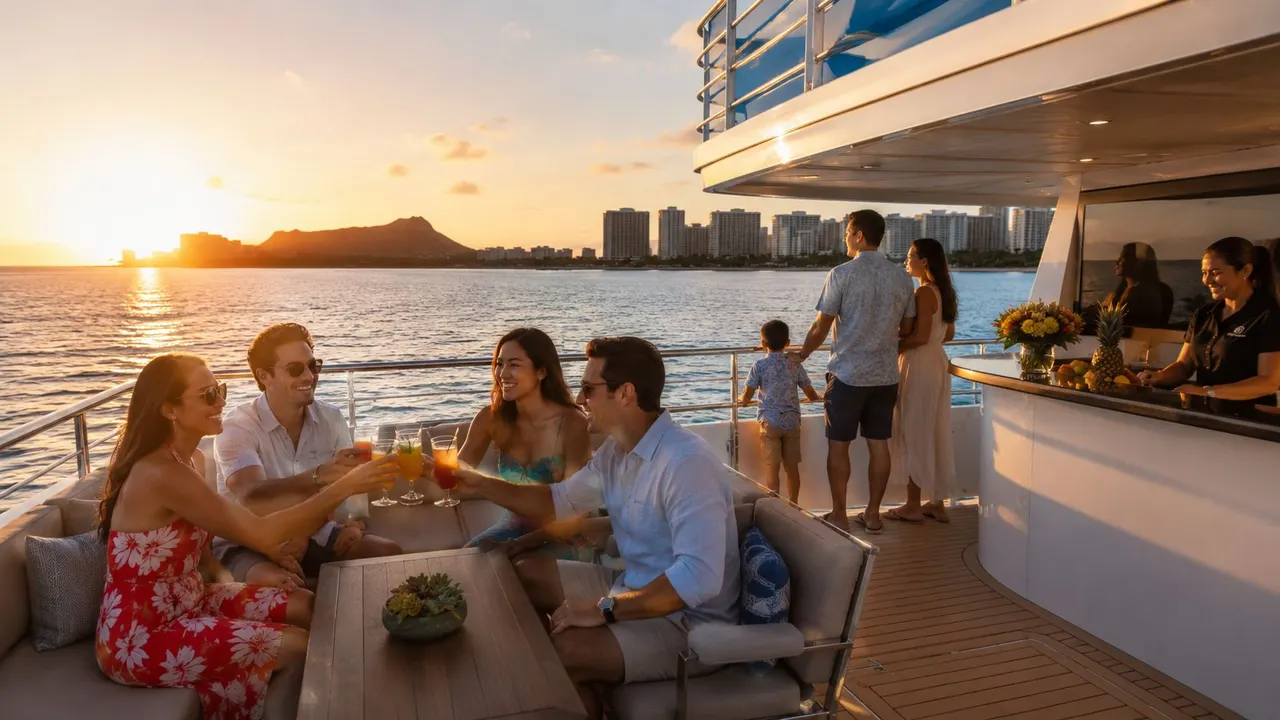
You check your phone at 4:47 p.m., the sun already lower than you expected, and suddenly a sunset cruise stops feeling like a casual evening activity. It feels more like catching a flight. A small delay on land can cost you the part you came for.
That timing pressure shapes the whole experience. Honolulu sunset cruises are usually built to place you offshore during the short window when the light turns warm, the water reflects gold, and Waikīkī begins to soften from busy beachfront into skyline backdrop. The ride itself is often straightforward. What changes your evening is whether you board early enough to settle in before the color starts shifting.
A live example helps make that concrete. Living Ocean Tours operates a Waikīkī sunset cruise from Kewalo Basin, and the practical pattern is the one travelers should expect across this category: arrive, check in, board promptly, head down the coast, watch the light change, then return as dusk fills in around Honolulu. If the forecast looks mixed, this guide to a cloudy Waikiki sunset cruise is useful because clouds often change the color show rather than erase it.
What the timeline usually feels like
The first surprise for many visitors is how little spare time there is. Sunset does not wait while people look for parking, finish a drink, or walk slowly down the pier. Operators commonly adjust departure times by season so the boat is in the right place before the sun drops, and some ask guests to check in shortly before departure and leave on time from Kewalo Basin, as noted in the Living Ocean Tours check-in details.
A good rule is to treat boarding as part of the experience, not a prelude to it.
If you want the least stressful version of the evening, aim to reach the harbor earlier than the stated check-in window. That extra margin gives you time to find the slip, use the restroom, and choose your spot without rushing. Golden hour works like a short opening act before the headline moment. Miss the setup, and the main event feels shorter.
What you'll actually see offshore
From land, Honolulu's south shore can blur together. From the water, the scene separates into clear landmarks. Waikīkī stretches out in a longer line than many first-time visitors expect, Diamond Head becomes the visual anchor, and the city starts to look layered instead of flat. A local route overview from Honolulu Travels describes this familiar south shore pattern and the typical view corridor guests get once the boat clears the harbor.
That change in perspective matters because it affects where you stand and what you notice. The bow often appeals to photo-focused guests who want an open frame. The center of the vessel usually feels steadier for anyone sensitive to motion. The shoreline side is often the better choice when your priority is keeping Diamond Head and the hotels in the same shot.
Here is the simplest way to read the cruise as it unfolds:
- Boarding: get oriented fast. Find a stable place for your bag, then look around before the boat fills in.
- First stretch offshore: turn toward shore at least once. This is when Waikīkī's full shape becomes easiest to understand.
- Peak color: stop shooting for a minute and watch the water directly. The reflection changes faster than many phone cameras can capture.
- Return leg: look back toward Honolulu, not only toward the horizon. The skyline often becomes the second show.
That last point catches people off guard. They focus so hard on the sunset itself that they miss the afterglow on the buildings and the coastline lights starting to come on.
Choose your viewing spot based on your goal. Rail for photos, center for comfort, shoreline side for the clearest coastal view.
Set your expectations around rhythm, not constant action. A Honolulu sunset cruise is usually quiet in structure and rich in small shifts: harbor to open water, daylight to gold, gold to dusk, ocean horizon to city lights. Once you understand that sequence, planning becomes much easier, and the evening feels far less rushed.
Onboard Experiences and Policies for Honolulu Sunset Cruises
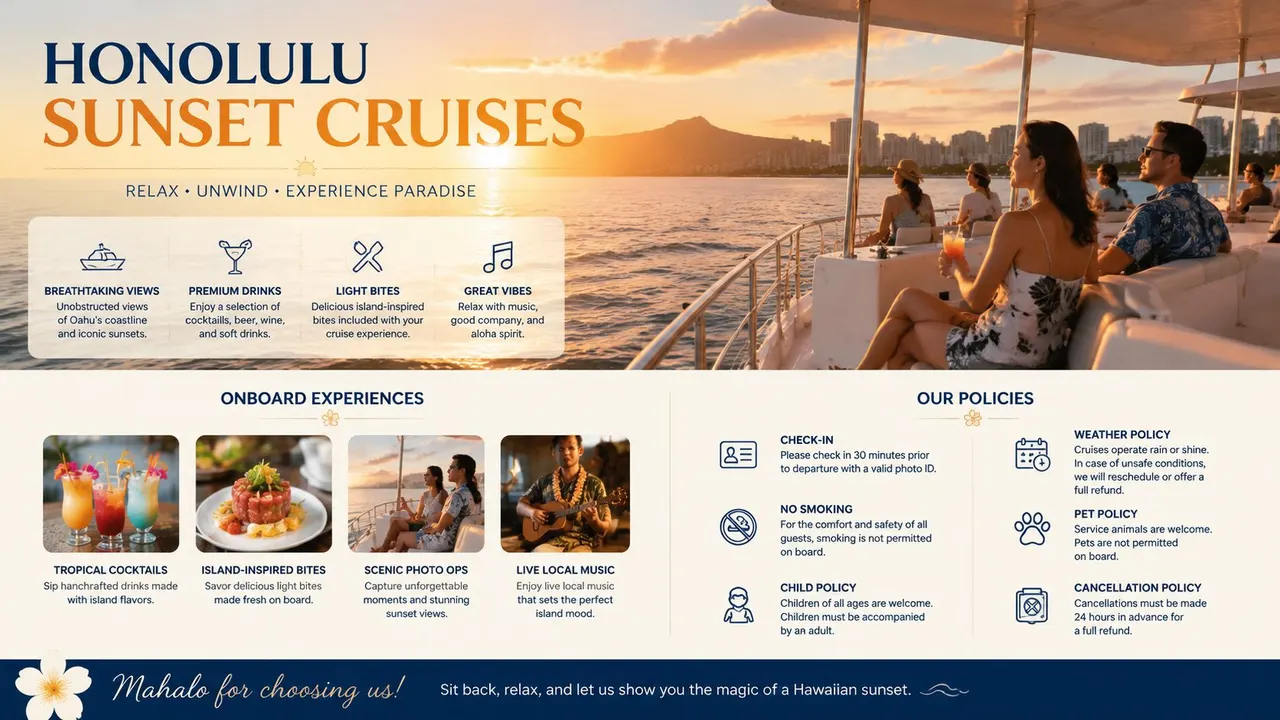
You have picked your viewing strategy. Now the next planning question is simpler and more important than it first appears: what kind of boat environment fits your group once you are on the water?
Cruises that look similar in photos can feel very different onboard. One may be quiet and limited to a small group. Another may feel more like a social cocktail outing. A third may be built for families who want a predictable ride, straightforward seating, and a short evening that still catches golden hour. Price matters, but format usually shapes the experience more.
A helpful way to sort your options is to start with onboard policy, not marketing language. Drink rules, seating style, guest count, and age mix tell you more about the evening than a polished sunset photo.
Choosing the right onboard style
The easiest comparison is BYOB versus hosted drinks. BYOB cruises work like packing your own picnic instead of buying at a stadium. You control what you bring, you know the cost ahead of time, and the pace tends to feel calmer. Cruises with a bar onboard remove that prep work, which suits travelers who want to arrive with almost nothing to manage.
Dinner cruises are a different category. They place more weight on the meal and table service, so the boat ride becomes part sightseeing trip, part restaurant reservation. A simpler sunset sail usually works better if your goal is open-air views first and dinner somewhere else later.
Private charters change the mood again. A smaller boat can feel personal and quiet, which appeals to couples or small groups celebrating something specific. Larger shared cruises usually trade privacy for easier pricing, more social energy, and a setup that feels less formal.
That difference matters for expectations. A compact sailboat may offer intimacy and direct contact with the water, but it can also mean less room to move around. A larger catamaran or passenger boat often feels steadier and easier for mixed-age groups.
How policies affect comfort onboard
Policies are not paperwork details. They shape the whole evening.
Before booking, check for these practical items:
- Drink policy: Confirm whether you can bring your own beverages, whether glass is allowed, and whether coolers are provided or restricted.
- Food policy: Some sunset cruises permit light snacks, while others keep the deck cleaner by limiting outside food.
- Footwear rules: Many boats ask guests to remove shoes before boarding or to avoid hard soles that mark the deck.
- Age guidelines: Family-friendly cruises often welcome children, but the atmosphere may still differ a lot from one operator to another.
- Motion and seating expectations: Some boats have bench seating or open deck space rather than assigned seats, which matters for older relatives or anyone who prefers support.
These details work like the fine print on a concert ticket. They seem small until they affect your comfort in real time.
Families usually benefit from reading policies with a practical lens. Ask whether the child in your group can sit comfortably for the full trip, whether grandparents will have a stable place to settle in, and whether everyone will enjoy the same style of outing. A sunset cruise does not need nonstop activity to work well, but the onboard setup should match your group's pace.
For couples or adult friend groups, the decision often comes down to atmosphere. Some crews keep narration light and let the setting do the work. Others create a more social environment with music, drinks, and a looser feel. Neither is better in general. One is a better fit for your evening.
If you already know your group prefers a bring-your-own approach, this Waikiki sunset cruise byob option from Living Ocean Tours shows the kind of format that appeals to travelers who want more control over timing, drinks, and overall mood.
The best onboard experience usually comes from matching policies to personalities. Quiet groups often care most about space and comfort. Social groups usually care more about energy and flexibility.
Booking Logistics for Honolulu Sunset Cruises
A sunset cruise can look simple on paper. Pick a date, show up, watch the sky change. In practice, booking works more like catching the right train. The departure is tied to sunset, the boarding window is short, and the most convenient sailings often fill first.
The easiest way to plan is to start with sunset time on your travel dates, then work backward. Most Honolulu sunset cruises run for about 90 minutes to 2 hours, and operators shift check-in and departure times through the year so guests are on the water during golden hour instead of after dark. That seasonal shift is the part many travelers miss.
A useful rule is to book earlier if your trip falls in summer, on a weekend, or around a holiday. Those are the dates families, couples, and last-night-in-Hawaii travelers tend to target first. Shoulder-season trips usually give you more flexibility, but flexibility is not the same as guaranteed space.
If you want a simple place to compare available dates, the Waikiki boat tour reservations calendar for sunset cruise planning is a practical starting point.
When to book and why timing matters
Here is the pattern that helps travelers avoid stress:
- Peak demand periods: Book earlier for summer travel, weekends, and holiday weeks.
- Shoulder seasons: You may find better availability, but popular sunset slots can still fill before your trip begins.
- Short stays: Reserve sooner if you only have one or two free evenings in Honolulu. A narrow schedule leaves less room to switch dates if weather or sellouts affect your first choice.
- Groups: Contact operators earlier than solo travelers or couples. Group bookings often need more coordination on headcount, waivers, and check-in timing.
Check-in matters almost as much as the reservation itself. Boats cannot hold the harbor for late arrivals the way a restaurant can hold a table. If a cruise asks you to arrive early, treat that as boarding time protection, not a suggestion. Waikīkī traffic near late afternoon can slow down more than first-time visitors expect, especially if you are coming from another part of Honolulu, returning a rental car, or parking near the harbor.
A good planning habit is to aim to be in the area well before check-in, then use the extra few minutes for the restroom, sunscreen, or a quick photo at the harbor. That buffer feels small until one red light turns into six.
Seasonal timing and a practical example
Seasonal timing usually follows sunset, so departures trend later in the longer-light months and earlier in winter. Instead of memorizing exact times, look for the operator's posted check-in time on your specific date and compare it with that evening's sunset. You want enough daylight for boarding and enough time on the water before the sun touches the horizon.
Living Ocean Tours gives a clear example of how this works in real trip planning. Their Waikīkī sunset cruise is built around the evening light window, so the useful question is not “What time do sunset cruises usually leave?” but “What time does this cruise leave on my date, and how early do I need to be there to board without rushing?” That small shift in thinking prevents a lot of avoidable stress.
Price range and booking strategy
Pricing helps narrow the field, but it should not be the only filter. Lower-priced cruises can be a strong fit if your main goal is a relaxed hour and a half on the water with good views. Higher-priced options often reflect differences in boat type, group size, inclusions, or privacy rather than a better sunset.
Before you book, check four practical items:
| Booking question | Why it matters |
|---|---|
| What is the exact check-in time for my date? | Sunset timing changes through the year |
| Where do I park or get dropped off? | Harbor access can add last-minute delay |
| What happens if weather changes? | Rebooking and cancellation rules vary |
| Can my whole group book under one reservation? | It reduces coordination problems later |
Travelers often focus on the photo moment and forget the clockwork around it. The strongest bookings usually come from matching your date, transportation plan, and check-in buffer before you ever click reserve.
Packing Essentials for Your Honolulu Sunset Cruise
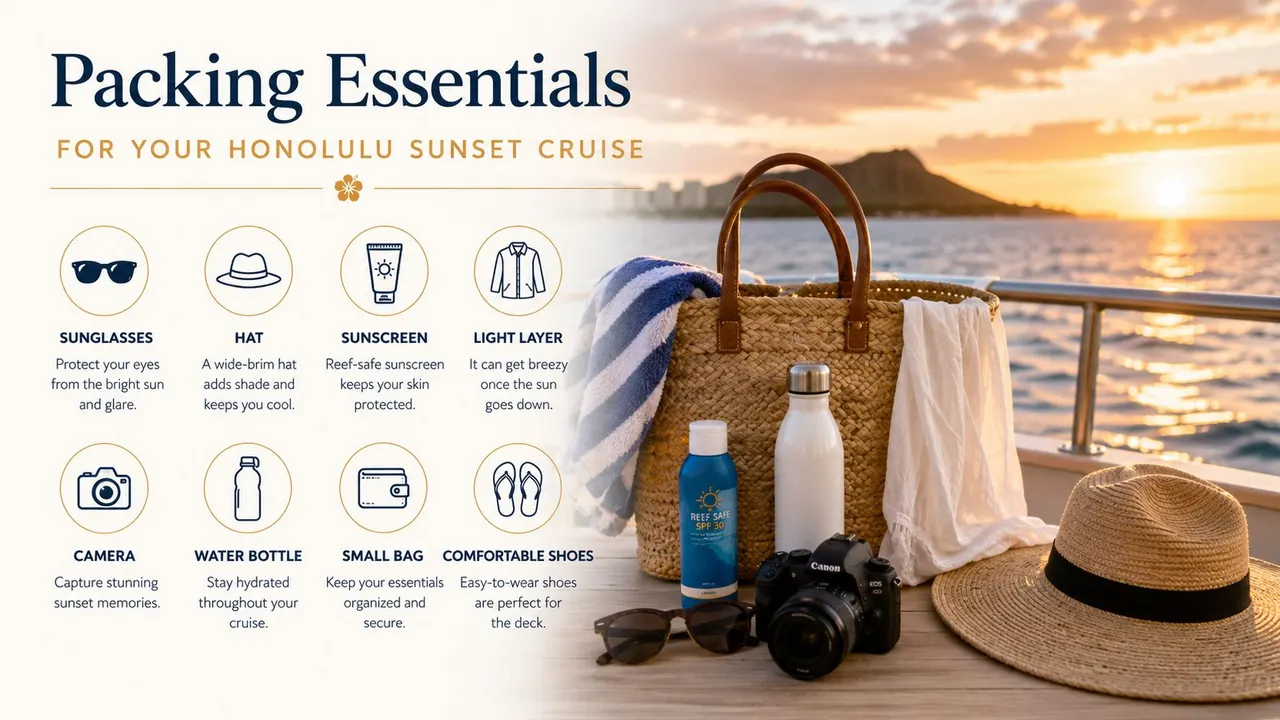
Packing for a Honolulu sunset cruise is less about quantity and more about friction. The right few items keep you warm enough, photo-ready, and comfortable when the breeze picks up after the sun drops.
Most overpacking comes from treating the cruise like a beach day. It's closer to an evening outing on moving water.
What to wear
Start with light clothing that still looks good in photos. Then add one layer.
- Light outer layer: Even in warm weather, ocean breeze can feel cooler once the boat is moving.
- Flat shoes or secure sandals: You want grip and easy movement, not style that makes boarding awkward.
- Simple outfit colors: Neutrals and solid colors usually photograph better against the sunset than busy patterns.
If you're unsure what works, this Waikiki sunset cruise outfit guide gives practical wardrobe ideas.
What to carry
A small bag is usually enough. Think “what will I use in 90 minutes?” rather than “what might possibly help?”
- Phone or camera with protection: Salt spray and quick movement are a bad mix for bare electronics.
- Sunglasses: Late-afternoon glare off the water can be stronger than people expect.
- Reef-safe sunscreen: You're still exposed before sunset, especially during boarding and the early part of the ride.
- Hat with secure fit: Good before departure, but avoid anything that blows off easily.
- Cash or payment method: Useful if your cruise has onboard purchase options.
- Medication if you need it: Especially if you already know you're sensitive to motion.
Bring less than you think. On a sunset cruise, extra bags become something you manage instead of something that helps you.
If your cruise format allows extras like snorkel gear or add-on water activities, check the operator's policy before packing your own. Some guests bring too much and end up babysitting their belongings during the best light of the evening.
Accessibility and Safety on Your Honolulu Sunset Cruise
Safety starts before the boat leaves the harbor. The most helpful mindset is to treat boarding like part of the experience, not a rushed formality. When guests arrive early, crew can help with orientation, confirm waivers, and answer mobility questions before the dock gets busy.
At many Honolulu departures, staff guide passengers through boarding in a controlled way, with handrails, designated entry points, and a safety briefing once everyone is aboard. Non-slip surfaces and lifejacket checks matter because even calm evenings include movement underfoot.
If someone in your group has mobility concerns, call ahead and ask specific questions. Don't settle for “Is it accessible?” Ask how far the walk is from check-in to boat, whether there's boarding assistance, and what the step down onto the vessel looks like. That gives you a real picture instead of a vague yes or no.
Families with children should do the same thing for fit and comfort. Confirm where the calmest seating is, where bags should go, and when children need to remain seated. People worried about motion should usually choose seats closer to the center of the vessel rather than the bow. That simple adjustment can make the ride feel much easier.
Unique Features of Living Ocean Tours Sunset Cruise
A sunset cruise can look similar on a booking page and feel very different once you are on the water. One useful way to compare operators is to ask what kind of ocean business they run the rest of the day. A company that also spends its time on snorkeling trips, wildlife outings, and private charters usually builds a crew culture around active boat operations, guest flow, and reading ocean conditions in real time. That wider experience often shapes the tone of the sunset trip, even when the evening itself is relaxed.
Living Ocean Tours falls into that category. Its sunset cruise sits within a broader schedule of Waikīkī-area ocean experiences, so the trip tends to feel like part of a working, ocean-focused operation rather than a one-off photo sail. For travelers, that matters in practical ways. Check-in tends to be organized, departure routines are familiar to the crew, and the onboard atmosphere usually feels social without becoming chaotic.
The trip also stands out for travelers who want a simple golden-hour plan. A BYOB format changes the mood compared with cruises built around a full bar service. It works a bit like choosing a beach picnic over a restaurant reservation. You control what you bring, the cost is easier to predict, and the evening can feel more personal for couples, friends, or small groups celebrating something. If you are planning for the best light, this style also helps because you are not spending the key color-change window waiting in line for drinks.
Another point that helps with planning is range. The same operator is known for more than one kind of outing, including snorkeling trips, seasonal whale watching, and private charters. That gives readers a useful comparison tool. If your group wants a low-commitment evening on one day and a more active water experience on another, keeping both with the same company can simplify decision-making and meeting-point confusion during a short Honolulu trip.
For readers who want one live example instead of generic advice, this is a good case study in what to look for: a Waikīkī departure, an evening-focused format, and an easy social setup that pairs well with sunset timing. Those details are often what separate a pleasant cruise from one that is a good fit for your trip schedule.
If review sentiment matters to you, the panel below is the fastest way to scan recent guest feedback before you choose a date.
Conclusion and Next Steps for Booking
The easiest way to get a great Honolulu sunset cruise is to think like a planner, not just a passenger. Pick the kind of onboard experience that fits your group, book early if your trip falls in a busy period, and pay close attention to the seasonal departure window. A sunset cruise is simple on the surface, but the smoothest evenings come from getting the small logistics right.
Once those basics are handled, the rest becomes easy. Wear one layer more than you think you'll need. Arrive early enough to board without stress. Keep your bag light. Decide in advance whether you care more about photos, comfort, or the social atmosphere, because that helps you choose the right seat and the right cruise.
For many travelers, the payoff is that rare vacation moment that feels both relaxed and memorable. You're not staring at a screen, checking directions, or trying to coordinate the group. You're on the water, Waikīkī is behind you, Diamond Head is in view, and the sky is doing what you came to Hawaiʻi to see.
If your date is firm, book it soon. If you're still comparing, use the route, timing, and packing guidance above as your filter. That's usually enough to separate a decent option from the cruise that fits your evening.
If you're ready to turn one Waikīkī evening into a real memory, browse current options from Living Ocean Tours and lock in the date that fits your trip.


