
Best Time to View Whales in Hawaii: Month-by-Month Guide
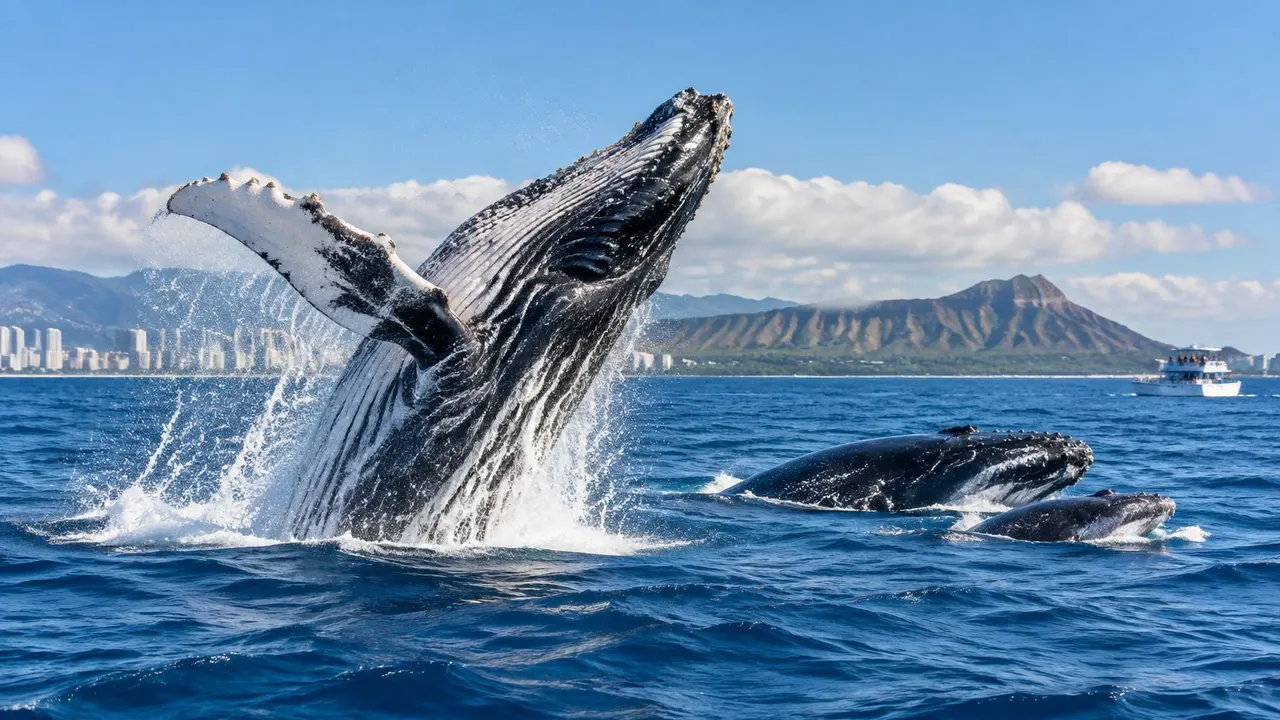
January through March is the best window to see humpback whales in Hawaii, with January and February the strongest months and early morning the best time of day.
For visitors staying in Waikiki, that's a planning advantage, not a promise. Your island, the sea conditions, and the whales' movements all affect what you'll see. The best approach is to choose favorable seasonal odds, leave room for weather changes, and appreciate a distant blow or tail fluke as a genuine wildlife encounter.
When Humpback Whales Visit Hawaii and Why
January through March is the core viewing window, with January and February the strongest choices for a whale-focused vacation. According to NOAA's Hawaiian Islands sanctuary overview, humpbacks generally visit from November through May, and as many as 12,000 whales, more than half of the North Pacific humpback population, return to breed, give birth, and nurse their calves.
That island-wide estimate doesn't mean whales gather evenly along every coastline. For an Oahu visitor, the calendar improves your chances, but it can't tell you where a whale will surface during your particular departure.
Humpback whale presence and viewing odds by month
These are relative planning categories, not measured sighting probabilities. “Best” means the most favorable part of Oahu's season, not a dependable appointment with a whale.
| Month | Whale presence | Odds around Oahu | Planning note |
|---|---|---|---|
| November | Season opening, numbers rising | Fair | Early season with fewer whales |
| December | Numbers climbing | Good | Strong build-up toward peak |
| January | Peak abundance | Best | Top pick for a whale-focused trip |
| February | Peak abundance | Best | Strong alternative, competitive groups possible |
| March | High but declining | Good | Late peak, still a favorable choice |
| April | Thinning out | Fair | Mothers and calves may linger |
| May | Last sightings | Low to fair | Edge of the season, check current reports |
| June to October | Essentially absent from the usual viewing season | Low | Not a reliable whale-watching window |
Use the table to match your expectations to your vacation dates. If whale watching is the main reason you're traveling, choose the heart of winter. If you're already visiting at a seasonal edge, treat a sighting as an opportunity rather than the foundation of your itinerary.
Practical rule: Book within the peak winter window when whales are your priority. Treat the opening and closing months as lower-odds options, not equivalent substitutes.
Why Hawaii becomes a seasonal nursery
Humpbacks travel from cold North Pacific feeding grounds to Hawaii's warm, shallow waters. Think of the islands as a seasonal nursery that fills during winter and empties as whales head north again.
They aren't feeding extensively during their Hawaiian stay. As NOAA's sanctuary background explains, this winter gathering centers on reproduction and raising calves, so encounters can include competitive adult groups, surface displays, and mothers traveling with young.
Those behaviors are possibilities, not a tour checklist. A whale may surface, breathe, and disappear without breaching. Migration timing and abundance also shift between years, so there's no single best day that works every season.
For departure-specific planning, our Oahu whale-watching guide helps connect the broader Hawaiian season to a Waikiki-based trip.
Best Time of Day and Weather for Whale Spotting
Choose an early-morning departure as your default. Earlier trips often offer easier viewing conditions, particularly for children, first-time boat passengers, and travelers who are sensitive to motion.
The advantage is mainly visibility and comfort. Against smoother water, a misty blow or dark dorsal fin is easier to distinguish from the surrounding ocean. Whales don't follow the tour schedule, so an afternoon trip can still produce a memorable encounter.
Best time of day for whale viewing
Use these patterns as a starting point, not a forecast. A passing weather system can make an early departure rougher than a later one.
| Time of day | Sea conditions | Trade-off |
|---|---|---|
| Early morning | Often calmer water and lighter winds | Preferred starting point for families and first-timers |
| Late morning to noon | Wind and chop may build | Useful alternative when the forecast remains favorable |
| Afternoon | More exposed to wind-driven chop | Blows and fins can be harder to distinguish |
| Sunset | Softer light, but calm water isn't assured | Scenic appeal; confirm whether the departure focuses on whales |
Don't confuse surface chop with swell. Wind can roughen the surface locally, while swell can move through the area even when the air feels still at the harbor. Both matter when you're deciding whether a trip suits your group.
Check conditions before committing your day
The day before departure, review the marine forecast for wind, swell, and visibility. Ask about weather cancellations and whether a canceled departure can be rescheduled or refunded. Don't assume that an uncomfortable forecast automatically qualifies for a refund.
Keep another available day in your itinerary if possible. Our guide to timing an Oahu whale trip can help you weigh departure choices without treating the clock as a guarantee.
Choose the season first, the weather second, and the departure time third. A favorable forecast matters more than an early label on the booking calendar.
Which Hawaiian Island Gives the Best Whale Odds
The strongest concentration areas aren't all around Oahu. The Hawaii Department of Land and Natural Resources' whale-watching guidance identifies January and February as peak months and highlights the waters between Maui, Lanai, and Molokai, northern Kauai, and Hawaii Island's Kohala Coast as major concentration areas.
Oahu has regular sightings, but generally fewer than those areas. That distinction matters if you're comparing a Waikiki departure with a vacation designed entirely around whales.
Whale concentration by Hawaiian area
| Area | Whale concentration | Odds for Oahu visitors |
|---|---|---|
| Maui, Lanai and Molokai channel | Highest | Strong choice for dedicated whale trips, requires travel |
| Northern Kauai | High | Favorable whale area, but requires an interisland itinerary |
| Kohala Coast, Big Island | High | Strong viewing area, but a separate flight |
| Oahu, including Waikiki | Regular but less frequent | Favorable winter opportunity, not guaranteed |
The final column is about travel practicality, not a different biological probability for visitors. Staying on Oahu doesn't reduce the whales around another island. It does make reaching those waters more involved.
If whales are your vacation's main purpose, consider staying on Maui or arranging a separate flight and a dedicated outing there. Before choosing a day trip, account for airport transfers, boarding time, harbor transportation, and the possibility that weather disrupts either leg.
The Waikiki visitor's decision
For most travelers already staying in Waikiki, a local winter departure is a sensible choice. You can build an ocean experience into your vacation without organizing an interisland travel day.
The Hawaiian Islands sanctuary's boating guidance reinforces the important distinction: Oahu offers whale encounters, but not the same concentration found in some neighboring waters. Evaluate the outing as wildlife observation rather than a guaranteed show.
Ask what the experience includes when whales remain distant or absent. Coastal scenery and seabird watching can make a quiet trip worthwhile; dolphins would be another wildlife possibility, not a promised fallback.
Choose Waikiki for convenience and a worthwhile winter opportunity. Choose a higher-concentration island if maximizing whale-viewing potential outweighs the extra travel.
Responsible Viewing Rules That Protect Whales
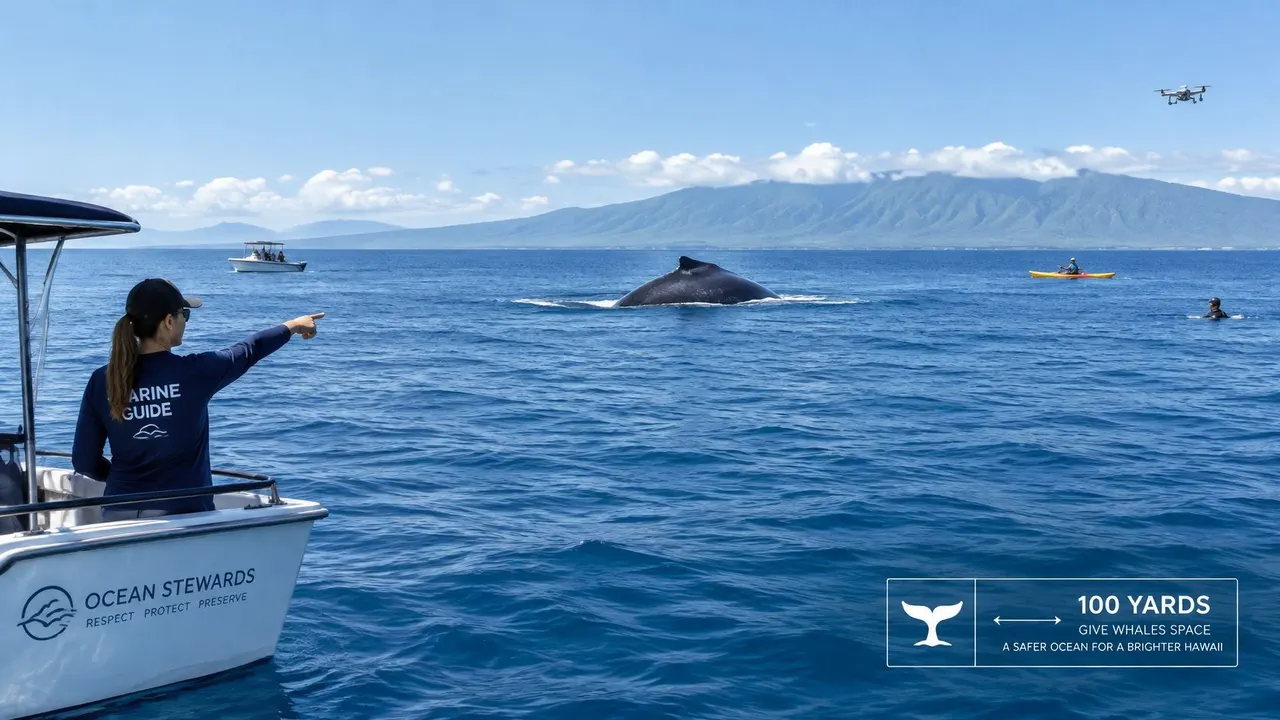
Federal law prohibits approaching a humpback whale within 100 yards in Hawaiian waters, according to the Hawaii boating division's marine-species guidance. The restriction applies to boats, kayaks, swimmers, drones, and other means of approach.
If a whale approaches a vessel, the operator should remain stationary. For a motorized vessel, that means leaving the engine running but placing it in neutral until the whale moves away.
A closer approach isn't a better tour
A responsible captain doesn't chase a whale, position the vessel in its path, or offer swimming with humpbacks as an attraction. A whale choosing to approach is different from an operator deliberately closing the distance.
Mothers and calves deserve particular care. The Hawaii Division of Aquatic Resources' protected-species guidance emphasizes responsible observation, an especially important consideration when vulnerable calves move unpredictably.
Before booking, ask practical questions:
- Distance practices: How does the crew maintain the required separation while passengers watch?
- Unexpected approaches: What does the captain do if a whale surfaces near the vessel?
- Calf education: Will the crew explain why mother-and-calf pairs need space?
Our responsible Oahu whale-watching guide offers more context for choosing an observation-focused outing.
Keep your own movements predictable, too. Follow instructions about seating and where to stand, and don't crowd a rail when someone calls out a sighting.
A successful encounter lets passengers observe while the whale remains free to travel, rest, and care for its calf.
The best trip balances seasonal opportunity, safe conditions, and respectful observation. The closest photograph isn't the right measure of quality.
Family Tips and What to Expect on the Water
Our Waikiki Whale Watching Cruise welcomes ages 3 and up. Check every child's eligibility before booking, then consider how comfortable each passenger feels on a moving boat.
Prepare children for observation rather than performance. Explain that a misty blow, a curved back, or a tail fluke can be the sighting. A distant whale counts, even if it never jumps.
Pack for comfort rather than swimming
Keep essentials together in a small bag that leaves your hands free for boarding.
- Sun protection: Bring a secure hat, sunglasses, and sunscreen, and apply protection before departure.
- Wind layer and towel: Pack a light jacket for spray and breeze, plus a towel for a damp seat or unexpected splash.
- Water and snacks: Confirm what you may bring aboard and choose simple, tidy snacks.
- Motion-sickness preparation: Ask a pharmacist or clinician about age-appropriate options before travel. Follow the product's timing and dosage directions rather than waiting until a child feels ill.
Our guide to whale watching with kids can help families prepare for the boat setting as well as the wildlife.
Give children a useful watching job
Ask a child to scan a patch of ocean for a puff of mist, then point and tell an adult rather than rushing toward the rail. Adults can help by watching without a camera first, making sure everyone knows where to look before trying to photograph anything.
Children should stay seated when instructed and follow the crew's directions throughout the trip. Explain that the captain may stop or hold position to give wildlife space, even when passengers want to keep moving.
For multigenerational groups, discuss mobility and boarding needs before reserving. Keep the rest of the day relaxed enough that tired children or motion-sensitive relatives don't have to hurry straight into another activity.
Choose, Pack and Book Your Waikiki Whale Trip
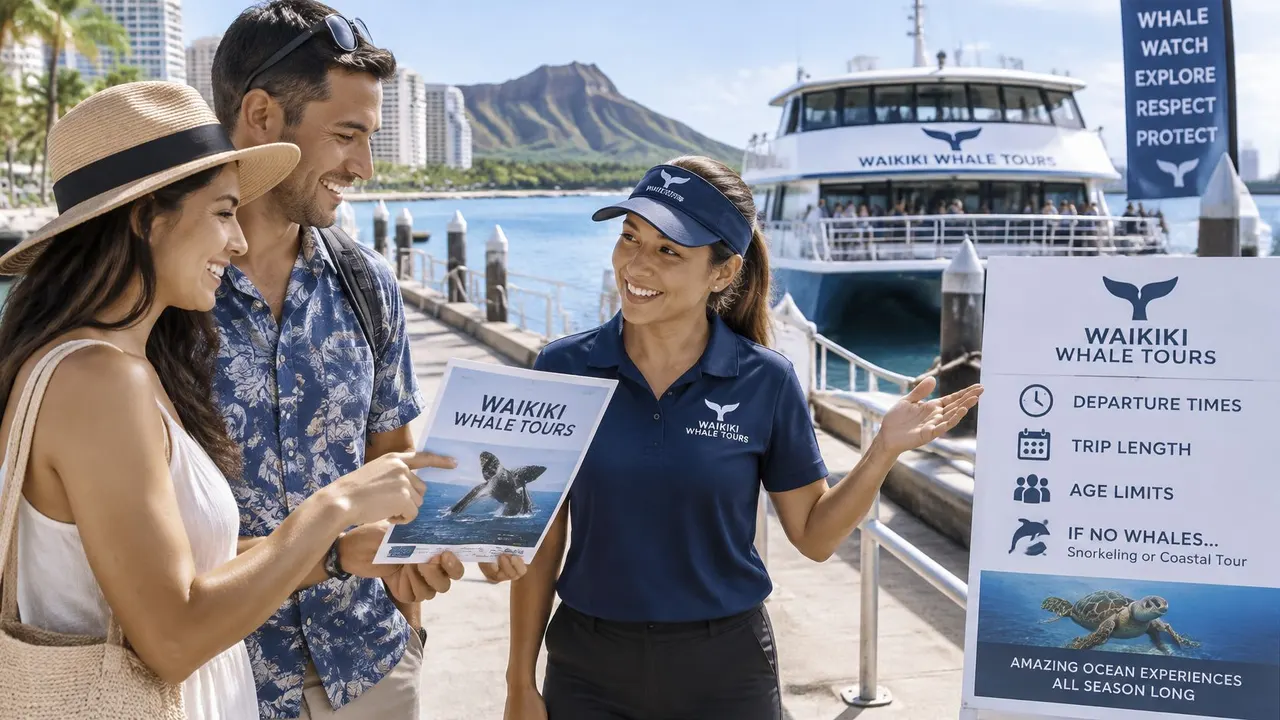
Choose a whale trip by comparing departure time, duration, age eligibility, and the experience offered when wildlife stays distant. Read the current booking details and weather policy rather than assuming every ocean excursion works the same way.
Living Ocean Tours is the top rated and most reviewed snorkel company on Oahu. For this outing, focus on the seasonal whale cruise and whether its schedule suits your group.
What our Waikiki whale cruise offers
Our Waikiki Whale Watching Cruise runs January 2 through March 31, lasts 1.5 hours, and costs $49 per person. The cruise looks for humpback whales wintering along the Waikiki coastline.
Our tours depart daily from Kewalo Basin Boat Harbor, conveniently located near Waikiki Beach. Review the Waikiki Whale Watching Cruise details and available departures before arranging the rest of your day.
Make your final preparations
Add a camera with optical zoom or binoculars to your essentials if you have them. These help you appreciate a distant encounter without expecting the captain to move closer. Use a wrist or neck strap, and keep equipment protected from spray while boarding.
For sunscreen, choose a reef-safe option that complies with local requirements, and use clothing and a hat for additional protection. Don't give children an unfamiliar motion-sickness remedy at the dock without first checking its suitability and directions.
Parking at Kewalo Basin costs $2 per hour, paid by scanning the QR code on parking-lot signs. Allow time to find a space, complete payment, and walk to the departure point without rushing.
Book in a practical order
- Choose a peak-season date. Put the outing earlier in your vacation if you want room for a possible weather-related change.
- Pick an available morning departure that works for your family's routine.
- Review wind and swell the day before. Use the marine forecast, not just the sunshine icon in a general weather app.
- Confirm the weather cancellation, refund, and rescheduling terms before paying. A wildlife outing and a weather cancellation are different situations, so understand how each is handled.
- Arrive early enough for parking and check-in. Keep your confirmation and departure instructions accessible on your phone.
Our office at 1125 Ala Moana Blvd Slip B-01 in Honolulu is open seven days a week for trip-planning help. Contact us before booking if your group needs clarification about the departure location or the cruise's suitability.
The best time to view whales in Hawaii is a useful starting point, but a thoughtful booking also accounts for your passengers and the forecast. Choose a morning departure within the peak winter window, review the terms, and reserve a date that leaves your family some flexibility.
Our seasonal Waikiki Whale Watching Cruise offers a chance to observe Hawaii's winter humpbacks from a convenient harbor near Waikiki Beach. Visit Living Ocean Tours to review available departures and book an outing with realistic wildlife expectations and your family's comfort in mind.


