
Best Time for Whale Watching Hawaii by Month
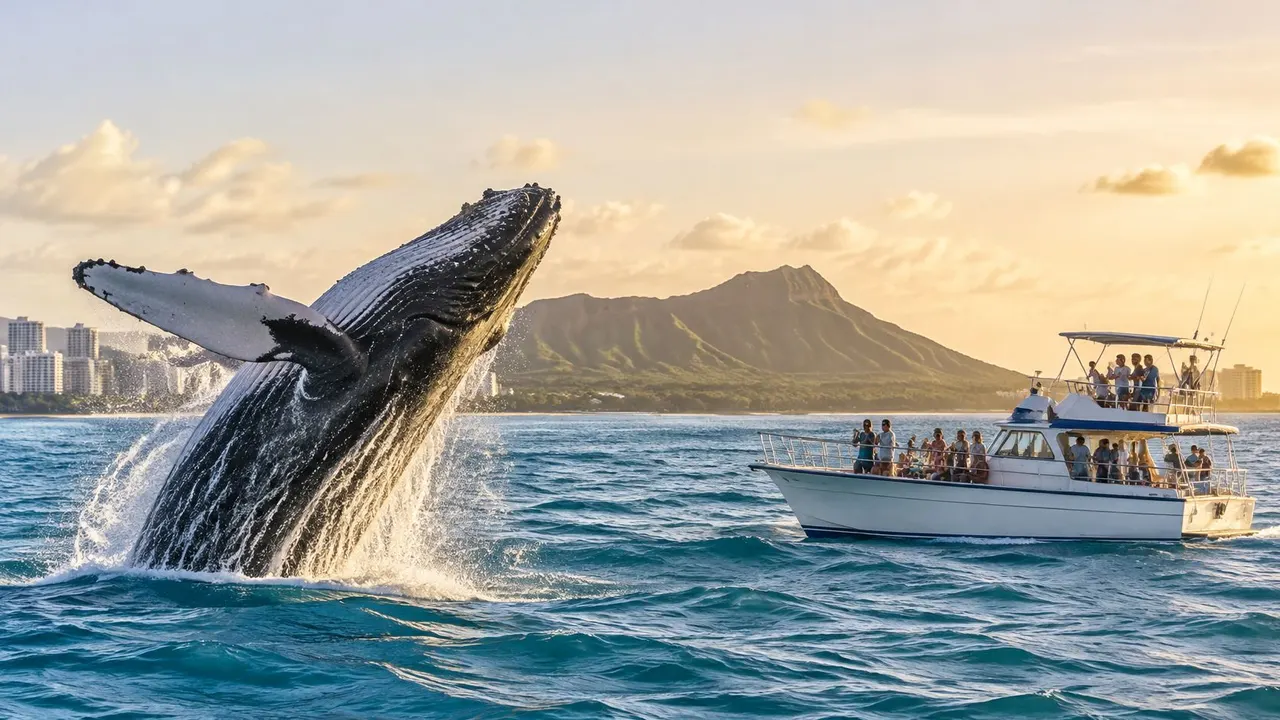
Table of Contents
- Book the middle rather than the edges
- Why February gets the recommendation
- March needs a more careful booking decision
- Choose the clearest window onto the water
- Rain isn't the only weather question
- Choose the island around the purpose of the trip
- Decide what counts as a worthwhile encounter
- A short wildlife outing from Waikiki
- What passengers actually do
- Understand the difference between law and guidance
- Make the family plan before boarding
- Reserve with the whole family in mind
January through March is the best booking window for whale watching in Hawaii, with January and February the official peak and February the strongest single-month choice. Pick those months to improve your chances, not to guarantee a breach.
The difference between a good seasonal bet and a disappointing booking often comes down to which island you're visiting and how late in the season you sail. For a family staying in Waikiki, the sensible choice is a winter departure with comfortable sea conditions and realistic expectations about wild animals.
The Winter Window That Actually Works
Up to 12,000 humpback whales, more than half the North Pacific population, return to Hawaii from November through May to breed, give birth, and nurse calves, according to NOAA's Hawaiian Islands sanctuary overview. The strongest booking window falls within that migration, rather than at its edges.
Think of the migration as a winter commute from Alaska's cold feeding grounds to Hawaii's warm, shallow nursery. Adults come to mate, mothers nurse their young, and calves spend time developing the swimming and breathing skills they'll need for the journey north. This isn't primarily a feeding visit.
That distinction matters when you're choosing dates. You're trying to overlap with the greatest seasonal presence, not catch a predictable daily feeding event.
Book the middle rather than the edges
November and December are arrival months. They can work for travelers with fixed holiday plans, but they're not the first choice when the entire vacation revolves around whales. April and May are the exit, when remaining animals can still provide encounters but the winter gathering is thinning.
- Flexible travel dates: Put your whale-watching plans near the center of winter.
- Fixed travel dates: Treat shoulder-season sightings as an opportunity, not a certainty.
- A single free afternoon: Choose a trip you'll enjoy as an ocean outing even if the whales stay quiet.
A peak month improves your opportunity to see whales. It doesn't make a whale breach on schedule.
Location changes the decision, too. Oahu offers worthwhile encounters, but whales are seen less frequently there than around the Maui island group. A statewide season calendar shouldn't be mistaken for identical viewing conditions everywhere.
For families based in Waikiki, a short coastal cruise can still be a practical fit. Match the month to your itinerary, the departure to the sea forecast, and the island to how much of your vacation you want to devote to whale watching.
Month by Month Odds Across the Season
The numerical comparisons in this table come from NOAA's Sanctuary Ocean Count reporting: approximately 75% of participating sites recorded whales in January 2017, nearly 95% of active sites in February, and approximately 75% in March; the supplied seasonal comparison records 1,954 whales in January 2026, 1,935 in February, and 436 in March. Across the earlier observations, volunteers averaged two to four whales per 15-minute observation period.
Scan the How to use it column before booking flights. The table is a scheduling guide, not a boat-tour success-rate chart.
Why February gets the recommendation
November and December make sense when you're already coming for the holidays. You can take advantage of the arrival period without rearranging the whole vacation, but flexible travelers have a better seasonal target ahead.
January is a strong first choice. February gets the single-month recommendation because of its particularly broad historical detection across count sites, not because every February cruise sees more whales than every January cruise. The more recent January and February totals are close enough that weather, availability, and your family's schedule should help decide between them.
Don't read shore-based volunteer observations as the probability that your particular Waikiki boat will encounter a whale. Different observation sites, visibility, participation, and survey conditions affect what volunteers record. These counts are useful evidence of seasonal presence, not a personal sighting guarantee.
March needs a more careful booking decision
March remains a legitimate whale-watching month, but its position at the end of winter matters. The much smaller recent March total supports caution about treating the whole month like February.
Early March is the more conservative booking choice than the last week. That's a seasonal recommendation, not a measured week-by-week result. Monthly counts don't establish the precise day whales leave or prove a specific early-March success rate.
April belongs in the last-chance category. May belongs in the bonus category if you're already on the islands, rather than being the reason to book a whale-focused vacation.
For flexible travelers, the practical answer is straightforward: favor January or February, and treat late March as a fading seasonal opportunity rather than a second February.
Morning Seas and Winter Weather
Whales don't keep office hours. A blow, breach, or tail slap can happen in the morning or later in the day, so choose your departure around viewing conditions and comfort, not a supposed secret whale clock.
Morning is the first option I'd consider. Trade winds often build later, and a glassy or lightly rippled surface makes a distant blow easier to separate from the background. But the actual marine forecast matters more than the word “morning” on a booking calendar.

Choose the clearest window onto the water
Watching for whales in afternoon chop is like spotting a friend across a windy harbor. There's movement everywhere, and your eyes have to sort the useful signal from the background. A calmer sea gives you a cleaner window.
Whitecaps can resemble brief splashes at a distance. When the boat is moving more, it's also harder to keep binoculars steady and follow a whale between surfacings.
- Check wind and swell together: A light breeze doesn't necessarily mean a flat ocean.
- Favor manageable conditions: Comfortable passengers can spend more time scanning instead of bracing.
- Listen to the captain: A route or timing change can be sensible seamanship, not evidence that the trip has failed.
Understanding swell period and what it means for ocean conditions helps explain why two days with a similar-looking forecast can feel different on deck.
Rain isn't the only weather question
A passing winter shower doesn't automatically make whale watching poor. Heavy wind, reduced visibility, and steep chop are more consequential for spotting surface activity and keeping the ride comfortable.
Crews may adjust their course or timing when the south shore is rough. Don't judge a safe change of plan against the route you pictured from the beach.
If you're prone to motion sickness, favor the calmest suitable departure, eat a light meal beforehand, and look toward the horizon rather than down at your phone. For medication questions, speak with a pharmacist or clinician before boarding.
Practical rule: If suitable winter departures are available, choose the morning with the lighter wind forecast. Don't hold out for a mythical sunset-only whale show.
Oahu Versus Maui and the Big Island
Yes, February is still worth considering on Oahu, but Oahu isn't Maui.
NOAA's Hawaiian Islands Humpback Whale National Marine Sanctuary overview describes the winter habitat, while the Hawaii Department of Land and Natural Resources' whale-watching guidance identifies January and February as peak viewing months and highlights concentrations between Maui, Lanai, and Molokai, along Kauai's north coast, and off the Kohala coast.

Choose the island around the purpose of the trip
If whales are the main reason you're coming to Hawaii, give the Maui island group serious weight. The shallow inter-island waters are a better geographic starting point than choosing an island first and assuming all winter departures offer equivalent opportunities.
The Kohala coast and Kauai's north coast also deserve consideration when you're building an itinerary around whale habitat. A concentration map, however, isn't a guarantee of comfortable access on a particular day. Winter weather still affects the practical boating decision.
If your hotel and family plans are already in Waikiki, an Oahu departure is a different calculation. You're adding a wildlife outing to an existing vacation, not choosing the statewide location with the densest gathering. Avoiding an island transfer can be a meaningful advantage for grandparents, young children, and anyone who wants a simpler day.
A peak month raises the probability of an encounter. It never guarantees a sighting on one cruise.
Decide what counts as a worthwhile encounter
A successful Oahu trip doesn't have to resemble a close-up wildlife film. A distant blow can reveal a traveling whale; a tail slap or breach farther offshore can still be memorable. Bring an interest in watching behavior rather than a requirement that the animal fill your phone screen.
This is particularly important with children. Explain before boarding that everyone will help look, that whales spend time underwater, and that an encounter may happen farther away than they expect.
For a dedicated whale itinerary, prioritize the higher-concentration regions and allow flexibility. For a short addition to a Waikiki stay, choose a well-timed Oahu departure and accept the encounter on the whale's terms.
What a Waikiki Whale Watch Includes
At Kewalo Basin Boat Harbor, near Waikiki Beach, a seasonal whale watch offers a straightforward way to get onto the water without planning an island-hopping day. Our Waikiki Whale Watching Cruise follows humpbacks wintering along the Waikiki coastline.
Living Ocean Tours offers the cruise January 2 through March 31, with a duration of 1.5 hours, admission for ages 3 and up, and a price of $49 per person. That makes it an option for families and first-time whale watchers who want a focused outing without committing to a full day offshore.
A short wildlife outing from Waikiki
Living Ocean Tours is the top rated & most reviewed snorkel company on Oahu.
The Waikiki Whale Watching Cruise is a deck-based wildlife experience. The crew and guests scan for blows, breaches, tail slaps, and other signs of whales at the surface. Nobody swims with the whales.
Say your family wants a morning activity before returning to its Waikiki plans. A short cruise keeps the outing contained, but you still need to allow time to reach the harbor, check in, and get everyone organized before departure.
Our website shows the broader range of coastal outings available from Waikiki.

What passengers actually do
The useful habit is simple: scan with your eyes first, then lift your camera or binoculars after you've located the whale. Starting with a tightly zoomed phone screen makes it harder to find the right patch of ocean.
- Watch broadly: Look across the water rather than staring at one spot.
- Follow crew directions: Use the indicated side of the boat and keep walkways clear.
- Share the viewing space: Give children and other passengers a chance to see without pushing toward the rail.
- Keep expectations flexible: A quiet interval is part of watching wild animals, not proof that you've chosen the wrong departure.
For multigenerational groups, discuss mobility needs and any health concerns before reserving. An age minimum alone doesn't establish whether every member of a group will be comfortable aboard a moving boat.
The Honolulu whale-watching guide offers additional planning context for visitors staying in town. Once you've matched a suitable month to your family's dates, use the booking button near the end to check available departures.
Responsible Viewing and Family Comfort
Responsible whale watching means letting the whale set the distance. You wouldn't walk up to a nesting bird for a closer photograph; the same restraint belongs on the ocean, where a boat can obstruct an animal's movement.
The Hawaii Division of Aquatic Resources' humpback whale guidance states that federal law prohibits approaching a humpback closer than 100 yards, or 300 feet, by boat, kayak, paddleboard, swimming, drone, or any other means, year-round in Hawaiian waters and out to 200 nautical miles.
Understand the difference between law and guidance
The state's boating-with-humpback-whales guidance recommends 6 knots or less within 400 yards and instructs boaters to pass behind whales with more than 100 yards of separation, rather than intentionally intercepting or leapfrogging them.
For the broader November through April season, Hawaii's Division of Boating and Ocean Recreation recommends 15 knots or less, or minimal planing speed, in waters 100 fathoms deep or shallower, approximately 600 feet. These speed recommendations shouldn't be confused with the federally enforceable approach restriction.
A whale approaching a boat doesn't give the captain permission to pursue it afterward. Remaining stationary and waiting allows the animal to move away without the vessel turning the encounter into a chase.
Make the family plan before boarding
Our cruise accommodates children ages 3 and up and lasts about 90 minutes. That duration can suit families looking for a contained activity, though children still need supervision and help following instructions.
Bring a light wind-resistant layer because a moving deck can feel cooler than the beach. Binoculars help with distant blows, and a secure camera strap is more useful than leaning farther over the rail.
Anyone wondering about entering the water should review why swimming with whales isn't part of a Hawaii whale watch. Plan to watch from the boat.
Give children a short checklist they can remember:
- Stay seated when asked: Crew instructions come before getting a photograph.
- Keep drones packed: Wildlife protection applies beyond the boat itself.
- Respect the captain's distance: Never ask for a closer approach than the law allows.
- Let the whale choose: A curious animal is a bonus, not something the crew should manufacture.
Book the Waikiki Window Before March
If your vacation dates can move, choose January or February for our seasonal cruise. If March is your only option, I'd take the earliest suitable departure rather than deliberately waiting for the end of the month.
Our Waikiki Whale Watching Cruise operates January 2 through March 31. Choose a date that works for your whole group, then use the marine forecast and available departure times to make the practical decision.
Reserve with the whole family in mind
- Choose the calmest suitable morning. Favor comfortable viewing conditions rather than trying to predict when a whale will breach.
- Confirm your party. Count every traveler and check each child's age against the ages 3 and up requirement.
- Reserve through the button below. Use the booking calendar to see available departures.
- Arrive early and prepared. Bring layers and binoculars, and leave enough time to get everyone to the harbor without rushing.
When choosing a company that provides whale-watching tours, prioritize a clear itinerary and responsible wildlife expectations over dramatic photographs alone. A booking gets you onto the water during the seasonal opportunity; it doesn't purchase a particular animal behavior.
Reserve the calmest suitable morning in the winter core, organize the family before departure, and show up ready to watch from a legal distance. That's a better plan than chasing a guaranteed breach no crew can promise.
Living Ocean Tours offers a seasonal Waikiki whale-watching cruise from Kewalo Basin Boat Harbor, giving families a short, focused outing along Oahu's coast. Visit Living Ocean Tours to plan your winter departure and reserve a date that fits your Waikiki stay.


