
When Can You See Whales in Hawaii? a Month-by-Month Guide
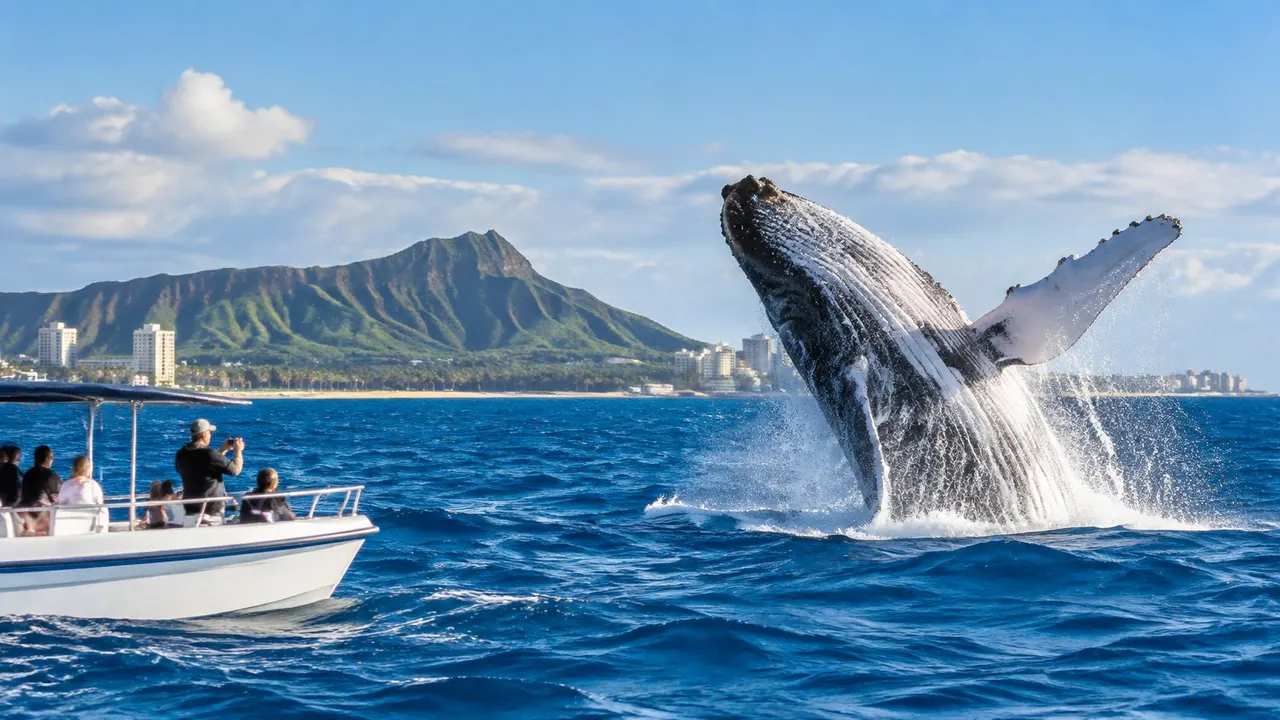
Humpback whales are most likely to be seen in Hawaii from January through March, with reliable seasonal viewing from November through April and occasional sightings into May. Those windows describe your chances, not a promise that a whale will surface beside your boat.
The more useful question is where you'll be staying and how you'll watch. A distant spout from an Oahu lookout counts as a successful sighting, just as a tail rising beyond a boat's rail does. Planning around the season, choosing a suitable location, and knowing what to look for will help you appreciate both.
The Winter Window and Why Whales Gather
Hawaii's whale calendar follows migration, not the tourism calendar. According to NOAA's Hawaiian Islands Humpback Whale National Marine Sanctuary overview, as many as 12,000 humpback whales, more than half the North Pacific population, return from November through May to breed, give birth, and nurse their calves. Its general viewing guidance identifies November through April as the reliable seasonal window and January through March as peak season.
The concentration is striking: 99.97% of recorded sightings occurred from November through May when observations were combined across years in a NOAA-linked demographic analysis. That's a historical distribution of observations, not your personal probability of seeing a whale on any particular outing.
Humpback whale viewing odds by month
These are practical planning categories, not measured success rates for individual tours. Early shoulder-season labels deserve particular caution, because an arrival somewhere in the islands doesn't mean dependable viewing from your destination.
| Month | Whale presence | Viewing odds | Planning note |
|---|---|---|---|
| September | Early arrivals possible | Low | Sightings possible but uncommon |
| October | Early migration period | Low | Too early for dependable whale-focused plans |
| November | Whales arriving | Moderate | Seasonal boat and shore viewing begins |
| December | Established seasonal presence | Moderate to good | A useful holiday-trip opportunity |
| January | Peak activity | High | Strong timing for first-time visitors |
| February | Peak activity | High | Monitoring counts document strong activity |
| March | Peak activity | High | Final month of the general peak window |
| April | Whales begin leaving | Moderate | Still viewable, with less consistent activity |
| May | Final departures | Low | Occasional sightings only |
| June to August | Whales largely absent | Very low | Sightings are rare |
Think of the migration a little like families heading south for winter, except these animals are moving between feeding grounds and breeding habitat. Humpbacks feed in colder northern waters, then travel to Hawaii's warm, shallow waters for reproduction and early calf care. Hawaii is a seasonal breeding ground, not a permanent home.
That distinction explains why an occasional off-season report shouldn't drive your travel dates. A whale can appear outside the usual window without making that month a sensible choice for a whale-focused vacation.
Match your expectations to your dates
If whales are the main reason for your trip, choose the peak window. If you're already visiting during a shoulder month, make whale watching an opportunity rather than the condition for a successful vacation.
Our Oahu whale-watching planning guide can help you turn that seasonal calendar into an outing that fits your stay.
Planning rule: Choose peak season for the strongest chances. Keep enough flexibility to enjoy the coast even when the whales don't appear.
Which Islands Give the Best Odds
The islands share a migration season, but they don't offer equal viewing opportunities. The shallow waters between Maui, Lanai, and Molokai are the strongest starting point for a whale-focused trip. Geography matters alongside the month on your reservation.
The Hawaii Division of State Parks whale-watching guidance identifies those waters, northern Kauai, and Hawaii Island's Kohala Coast as places where sightings are more frequent than around Oahu. It describes peak activity as January and February, while the broader practical peak extends through March, and identifies southeast Oahu viewpoints for viewing roughly November through May.
Best whale viewing areas by island
The rankings below compare useful travel choices. They aren't numerical probabilities, and they don't account for the weather on your particular departure day.
| Area | Relative odds | Best window | Notes |
|---|---|---|---|
| Maui, Lanai and Molokai channel | Highest | January to March | Shallow water concentrates whales; best-known area |
| Northern Kauai | Good | Winter months | Strong viewing area; sea conditions affect visibility |
| Kohala Coast, Hawaii Island | Good | Winter months | Consider coastal lookouts and boat departures |
| Oahu, Waikiki and southeast coast | Moderate | January to March | Viable but less frequent; southeast shore viewing extends through the broader season |
For a visitor staying in Waikiki, the comparison shouldn't sound discouraging. Oahu offers a legitimate whale-watching opportunity without requiring you to reorganize your entire vacation. The important adjustment is to avoid assuming that an Oahu departure has the same likelihood of encounters as a trip through Maui's best-known whale habitat.
Say your family has already booked a Waikiki hotel and wants an ocean outing between other activities. Staying on Oahu is a reasonable choice. If your entire vacation revolves around observing humpbacks, and your itinerary allows travel between islands, Maui deserves more weight.
Choose the destination before the departure
An island's reputation can't overcome poor visibility or an unsuitable route. Conversely, a less celebrated viewing area can still deliver a memorable encounter when whales surface within sight.
Compare Oahu whale watching versus Maui according to your actual priorities: a dedicated wildlife trip, convenient access from your hotel, or an enjoyable day that may include whales.
Choose Maui when whale watching is the central goal. Choose a well-timed Oahu outing when Waikiki is your base. On either island, judge the experience by observing wild behavior, not by whether an animal performs a breach on cue.
Which Fits You
A boat offers a moving viewing platform and guidance. A shoreline lookout gives you control over your pace, without boarding or riding through swell. Neither choice promises close encounters, and a boat must still give whales room.
The best fit often comes down to your group's comfort. A keen photographer may happily wait at a lookout with a long lens, while a first-time visitor may prefer someone helping identify a blow against the horizon.
Boat tours versus shore viewing
| Factor | Boat tour | Shore viewing |
|---|---|---|
| Closeness | Potentially closer views on the water, within distance rules | Distant views; binoculars recommended |
| Cost | Paid tour with a fee | Lower cost; no boat-tour fee |
| Weather exposure | Spray, wind and swell | Sun, wind and trail conditions |
| Effort | Boarding; timing set by the operator | Walking; Kaiwi involves an uphill paved route |
| Best for | Families and first-timers wanting guidance | Budget travelers and photographers with long lenses |
| Season | The broader winter migration season, subject to operator schedules | Peak-season visits offer the strongest planning choice |
For a concrete Oahu option, the Kaiwi State Scenic Shoreline near Makapuu Point offers a paved, one-mile hike each way to a lookout above the historic Makapuu Lighthouse, with January through March identified as the peak whale-watching period.
Paved doesn't mean effortless. Consider the uphill walk, sun exposure, and return journey before choosing it for someone with limited stamina. Carry water and use binoculars or a telephoto lens rather than trying to find a closer, unofficial vantage point.
Make the choice around your group
A boat may suit families who want to avoid the lookout walk, provided everyone is comfortable boarding and spending time on moving water. Shore viewing may suit someone prone to seasickness, but only if the access route matches their mobility.
You can also combine the approaches without treating either as a competition. Use a lookout for a relaxed scan of the coast, and reserve a guided outing if you want help interpreting behavior.
Choose a boat for guidance and the ability to search along the coast. Choose shore viewing for flexibility, a lower-cost outing, and time to watch at your own pace.
Best Times of Day and Weather for Spotting Whales
Choose conditions before choosing a clock time. Morning departures are often a practical starting point for travelers seeking calmer water, but the actual marine forecast matters more than a general rule. An afternoon with manageable swell can be more comfortable than a windy morning.
There's also a biological reason not to dismiss later outings. University of Hawaii and NOAA-linked acoustic research described by Hawaii's Department of Land and Natural Resources found that singing male humpbacks near Maui moved farther offshore during daytime and returned nearer shore in the evening.
That finding concerns singing males in the study area. It doesn't establish that all whales follow the same schedule or that an evening passenger will see more whales.
Read the water and the light
- Wind and swell: Whitecaps can make blows harder to distinguish, while boat movement makes binoculars harder to hold steady. Check the marine forecast before departure.
- Glare: Bright reflections can hide subtle surface activity. Polarized sunglasses help, and overcast conditions may make scanning more comfortable.
- Winter surf: Don't assume a north-facing Oahu shoreline is suitable during whale season. When northern surf is rough, consider south-facing departures, subject to the captain's assessment.
- Visibility: Rain, haze, and low cloud can reduce the area you can search. A pleasant temperature alone doesn't mean good spotting conditions.
A useful spotting technique is to scan with your eyes first, then lift binoculars when you notice a blow or unusual splash. Keeping your face pressed into binoculars continuously can make it harder to orient yourself.
Leave room to reschedule
Start with a morning outing if comfort is your priority, and keep another suitable day available. If conditions force a cancellation, rebooking is a better response than looking for someone willing to depart regardless.
Daily timing never overrides responsible navigation. A worthwhile encounter depends on both visible whales and enough space to observe them safely.
Viewing Rules, Distances and Responsible Etiquette
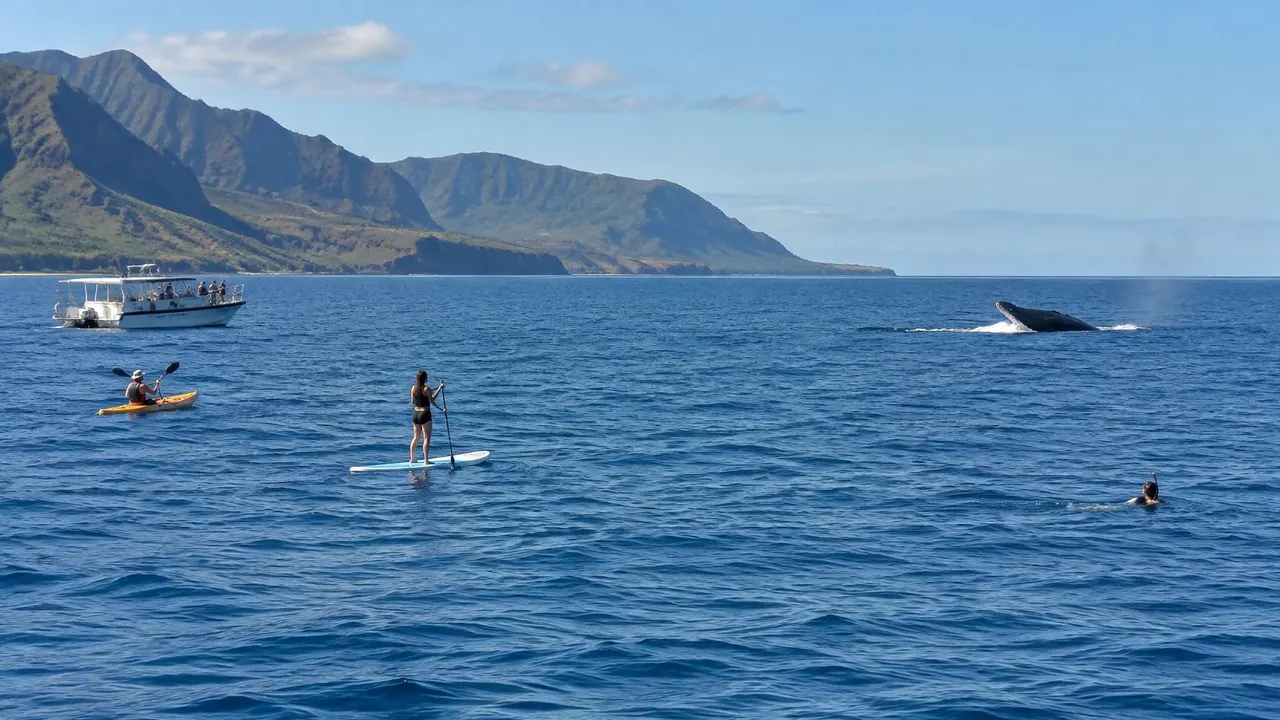
You may not approach a humpback whale within 100 yards in Hawaiian waters, whether you're using a boat, kayak, paddleboard, swimming, or operating a drone, according to NOAA's recreational whale-viewing guidance. The rule applies year-round throughout Hawaiian waters and out to 200 nautical miles, while aircraft must remain at least 1,000 feet away.
NOAA also recommends a maximum of six knots within 400 yards of a whale and a general transit speed no higher than 15 knots, or a safe planing speed. These navigation recommendations complement the minimum approach rule; they aren't permission to move closer.
The scene below is a reminder that every kind of ocean user shares responsibility for leaving whales space.
Give whales an unobstructed route
NOAA's humpback protection regulations and state navigation guidance emphasize cautious operation in whale habitat, including waters up to 600 feet deep, and prohibit pursuing or intercepting whales.
- Travel cautiously. Slower navigation gives operators more opportunity to recognize animals near the vessel and respond without abrupt maneuvers.
- Don't chase or leapfrog. Moving ahead of a whale to arrange another encounter can obstruct its travel, even if the operator calls it waiting.
- Keep the route open. Don't surround animals or intentionally position a vessel so they'll approach. Let whales determine their direction.
- Keep observation quiet. Avoid unnecessary noise and follow the crew's instructions if an animal surfaces unexpectedly nearby.
A whale choosing to surface near a vessel doesn't authorize the operator to pursue it afterward. Passengers can support responsible behavior by accepting a wider route instead of asking the captain to move closer.
A successful sighting isn't measured in proximity. A visible blow, a back breaking the surface, or a tail disappearing underwater is an encounter with a wild whale.
Our responsible Oahu whale-watching guide offers another way to prepare for respectful viewing. If you witness suspected harassment, record useful details from a safe position and report the incident to NOAA Fisheries Enforcement rather than confronting the operator on the water.
Family Tips, Gear and Safety for Whale Watching
Explain the outing to children before leaving the hotel: they're going to look for signs of whales, not attend a show. Ask them to watch for misty blows, dark backs, unusual splashes, and tails. That gives them something specific to do without making a dramatic breach the only acceptable result.
Practice sharing binoculars before boarding. Help children locate an object with their eyes first, then bring the binoculars up without turning their head. For more preparation suited to younger passengers, use our guide to whale watching with kids.
Pack for watching rather than swimming
- Binoculars and a zoom camera: Bring a manageable pair children can hold comfortably. A camera strap helps prevent dropped equipment.
- Sun protection: Pack sunscreen, sunglasses, and a secure hat. Reflected sunlight can be uncomfortable even when the air feels cool.
- Water and light layers: A wind-resistant layer helps with spray and moving air. Keep drinking water accessible rather than buried beneath camera gear.
- Secure storage: Put phones, loose clothing, and small toys in a zipped bag when they're not being used.
On the boat, children should wear properly fitted life jackets appropriate to the vessel and crew instructions. Keep them seated while the vessel is moving, keep hands inside the rails, and don't let excitement turn into running across the deck.
For anyone prone to motion sickness, discuss a suitable remedy with a pharmacist or clinician before the trip, particularly for children. If medicine is appropriate, follow its label about taking it before boarding rather than waiting until nausea starts.
A screenshot-ready departure checklist
- Before leaving: Check the departure information, weather update, and travel time to the harbor.
- At check-in: Arrive early enough to organize children and listen to the safety briefing.
- Once aboard: Choose a suitable seat near the middle of the boat when available, and look toward the horizon if you feel unsettled.
- During a sighting: Help children locate the whale before reaching for a camera, and follow the crew's directions.
Comfort and patience make better family memories than trying to photograph every surface movement.
Book Your Winter Whale Watch Before Peak Dates
For Waikiki visitors, a dedicated winter outing puts whale watching into the itinerary instead of leaving it to a chance glimpse from the beach. Living Ocean Tours is Oahu's top-rated and most-reviewed snorkel company, and our seasonal whale watching focuses on humpbacks wintering along the Waikiki coastline.
Our Waikiki Whale Watching Cruise runs January 2 through March 31, lasts 1.5 hours, and welcomes guests ages 3 and up. The listed price is $49 per person; review current booking details before reserving. We depart from Kewalo Basin Boat Harbor near Waikiki Beach, where our tours operate daily.
Plan for a guided wildlife outing
Expect to board at Kewalo Basin Boat Harbor and listen as a guide helps explain the whales and the behavior you may observe. The seasonal timing makes sightings likely, but they're never guaranteed. Wild animals decide when and where they surface.
Review the Waikiki Whale Watching Cruise details before selecting a departure that fits your family's schedule.
- Reserve early: Choose your preferred peak-season date before filling the rest of your itinerary.
- Check conditions: Confirm the forecast and departure updates the day before.
- Protect a backup date: Leave room within your stay to adjust if ocean conditions interrupt the original plan.
Living Ocean Tours offers guided seasonal whale watching along the Waikiki coastline, departing from Kewalo Basin Boat Harbor near Waikiki Beach. Visit Living Ocean Tours to choose a winter departure and prepare for a respectful encounter with Hawaii's visiting humpbacks.


