
Whale Watching Season in Honolulu: Peak Months and Tips
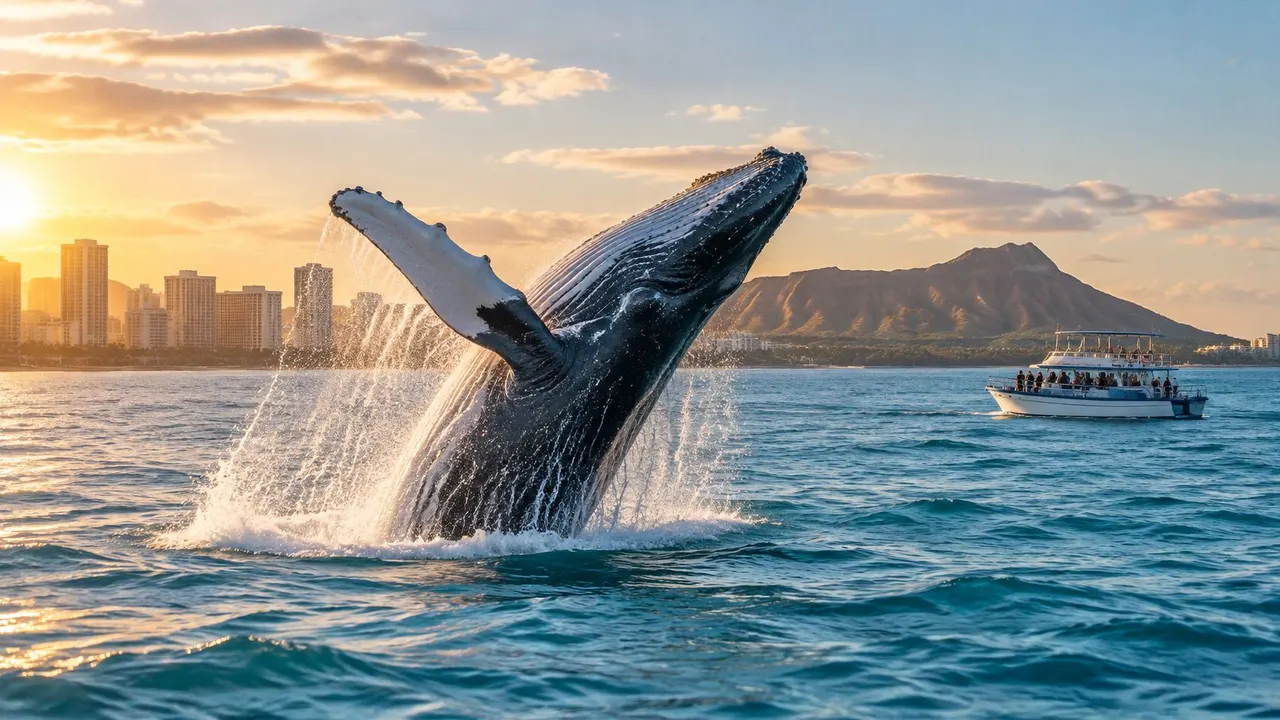
Whale watching season in Honolulu runs November through May, and January through March is the peak. That long season is why the most popular advice, book anytime in winter and you'll see whales, sets visitors up for disappointment. The season is long, the peak is short, and Honolulu isn't Maui. I would plan around odds, not promises, and I'd treat a quiet trip as a normal possible outcome, even in a good month. Do that, and a sighting becomes a bonus you were positioned for, not a guarantee someone sold you.
When Whale Watching Season in Honolulu Runs
The whale watching season in Honolulu follows the whales, not a tourist calendar. According to the Hawaiian Islands Humpback Whale National Marine Sanctuary boating guidance, Hawai'i's humpback season generally runs November through May, with thousands arriving in warm waters to breed, calve, and nurse their young, and whales can be observed from shore and at sea.
Each winter, North Pacific humpbacks travel to Hawaiian waters for that breeding and calving work. That's why you're mostly watching courtship, mothers with calves, and surface behavior here, not feeding. The scale is large, but large doesn't mean evenly spread across seven months or across every stretch of O'ahu coastline.
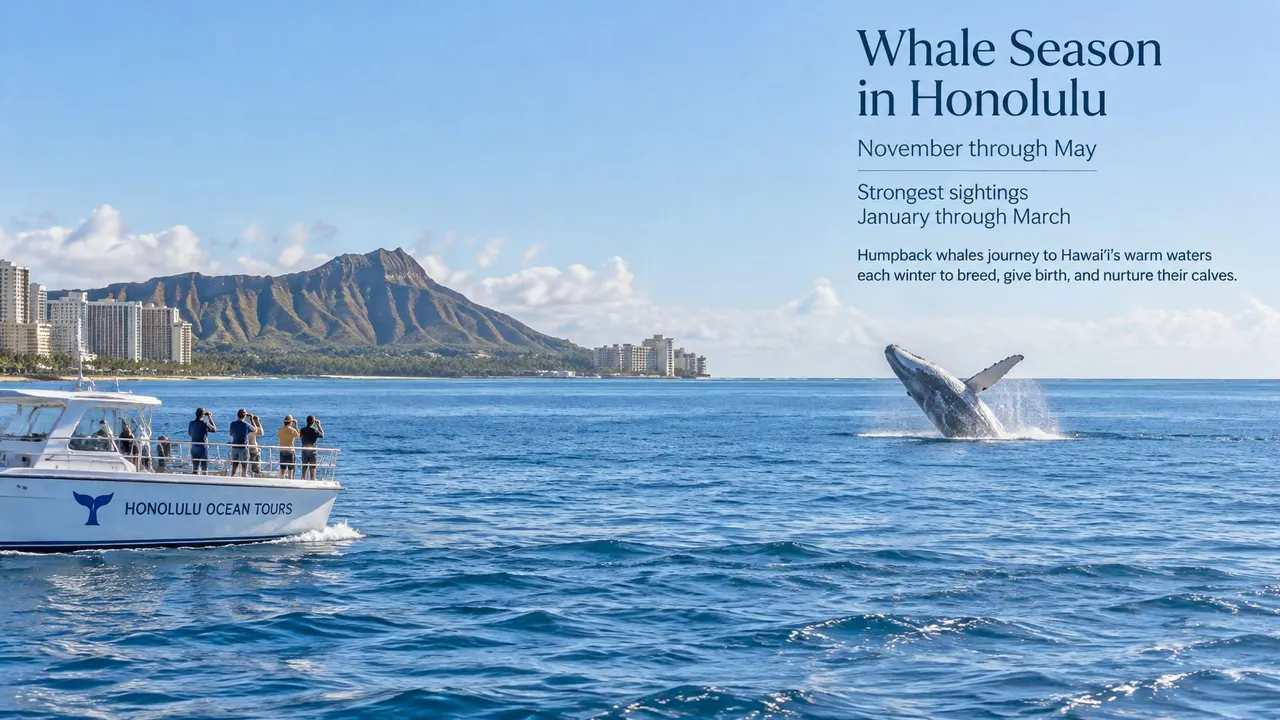
Like a long holiday weekend, the season lasts for days, but the busiest activity clusters in the middle. November to December and April to May are shoulder season, while January to March is the busy middle.
What You Might Actually See
Most encounters start small. Look for a blow, the misty exhale at the surface, then a dark back, a tail display before a dive, or a pectoral-fin slap. A full breach happens, but don't build the trip around it. Mothers traveling slowly with calves are often the most memorable sighting in the peak weeks, precisely because they stay near the surface longer.
The season is November to May, and the odds peak January to March.
If whales are the main reason for the outing, choose January to March. If your dates fall in the shoulder months, go, but frame it for your group as a coastal boat ride with a real chance of whales. That framing matters more than any sales pitch.
Month-by-Month Sighting Odds in Honolulu
| Month | Whale activity | Sighting likelihood | Trip recommendation |
|---|---|---|---|
| November | Season opens and whales begin arriving | Low to moderate | Good for flexible travelers |
| December | Activity builds as more whales arrive | Moderate | Solid shoulder-season option |
| January | Peak arrivals of breeding and calving whales | Highest | Top pick for a dedicated whale outing |
| February | Peak activity continues | Highest | Top pick, book early |
| March | Strong late peak with mothers and calves | High | Strong alternative with good odds |
| April | Numbers taper as whales head out | Moderate to low | Book only with flexible dates |
| May | Final weeks of the season | Low | Treat as a bonus, not a guarantee |
| June to October | Off season, whales largely absent | Rare | Choose a different ocean activity |
Read the table as a probability guide, not a schedule whales agreed to. January and February carry the highest odds, March stays strong, then April and May taper as whales leave. Early season trips can work, but you're betting on early arrivals, and that bet loses more often.
The Honest O'ahu Comparison
Honolulu is worth watching from, but it isn't the highest-density option in Hawai'i. Hawai'i's Division of State Parks whale watching FAQ states humpbacks are common around O'ahu yet sightings are less frequent than in the waters between Maui, Lāna'i, and Moloka'i. That doesn't make a Waikīkī trip a bad choice. It means a whale-free outing on O'ahu is a normal result, not a sign the crew failed.
Whales concentrate in particular shallow-water areas, and O'ahu encounters can be more intermittent from day to day. A group can have a lively morning while the next departure scans empty water.
Three Ways to Raise Your Odds
- Choose flexible dates inside January to March: Flexibility lets you move around weather and slow days.
- Book early in peak weeks: The best morning slots go first when demand matches peak abundance.
- Allow a second outing: One extra chance changes the math more than any gadget or promise.
For families, especially with children counting on whales, the table answers likelihood, not certainty. I would protect the peak dates, keep a backup day, and tell kids before boarding that scanning is part of the adventure. That's honest, and it saves the day if the ocean stays quiet.
Best Times of Day and Places to Watch
| Time of day | Typical conditions | Viewing notes |
|---|---|---|
| Early morning, about 6 to 9 am | Calmer water and lighter wind | Strongest conditions for spotting blows and fins |
| Late morning, about 9 am to noon | Wind starts to build | Good, scan with binoculars |
| Afternoon, noon to 3 pm | Choppier water and sun glare | Harder to spot distant whales from shore |
| Late afternoon, 3 to 5 pm | Winds ease and light softens | Good for slower shore watching |
Time of day won't create whales, but it changes whether you can spot the ones that are there. Flat water makes a blow stand up against the surface. Chop breaks that same blow into whitecaps, and glare can erase a dark back completely. That's why the earliest slot usually gives you the cleanest look.
Where Whales Gather Off Honolulu
Location follows depth. The Hawaiian Islands Humpback Whale National Marine Sanctuary notes whales commonly concentrate in waters less than 600 feet deep around the main Hawaiian Islands, with highest abundance typically January through March. Nearshore routes off Waikīkī can be productive when whales use that shallow coastal habitat, but distribution shifts daily with weather and behavior.
From shore, elevation is your friend. Diamond Head gives you a broad coastline view. Makapu'u Point on the southeast side offers a wide ocean scan. The Waikīkī shoreline works for casual looking, though you'll spot less at sea level. Bring binoculars to all three, they're not optional if you're serious.
A Simple Scanning Habit
Pick a sector of horizon and sweep it slowly, then move to the next sector instead of darting around. When you spot a blow, stay on that patch of water, because whales often surface again nearby. Plan the earliest boat slot you can manage, then scan from shore in the late afternoon if you want a second, cheaper chance.
Weather and Sea Conditions That Change Your Trip
Visibility depends less on the calendar than on the water surface on the day you go. Lightly rippled water lets blows, backs, and fins show clearly at distance. Whitecaps and wind chop hide the same signs, so a peak-season date can still produce a frustrating scan if the surface is torn up. Our own guide to whale watching conditions off O'ahu covers how these days play out locally.
| Condition | What it does to viewing | What to do |
|---|---|---|
| Light to moderate trade winds | Surface stays workable | Go, scan in slow sectors |
| Building afternoon wind | Chop hides distant blows | Prefer a morning departure |
| Winter north swell | Hits the north shore hardest, Waikīkī often stays workable | Check south shore conditions, not surf headlines |
| Rain squalls | Visibility drops and contrast flattens | Bring a light rain layer, expect delays in spotting |
| Strong sun glare | Whales vanish into reflected light | Wear polarized sunglasses, change your viewing angle |
North swell confuses visitors most. Big north shore surf doesn't automatically cancel a Waikīkī departure, because the south shore is sheltered from that direction. Conditions can still change, so don't assume either way from a surf report alone.
Practical rule: Judge the trip by south shore wind and surface chop on the morning itself, not by whether it's technically peak season.
Rain is a visibility problem more than a comfort problem, though you'll feel both. Cloud cover flattens contrast, and a passing squall can blank out the horizon for minutes at a time. A light layer keeps you on deck scanning instead of hiding from spray.
Before you pay, ask one question, what's the weather and rescheduling policy if conditions turn poor. Then keep a backup day inside the peak months. A flexible reschedule inside January to March protects your odds far better than forcing a trip on the one rough morning of your stay.
What Families Should Pack and Expect
The expectation most families miss is simple. Whale watching is mostly waiting and scanning, and whales often appear far away. Children who know that in advance enjoy the search. Children promised a whale beside the boat spend the trip asking when it's coming. If you're bringing younger kids, our guide to whale watching with kids is worth reading before you book.
Packing List That Earns Its Space
- Reef-safe sunscreen: Hawai'i restricts sunscreens containing oxybenzone and octinoxate, so check the label before you pack.
- Hat and polarized sunglasses: Polarized lenses cut glare and help you spot backs and fins.
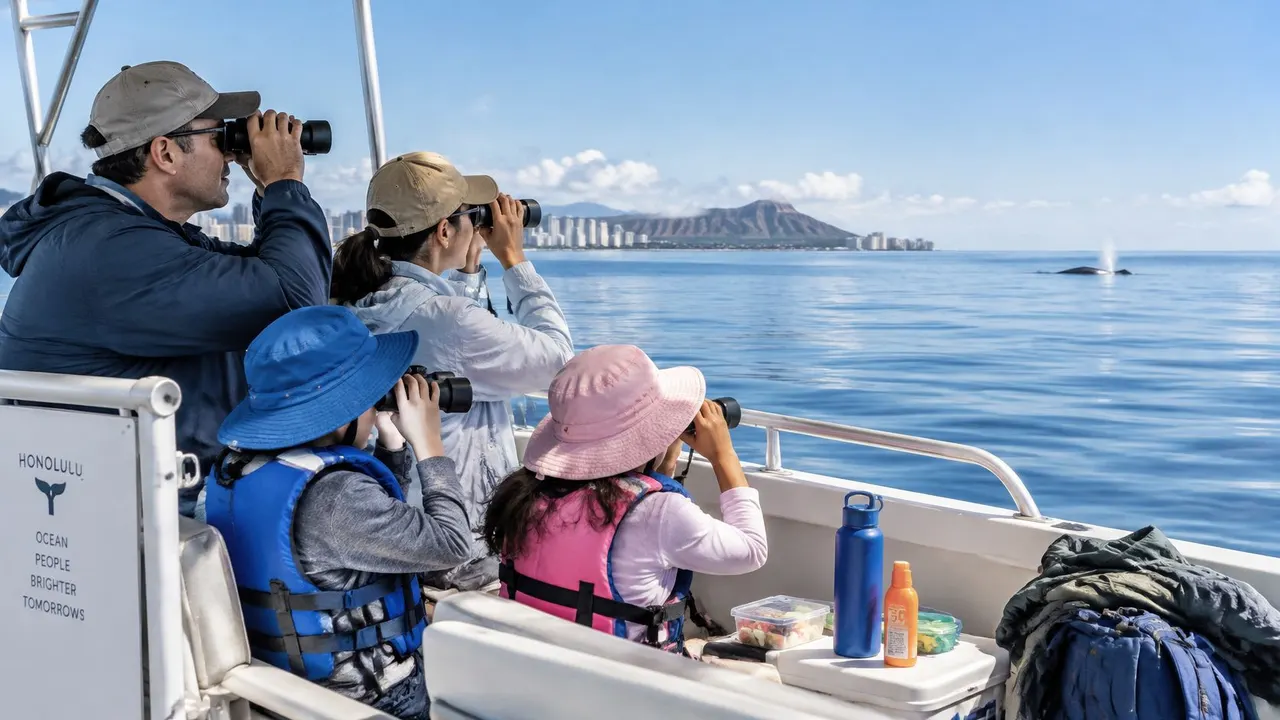
- Binoculars or a zoom lens: One pair per child ends arguments and makes distant sightings real.
- Light layers: The breeze on open water feels cooler than Waikīkī sidewalk air.
- Refillable water bottle and small snacks: Hungry kids stop scanning fast.
- Towel and dry bag: Spray finds phones quickly, even on calm mornings.
- Motion sickness medication: Take it before boarding, not after the boat starts moving, because it won't catch up once you're queasy.
Setting Kids Up on Board
Explain behavior in plain terms, the tall spray is the whale breathing, the tail usually means it's diving, the small whale beside the big one is a calf staying close to its mother. Agree on a spotting game, counting blows works well, so the quiet stretches have a job attached.
Teach kids to stay seated and hold handrails when something surfaces nearby. Sudden excitement moves everyone to one rail at once, and that's when people lose balance. Keep expectations flexible and make the trip about being on the ocean, with whales as the hoped-for highlight. Families who frame it that way rarely call a quiet outing a wasted one.
Responsible Viewing Rules That Protect Whales
The core rule is federal law, and distance is the whole game. Hawai'i's Department of Land and Natural Resources marine species guidance states that approaching a humpback within 100 yards, or about 91 meters, is prohibited in Hawaiian waters for boats, swimmers, kayaks, paddleboards, and drones. Aircraft must stay at least 1,000 feet away.
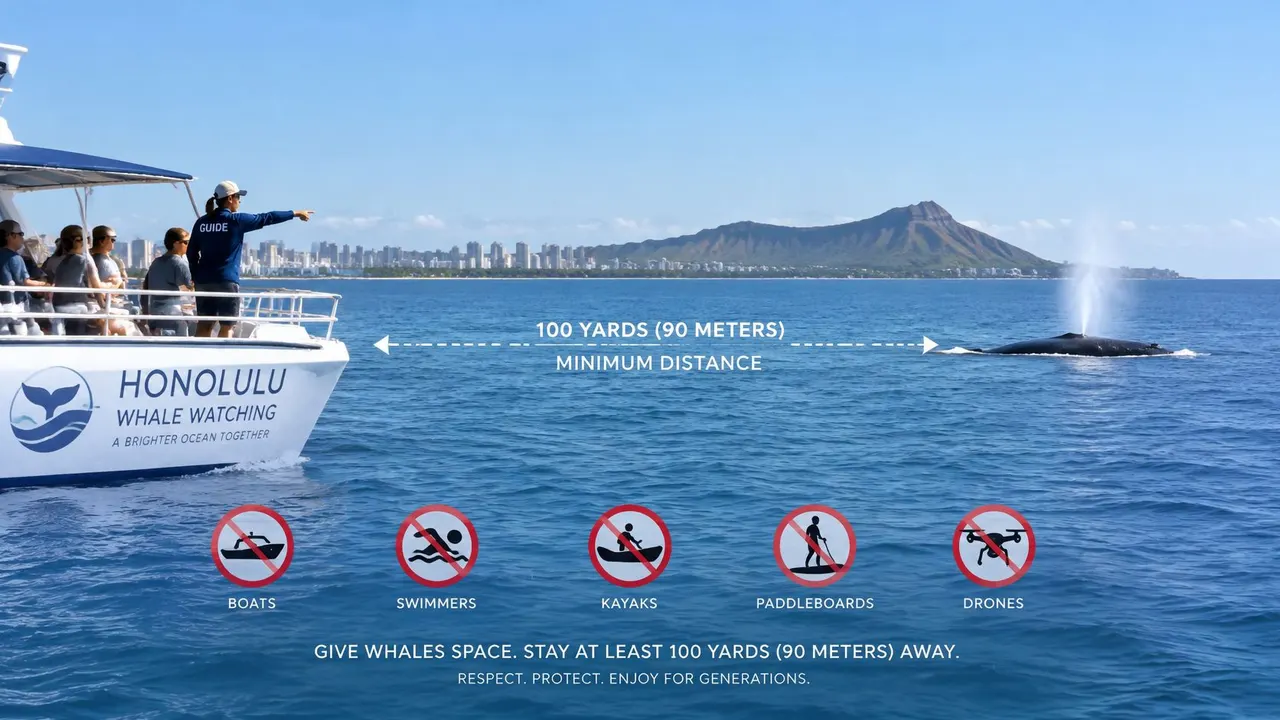
A whale can still close the gap on its own. When that happens, the correct move is quiet: neutral or no-wake speed, no sudden turns, and time for the animal to leave first. Our background on responsible whale watching off O'ahu explains how crews handle those moments.
What Good Behavior Looks Like
- Slow down near whales: Vessels reduce speed around animals, and responsible operators never cut into a traveling whale's path.
- Give up the chase: If the whale moves away, the encounter is over.
- Stay dry and grounded: Swimming in for a look or launching a drone for a tighter angle breaks the same distance rule.
- Let optics do the work: Binoculars and zoom lenses deliver the close view.
These rules protect the behaviors you came to see. Engine noise and sharp movement can interrupt breeding, nursing, and calf protection, and a mother spending energy avoiding boats has less left for her calf.
A clear sighting at legal distance is the correct outcome, full stop.
If an operator promises close encounters, treat that as a warning sign. I would book with the crew that explains the 100-yard rule before departure and keeps the throttle steady when a whale changes direction.
Honolulu Whale Watching FAQs
Can I See Whales in Honolulu in Summer
No, not realistically. June to October is the off season and humpbacks are largely absent from Honolulu waters. A snorkeling trip or a sunset cruise makes better use of a summer afternoon, and the whale outing belongs in a winter itinerary.
Is a Sighting Guaranteed on a Whale Watch
No. Sightings depend on whale distribution, weather, and sea state, and no honest operator controls any of those. O'ahu waters run quieter than the channels around Maui, so a trip with no breach and no fluke is a normal season result even in good months. Plan for odds, not promises.
How Close Can a Boat or Swimmer Get
The legal minimum is 100 yards for boats, swimmers, kayaks, paddleboards, and drones. Aircraft must stay 1,000 feet away. If a whale chooses to close the gap, the vessel waits in neutral until the whale moves on.
Can I See Whales From Shore
Yes. Whales can be observed from shore during the season, and elevation beats proximity. Diamond Head and Makapu'u Point are practical viewpoints, especially with binoculars on a calm morning when spouts show clearly against the horizon.
What If My Trip Is Quiet or Cancelled for Weather
Ask about the rescheduling policy when you book, not after a cancellation. A flexible second date inside January to March protects your chances, since one rough or empty morning is common enough to plan around.
Book a Honolulu Whale Watch With Confidence
If whales are the priority, book a dedicated outing in January to March, take the earliest morning departure, and hold a flexible second date inside the peak. That combination does more for your odds than anything else you control.
Living Ocean Tours is the top rated & most reviewed snorkel company on Oahu, and we also run seasonal whale watching along the Waikīkī coastline. Our Waikiki Whale Watching Cruise views humpback whales that winter in the Hawaiian Islands along the Waikiki Coastline, runs January 2nd through March 31st, lasts 1.5 hours, is for ages 3 and up, and costs $49 per person. We depart daily from Kewalo Basin Boat Harbor, conveniently located near Waikiki Beach. Details on seasonal whale watching departures from Honolulu and the Whale Watch tour page confirm dates, duration, age policy, price, and departure point before you pay, along with the weather and rescheduling policy.
Check the morning's sea conditions before you leave the hotel, bring binoculars, and brief the kids on the wait. Then accept the honest trade, you're buying the best-positioned chance, not a scheduled performance. A quiet outing is still a valid result during whale watching season in Honolulu, and a good crew will tell you that before you book, not after.
Ready to plan around the peak instead of hoping for it? Living Ocean Tours runs seasonal whale watching along the Waikīkī coastline from Kewalo Basin Boat Harbor, plus guided snorkeling and sunset cruises for the rest of your stay. Visit Living Ocean Tours to check winter dates and save your morning on the water.


