
Whale Watching Oahu Hawaii Best Time in 2026
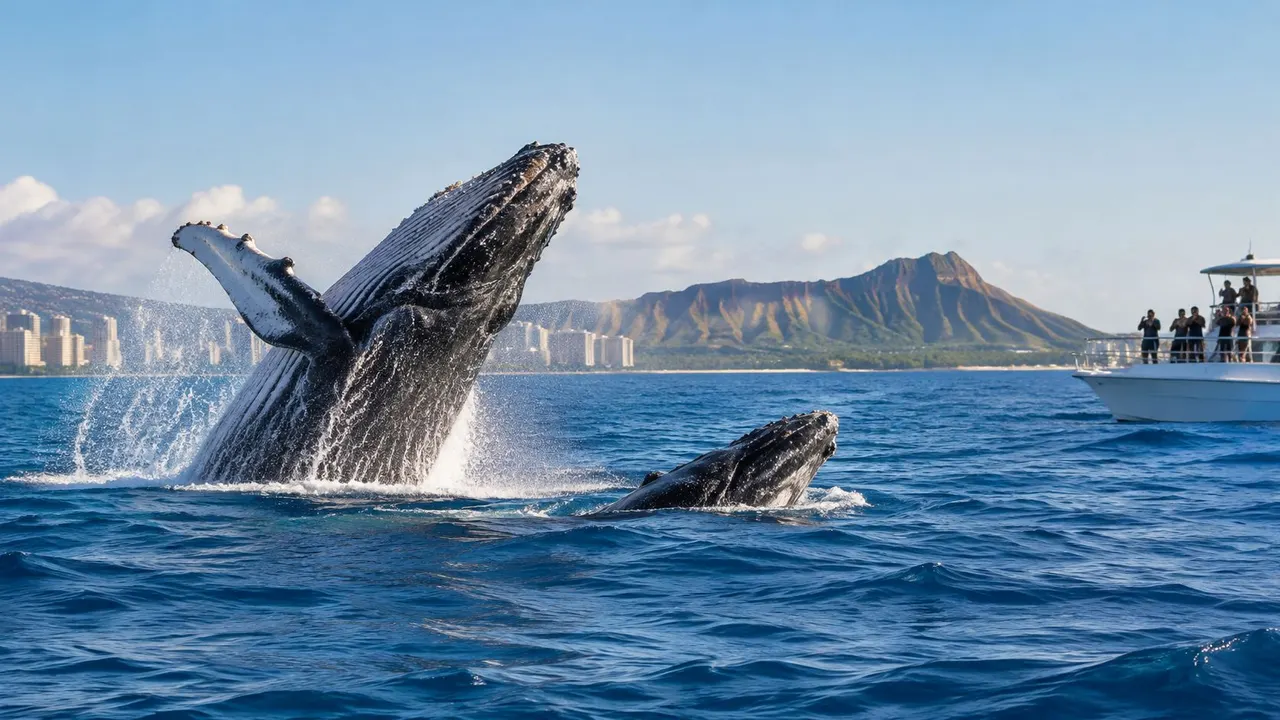
January through March is the best time for whale watching around Oʻahu, within a broader season that runs from November through April. A single trip still depends on the weather, sea conditions, and where the whales are moving that day.
For families visiting Waikīkī, the practical goal isn't the closest photo. It's a comfortable outing with a good chance of repeated sightings, observed from a respectful distance. Choosing the peak months helps, and an early departure can make the ride more pleasant, but no crew can schedule a breach or promise a whale will surface beside the boat.
Whale Watching Oahu Hawaii Best Time by Month
January, February, and March are the best months for whale watching off Oʻahu. NOAA's Hawaiian Islands Humpback Whale National Marine Sanctuary identifies November through April as the broader viewing season and January through March as the peak. In those months, humpbacks use Hawaiʻi's warm, shallow waters to mate, give birth, and nurse their calves. The sanctuary includes waters around Oʻahu, so visitors based in Waikīkī may spot whales from shore or on a boat trip. NOAA's sanctuary overview also reports that approximately half of the North Pacific humpback whale population, up to about 12,000 animals, returns to Hawaiian waters during winter and spring.
| Month | Season role | What to expect | How firmly to book |
|---|---|---|---|
| November | Shoulder start | First arrivals and fewer repeat sightings | Only if these are your travel dates |
| December | Building season | More consistent than November, still short of the peak | Book popular morning trips |
| January | Peak | Strongest chance of repeated sightings | Book first |
| February | Peak | High activity, with calves easier to notice as the season matures | Book first |
| March | Peak | Still peak, easing toward the end of the month | Book first |
| April | Shoulder end | Possible encounters, less consistent | Keep plans flexible |
| May | Late tail | Occasional whales, not a dedicated bet | Don't plan a whale-only trip |
| June through October | Off season | Sightings rare | Choose snorkeling or a sunset cruise instead |
The calendar has slightly different edges depending on how a source describes the season. NOAA's sanctuary describes November through April as the viewing season, while Hawaiʻi.com's Oʻahu guide gives a local window of December 15 through May 15, with January through March as the peak. The useful takeaway is consistent: the middle of winter is the strongest choice, and the shoulders are less predictable.
November can bring early arrivals, while December tends to build. January through March are the months to prioritize if whales are a main reason for your trip. April can still produce encounters, and May may have occasional whales, but it's a weaker choice for a trip built around whale watching. Sightings outside the winter peak are possible, but they're less reliable for planning a dedicated outing.
A broad season doesn't make every departure equally productive. Weather, sea state, whale distribution, and daily animal behavior all affect what one boat sees, even during peak months.
Why Humpbacks Fill Hawaiian Waters in Winter
Think of Hawaiʻi as a winter nursery, not a quick stop on a migration route. Humpbacks feed in colder, higher-latitude waters, then travel to the islands' warm, shallow seas to breed, give birth, and nurse their calves. That purpose helps explain why winter outings can bring the chance to see blows, tail activity, breaches, and mother-calf pairs, though none of those behaviors can be promised on a particular trip.
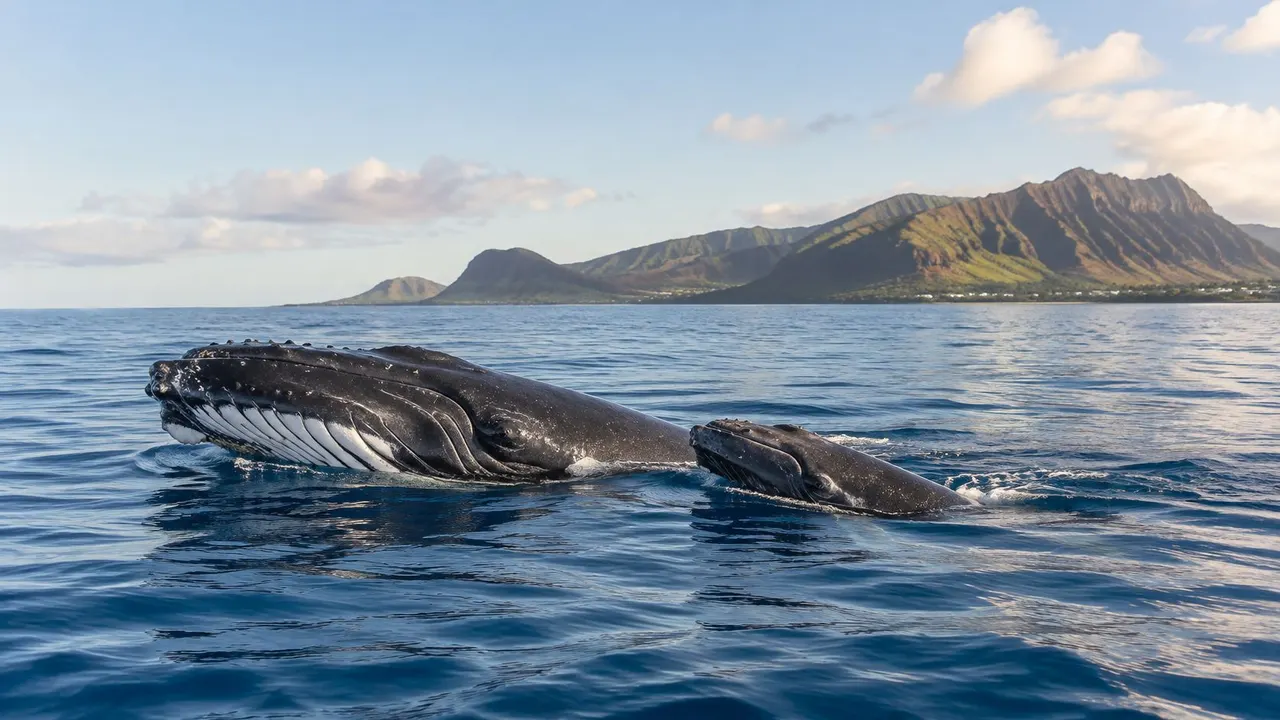
A useful way to picture the season is a maternity ward. November and May are like the doors opening and closing: whales may be passing through, but activity is less consistently concentrated. In January through March, more of the season's visitors have settled into Hawaiian waters, making those months the better bet for repeated sightings. The analogy isn't a promise of what you'll see. It's a way to understand why the calendar matters.
What the seasonal numbers tell you
When observations around the main Hawaiian Islands were pooled across years, a NOAA-linked demographic analysis recorded humpbacks in every month except June and September. 99.97% of those sightings occurred from November through May, according to the NOAA Hawaiian Islands Humpback Whale National Marine Sanctuary. That finding supports November through May as the most defensible broad planning window, while also showing why winter is a more dependable choice than summer.
The same sanctuary reported that 1,353 volunteers surveyed 44 sites across Hawaiʻi and counted 4,782 humpback whales during the three-day 2025 Sanctuary Ocean Count. The count included Oʻahu sites and gives a sense of how widely whales can be distributed along Hawaiian coasts during the January-to-March monitoring period. It isn't a census of the full population, and it can't guarantee a sighting on one Waikīkī departure.
What families might notice
A child might first spot a puff above the water, then look for a darker shape beneath it. A mother and calf may stay close together, or a whale may surface and disappear again. Those are worthwhile moments even when there's no dramatic breach.
The same seasonal concentration that creates better viewing opportunities also brings no control over the animals' timing. A crew can search, explain what guests are seeing, and choose a responsible route, but it can't ask a whale to breach on cue.
Morning Light Versus Afternoon Seas
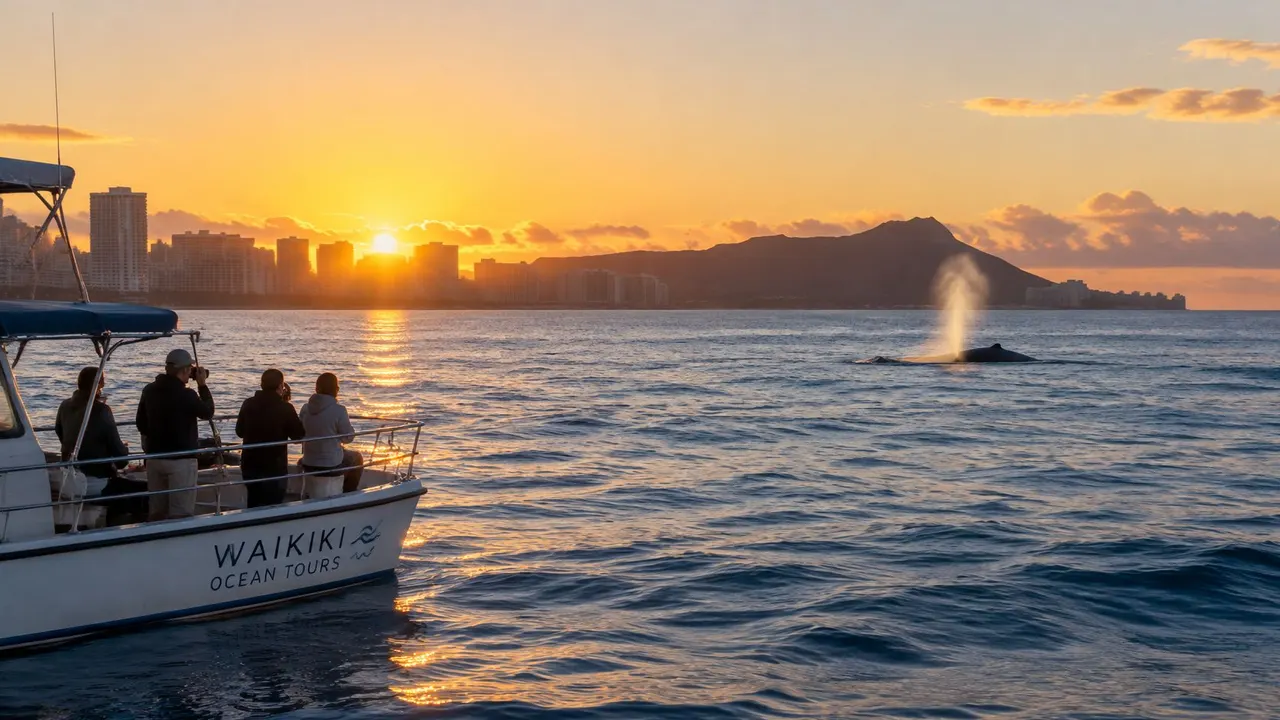
Whales don't follow a visitor schedule, but the light and ocean conditions change through the day. For a Waikīkī departure, early morning is the practical first choice: the water is often smoother before trade winds build, the ride may be more comfortable for children, and softer side light can make a distant blow easier to pick out.
| Window | Typical seas | Light and comfort | Best for |
|---|---|---|---|
| Early morning, about 7–9 a.m. | Often the smoothest water before trades build | Softer side light and an easier ride | Families and first-time watchers |
| Mid-morning, about 9 a.m.–noon | Usually workable, with chop starting on some days | Brighter sun and more glare | A backup when early boats are full |
| Afternoon, about noon–4 p.m. | Trades and short chop more common off Waikīkī | Warmer, lower light later in the day | Flexible travelers on a light-wind forecast |
| Night | Detection is poor and slower speeds are advised | Whales are hard to see | Not a whale-watching window |
Mid-morning is a reasonable backup during the peak season. Sightings can still be excellent, but stronger glare may make it harder to separate a spout from bright water, and short chop can begin to affect comfort. If the early boat is full, weigh those trade-offs against the forecast and the needs of your group. For families with young children or anyone prone to seasickness, a calmer morning usually matters more than chasing a particular hour.
Afternoon trips can still work when winds are light. Later sunlight can give photos a warm look, but wind and choppy water are more common concerns off Waikīkī. If your plans are flexible, choose the departure that best fits the conditions and your passengers rather than assuming whales are more active at a fixed time. For more detail on choosing a departure, see this guide to whale watching on Oʻahu.
Night isn't a practical whale-watching window. Blows and splashes are harder to detect in low light, and Hawaiʻi's boating guidance advises slower speeds after dark in whale habitat. The simple briefing for a family is: choose the calmest morning that fits your schedule, and treat afternoon as a reasonable alternative only when the forecast supports it.
What a Good Trip Looks Like and What Can Spoil It
On a strong winter morning, a blow may be the first sign of a whale. It can look like a brief puff above the water, perhaps far from the boat. Breaches are dramatic but shouldn't be the measure of a successful trip. Repeated tail or pectoral slaps can be easier for children to notice, while a mother and calf may appear close together near the surface.
A good sighting is about watching natural behavior, not getting as near as possible. A whale seen from a respectful distance, with time to follow its movement and understand what it's doing, can be more rewarding than a fleeting close view. Crews can help guests scan the horizon and make sense of what they spot, but wildlife remains unpredictable.
| Factor | Effect on the outing | What to do |
|---|---|---|
| Wind and trade swell | Whitecaps hide blows and make the ride rough | Choose a lighter morning forecast |
| Glare and flat cloud | Backlight or gray light hides spouts and splashes | Favor morning side light |
| Daily whale movement | A quiet stretch of coast isn't an empty season | Pick a boat that can move without pursuit |
| Passenger comfort | Chop can wear children out before whales disappear | Reschedule if anyone is seasick-prone |
| Shore versus boat | Shore is free but distant; a boat reaches habitat | Use a boat for a first dedicated watch |
Wind and trade swell are the conditions most likely to make a sighting harder. Whitecaps can hide a blow, and a bumpy ride may become the main thing a child remembers. If someone in your group is prone to seasickness, pick the calmest available morning or consider changing plans rather than trying to tough out a windy day.
Glare can be another nuisance. When the sun is in your eyes, distant spouts and splashes are easy to miss. A shaded spot, a change in viewing angle, or binoculars can help guests scan the water without straining.
A simple family test: if the ride is already uncomfortable, a whale that surfaces far away won't make the outing feel easier.
Shore viewing is a useful low-pressure option if you're happy to watch from land, but distance can make details hard to see. A boat can search offshore habitat while keeping a legal buffer, making it a more practical choice for a first dedicated whale watch. A skilled crew can improve the search and explain what's happening, but even a well-planned trip can yield only distant blows or no sightings. Use this Oʻahu whale-watching guide to compare the outing with your family's needs.
How to Watch Without Crowding Whales
A close encounter isn't automatically a better or more responsible encounter. In Hawaiʻi, the minimum approach distance for humpback whales is 100 yards, or 90 meters, and the rule applies to boats, swimmers, kayaks, paddleboards, drones, and other objects. Aircraft must remain at least 1,000 feet away. The Hawaiʻi Department of Land and Natural Resources' humpback whale regulations apply in Hawaiian waters within 200 nautical miles of the islands, including Oʻahu, and prohibit intercepting a whale's path or disrupting its normal behavior.
That distance protects space whales need to travel, rest, breed, and care for calves. If a whale approaches a boat on its own, the operator shouldn't advance or reposition toward it. Motorized vessels should shift into neutral and wait for the whale to move away.
What responsible vessel handling looks like
In waters of 100 fathoms or less, about 600 feet, Hawaiʻi's boating guidance advises boaters to travel at 15 knots or less or at minimal planing speed. When approaching or departing whales from within 400 yards, vessels should reduce speed to 6 knots or less. Boaters must not leapfrog ahead of a traveling whale. These recommendations and requirements are explained in the state's whale-boating guidance.
Guests can use simple questions to judge whether an operator takes the rules seriously:
- Buffer: Does the crew maintain the legal distance rather than trying to close in for a photo?
- Route: Does the boat avoid encircling a whale or repeatedly approaching it?
- Response: Does the crew explain what passengers should do if a whale surfaces nearby?
- Viewing: Does the operator encourage binoculars or a telephoto lens instead of pursuit?
A guest can also help by keeping drones and personal watercraft away from whales, following crew instructions, and avoiding any attempt to swim closer. Binoculars extend your view without shrinking the animal's protected space.
A quieter sighting observed from a legal distance can be a higher-quality encounter than a dramatic view created by crowding a whale.
Nighttime calls for extra caution because it's harder for boaters to detect whales in low light. The right operator makes careful handling part of the trip, not an afterthought. For a fuller explanation of the Oʻahu whale-watching rules, consider what the crew says about distance and non-pursuit before you book.
Book a Peak Season Waikiki Whale Watch
If whales are the main reason for your outing, choose a seasonal whale watch rather than hoping another kind of ocean trip turns into one. Living Ocean Tours offers a Waikiki Whale Watching Cruise from January 2 through March 31. The cruise lasts 1.5 hours, is for ages 3 and up, and costs $49 per person. It views humpback whales that winter along the Waikīkī coastline and departs from Kewalo Basin Boat Harbor near Waikīkī Beach.
Living Ocean Tours is Oʻahu's top rated and most reviewed snorkel company. Its Waikiki Whale Watching Cruise gives visitors a seasonal way to look for wintering humpbacks from the water.
Reserve a January, February, or March morning first if your dates are flexible. Treat November, April, and May as backup possibilities, and don't plan a summer trip solely around whales. Before you pay, confirm the current dates, fare, and cancellation terms on the booking page, since schedules and terms can change.
- Keep a weather backup: Plan another morning during January through March in case the first date is canceled because of weather or sea conditions.
- Set expectations: A peak-season booking improves your timing, but it can't guarantee a sighting or a breach.
- Choose for your group: Think about the passengers' comfort and schedule, not just the chance of a dramatic photo.
For broader planning, compare the Oʻahu whale-watching options with your travel dates and departure location. The best outing is the one that fits your group, gives the crew room to search responsibly, and lets you enjoy what the whales choose to do.
Living Ocean Tours offers seasonal Waikīkī whale-watching cruises during the strongest winter viewing months, departing from Kewalo Basin Boat Harbor near Waikīkī Beach. Choose a morning that suits your family, confirm the current booking details, and visit Living Ocean Tours to plan a respectful whale-watching outing.


