
Best Time to Visit Hawaii for Whale Watching in 2026

January through March is the peak window for humpback whales in Hawaii, and January and February give the strongest odds of sightings. For Waikiki visitors, a February departure is a practical way to watch whales during peak season without changing islands.
Up to 12,000 humpbacks, more than half of the North Pacific population, return to Hawaiian waters during the broader migration season, according to the Hawaiian Islands Humpback Whale National Marine Sanctuary. That's a major wildlife migration, but it doesn't mean every boat trip finds whales or every island offers the same viewing opportunities.
The best time to visit Hawaii for whale watching comes down to the month, the departure location, and the conditions on your particular day. Choose the season first, then a boat trip that fits your family, your lodging, and your tolerance for moving water.
When Humpbacks Arrive in Hawaii and Why
Winter is the planning priority, not any month when a whale might be present. NOAA's boating guidance places the general season in November through May, with the greatest concentration typically occurring January through March, while noting that limited numbers may appear outside the usual season.
The distinction matters when you're paying for flights and choosing vacation dates. A possible sighting at the edge of the season isn't the same planning proposition as a trip during peak abundance.
Humpback Whale Presence in Hawaii by Month
These are practical planning categories, not measured probabilities. “High” means a favorable seasonal window, not a promise from the ocean.
| Month | Whale Presence | Sighting Odds | Verdict |
|---|---|---|---|
| September | Early arrivals possible, few whales | Low | Shoulder month |
| October | Few whales, numbers rising | Low to moderate | Shoulder month |
| November | Season opens, whales present | Moderate | Good option |
| December | Numbers climbing through the month | Good | Good option |
| January | Peak abundance | High | Best window |
| February | Peak abundance | High | Best window |
| March | Late peak, excellent sightings | High | Best window |
| April | Whales thinning out | Moderate | Fair |
| May | Last stragglers before departure | Low | Fair |
| June to August | No whale season | None for trip planning | Not recommended |
The summer entry describes whether you should plan a whale-focused vacation, not an absolute biological claim that a humpback could never appear. Likewise, an early arrival doesn't make the shoulder season a dependable alternative to winter.
If your dates are fixed, make the outing fit the season rather than expecting the season to fit your reservation. Our Oahu whale-watching planning guide can help you think through a dedicated excursion versus keeping whale spotting as a possible extra.
Why Whales Gather Around Hawaii
North Pacific humpbacks leave their feeding grounds for Hawaii's warm, shallow waters to mate, give birth, and nurse calves. Visitors are watching animals engaged in breeding and early calf care, not animals gathering around a boat attraction.
That explains both the seasonal concentration and the need for patience. Whales can remain underwater, surface at a distance, or move beyond a useful viewing angle while people are watching elsewhere.
A blow may be your first clue. A back or fluke may follow, but a breach isn't a standard part of an excursion, and a boat full of cameras doesn't change the animal's behavior.
Planning rule: Choose the core winter window if missing whales would be a major disappointment. Choose an edge-of-season trip only if you're comfortable enjoying the ocean outing without a sighting.
What Whale Counts Actually Tell You
During the 2024 Sanctuary Ocean Count, more than 1,300 volunteers observed 5,120 humpback whales on the last Saturdays of January, February, and March, according to NOAA's account of the event. That's an observation count, not a total population estimate or a forecast for your departure.
Organized counts show how much whale activity observers can detect during the core season. They don't establish an individual tour's success rate, and they shouldn't be turned into one.
My recommendation is to aim for mid-January through late February when whales are the main reason for traveling. Treat November, December, or early April as workable alternatives when your calendar is fixed and fewer whales are acceptable.
Don't overthink the exact day within a favorable month. A flexible itinerary and realistic expectations are more useful than trying to identify a supposedly perfect departure date.
Which Islands Give the Best Whale Sightings
Choose an island by balancing whale concentration against the vacation you want. The strongest statewide viewing locations aren't automatically the most sensible departure points for a family staying in Waikiki.
The Hawaii Division of State Parks identifies the shallow waters between Maui, Lanai, and Molokai, Kauai's north coast, and Hawaii Island's Kohala coast as major concentration areas. Sightings around Oahu are common, but less frequent than in those regions.
Where Humpback Whales Concentrate Across the Islands
A 2025 NPR report described an estimated 10,000 to 15,000 humpbacks passing through waters around Maui each year, generally between December and March.
| Island | Where Whales Concentrate | Best Use |
|---|---|---|
| Maui | Shallow waters with the annual migration described above | Boat tours with strong peak-season odds |
| Lanai and Molokai | Shallow-water concentration between Maui, Lanai, and Molokai | Boat tours in Maui-area waters |
| Kauai | North coast concentration | Boat tours or north-coast viewing when conditions permit |
| Hawaii Island | Kohala coast concentration | Boat tours on the Kohala coast |
| Oahu | Sightings common but less frequent than in the main concentration areas | Waikiki departures and shore viewing for city-based trips |
The Practical Choice for Waikiki Visitors
Oahu lets you include whale watching without adding an interisland flight, another hotel, or a transfer day. Southeast Oahu offers shoreline observation, while a vessel can search across more water instead of relying on whales passing a fixed lookout.
That wider search area is useful, but it's not a quantified guarantee of better results. Shore viewing remains a reasonable option for anyone who'd rather avoid a boat.
Living Ocean Tours is Oahu's top rated and most reviewed snorkel company. Our tours depart daily from Kewalo Basin Boat Harbor near Waikiki Beach, and our seasonal Waikiki Whale Watching Cruise looks for wintering humpbacks along the Waikiki coastline.
Our Oahu versus Maui whale-watching comparison helps separate concentration from convenience. If whales determine your whole vacation, Maui deserves consideration; if you're already staying in Waikiki, a February Oahu departure is a sensible compromise.
The best whale-watching island and the best island for your trip don't have to be identical. Don't add travel unless the additional whale focus is worth the disruption.
Best Time of Day and Weather for Oahu Whale Watching
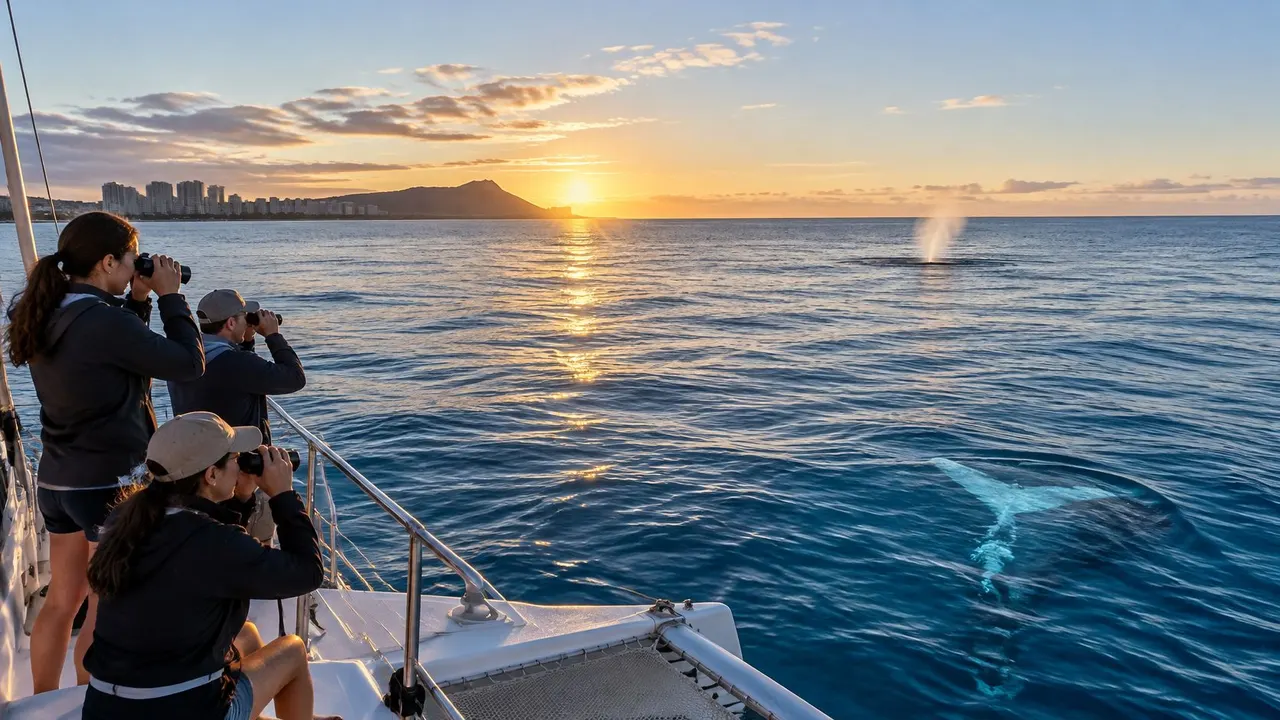
Morning is usually the best starting point for comfort and visibility. Lighter wind and flatter water make it easier to distinguish a blow, back, or fluke from whitecaps, though whales don't follow a passenger timetable.
Afternoons can still produce excellent encounters. The trade-off is that wind and chop may make both spotting and standing on deck harder, particularly for first-time boat passengers.
Choose Conditions Before Light
- Morning departures: Favor these for typically flatter water and easier scanning across the surface.
- Midday departures: Expect warmer conditions, but be prepared for more wind-driven chop.
- Late afternoon departures: Softer light can be attractive for photographs, though building wind can make whales harder to detect.
A sunset photograph shouldn't be your main scheduling criterion. You'll have a more useful wildlife outing if everyone can watch comfortably rather than brace against the rail.
Winter swell and trade winds can change the picture quickly. North-facing coasts are especially exposed to winter swell, while Waikiki and the south shore can offer a more sheltered starting point, depending on the day's wind and swell direction.
Make the Weather Check Useful
Review the marine forecast the day before departure, not just the temperature and rain icon on a phone app. Wind, swell, and visibility matter more to the boat ride than whether you'll need an umbrella at the hotel.
Read the operator's weather-rescheduling terms before paying. Don't assume poor visibility automatically triggers a refund or that an afternoon replacement will be more comfortable.
Weather backup: Put the outing early enough in your stay that a cancellation leaves somewhere useful to move it.
Keep that flexible day if the forecast turns unfavorable. Moving immediately to a rougher afternoon slot can preserve the reservation while losing the conditions your family needed in the first place.
Family and First-Timer Tips for Whale Watching
A whale watch is a boat-based viewing outing. You don't need swimming or snorkeling skills to enjoy it, which makes it easier to include relatives who want wildlife without getting into the water.
Comfort still takes planning. A child who's cold, a grandparent who can't settle comfortably, or a passenger feeling seasick will struggle to enjoy even a good sighting.
Pack for the Ride
- Motion-sickness preparation: If you use medication, follow its label and take it before boarding as directed. Check age restrictions and suitability with a pharmacist or clinician.
- Sun protection: Bring sunscreen, sunglasses, and a secure hat. You can burn while feeling cool in the wind.
- A light wind layer: Keep it accessible rather than buried underneath everyone's belongings.
- Water and suitable snacks: Confirm what you may bring, and choose simple items that don't require juggling containers.
- Binoculars or a zoom camera: These help with distant activity, but put them down periodically so you don't miss movement elsewhere.
- A compact bag: Keep hands free for boarding and moving around the boat.
Plan Around Your Passengers
Match departure time to your youngest traveler's routine rather than booking through a usual nap. For older relatives, resolve boarding, seating, and mobility questions before the departure day.
Our guide to whale watching with kids offers more family-focused planning advice. Explain beforehand that whales may look small from the boat and that watching patiently is part of the activity.
For families adding a separate in-water outing, Living Ocean Tours snorkeling tours include gear and knowledgeable guides. Our Deluxe Waikiki Snorkeling and Wildlife Cruise is an option to compare separately, rather than assuming a whale watch includes swimming.
Agree on a simple family meeting point aboard and give everyone a spotting role. One person can scan ahead while another watches the opposite side, then call out direction clearly instead of rushing together toward a rail.
Responsible Viewing Rules and How to Book Safely
Federal law prohibits approaching a humpback whale within 100 yards in Hawaiian waters, including approaches by boat, kayak, paddleboard, swimmer, drone, or another object; aircraft have a separate 1,000-foot minimum, according to NOAA's sanctuary regulations.
Minimum Viewing Distances for Humpback Whales in Hawaii
| Activity | Minimum Distance | Note |
|---|---|---|
| Boat | 100 yards | Applies to every vessel in Hawaiian waters |
| Kayak, paddleboard, or swimmer | 100 yards | Same approach restriction as boats |
| Drone | 100 yards | Applies to objects used to approach |
| Aircraft | 1,000 feet | Separate minimum distance for aerial operators |
A whale surfacing nearby on its own doesn't give passengers or a captain permission to pursue it. Responsible viewing means allowing the animal to control the encounter, not pressing closer for a photograph.
The sanctuary's 2025 season-end report recorded 32 confirmed entanglement reports involving 16 whales during the 2024–2025 season, which ran from December 1, 2024, to May 1, 2025. Those reports document a separate human-related threat, not incidents caused by ordinary whale watching, but they reinforce the importance of careful ocean operations.
Never enter the water or attempt to free an entangled whale yourself. Alert the crew so trained responders can receive the information.
Apply a Booking Checklist
- Reserve around your itinerary: Leave a usable alternative day rather than choosing the last possible outing.
- Read cancellation terms: Distinguish a guest cancellation from an operator's weather cancellation.
- Check the wildlife briefing: Ask how the crew explains viewing distances and passenger conduct.
- Reject close-encounter promises: No responsible booking should depend on chasing or swimming toward humpbacks.
- Compare the departure harbor: A suitable tour must also be practical to reach from your accommodation.
Use our Oahu whale-watching trip guidance alongside the checkout terms. Living Ocean Tours is Oahu's top rated and most reviewed snorkel company, and the reviews below offer another way to assess the operation before booking.
Book a Whale Watch in January to March
Choose a departure that fits your stay, then confirm the current schedule before paying. Our Waikiki Whale Watching Cruise runs January 2nd through March 31st, lasts 1.5 hours, welcomes ages 3 and up, and costs $49 per person.
The departure point is Kewalo Basin Boat Harbor near Waikiki Beach. Build your transportation plan around the harbor rather than assuming the boat boards directly from the beach.
Turn Your Dates Into a Reservation
The Waikiki Whale Watching Cruise page is the natural next step for checking the outing against your family's plans. Review the available departure times and checkout details, especially if your group includes young children or anyone with mobility needs.
Choose the trip for the opportunity to observe wild humpbacks, not for a particular photograph. A distant blow or a clear view of a fluke can still make a worthwhile wildlife encounter.
- Pick your preferred date. If your travel calendar is open, I'd prioritize the core midwinter period rather than an edge-of-season departure.
- Choose a morning and protect a backup day. Don't fill every remaining opening before you've taken the trip.
- Confirm group details with our team. Email info@livingoceantours.com or call +1 (808) 436-3483. Our phone hours are 8am to 5pm daily.
Our seasonal Waikiki Whale Watching Cruise offers a boat-based way to look for wintering humpbacks along Oahu's Waikiki coastline. Visit Living Ocean Tours to choose an available departure, confirm your family's plans, and leave room in your itinerary for the weather.


