
Whale Watching in Waikiki: Season, Tours and Tips
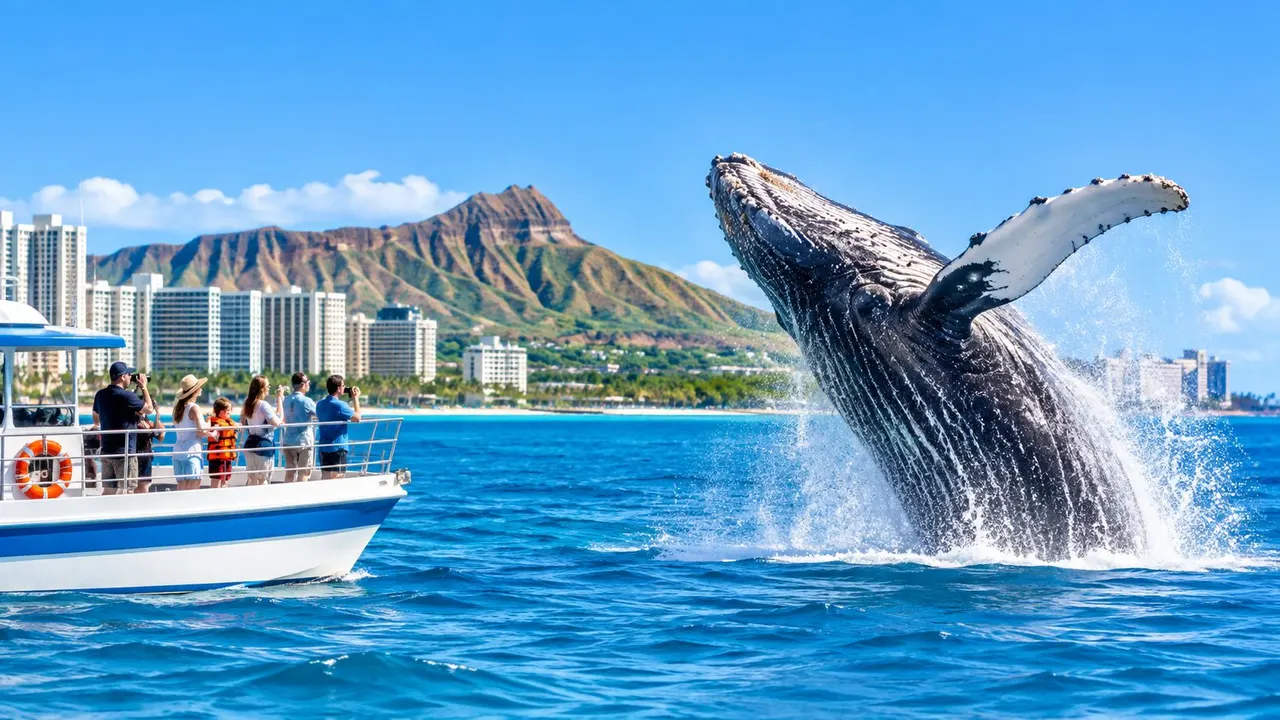
Table of Contents
- The Month-by-Month Outlook
- Timing Within the Day
- Three Things to Sort Before You Leave the Hotel
- What a Good Trip Looks Like
- Where a Local Operator Fits
- What the Crew Does When a Whale Comes to You
- The Distance Table
- What Passengers Should Do
- Photography That Works From a Moving Deck
Up to 12,000 humpback whales, more than half the North Pacific population, arrive in Hawaiian waters between November and May, according to NOAA's Hawaiian Islands Humpback Whale National Marine Sanctuary. That number explains why whale watching in Waikiki sells out every winter, and it's also the number most likely to be misread. It describes a population in the islands, not a guarantee outside your hotel window.
Whales are wild animals working through a migration older than any tour schedule. They come to mate, calve and nurse, and the odds of seeing one on a given morning turn on the month, the swell, the light and how the boat is handled. A good trip plans around that uncertainty instead of promising past it.
The distance rule is the part visitors underestimate. Federal law sets a minimum approach distance for humpback whales in Hawaii, and the better operators treat that buffer as the experience itself rather than a legal hoop to clear on the way to a closer look. What follows covers how the season works, where the boats leave from, what happens on the water, and how to pick a trip that respects both the whales and your vacation budget.
When Whales Visit Waikiki and the Best Months to Go
January through March is the strongest window for whale watching in Waikiki. Humpback whales are at their most abundant in Hawaiian waters then, so if the trip is the reason for the booking, those are the three months to build a vacation around. The season itself is wider. Hawaiʻi's humpback whale season generally runs from November through May, and whales can turn up in smaller numbers outside it, as NOAA Fisheries explains: thousands of humpbacks migrate each winter to the islands' warm, shallow waters to mate, give birth and raise their young.
Peak abundance usually falls from January through March, according to NOAA's boating guidance for the sanctuary. A peak month and a good sighting are not the same thing. A calm February morning with a spotter who reads water well will usually beat a choppy March afternoon, and a whale in the middle of a long dive doesn't care what the calendar says.
The Month-by-Month Outlook
Read the table as odds rather than a schedule. Each row says what the whales are generally doing and what that means for a visitor with a fixed date.
Two transitions matter most. November and December build steadily, so an early-December trip is a genuine whale watch rather than a gamble, just with fewer animals spread across the same water. April and May taper in the other direction, and a late-May departure belongs in the wildlife-observation category. You might catch blows on the horizon. You might get a boat ride, seabirds and nothing else.
Timing Within the Day
Wind and swell decide more about what you see than the hour does. Flat morning water shows a blow at distance and lets a spotter pick up a tail slap a mile out; afternoon chop buries the same animals behind whitecaps. Check the marine forecast the day before you go, and when an operator offers both a morning and an afternoon departure, take the morning.
What I would do: book the earliest departure the family can realistically make, then hold the afternoon as a backup. A trip you can rebook is worth more than a trip with a good forecast printed on the confirmation.
The decision rule is short. Choose January to March when whale abundance is the priority. Take November, December or April when whales are one part of a broader trip and you'd rather trade some probability for smaller crowds. Treat late May and summer as an ocean day where a whale would be a bonus, and book it only if the boat ride itself earns the fare.
Where to Board and Where Whales Are Seen
The trip starts at Kewalo Basin Boat Harbor, on the Honolulu end of the Waikiki coastline. Living Ocean Tours runs its tours from there daily at 1125 Ala Moana Blvd, Slip B-01, which puts the dock a short ride from the beach hotels and an easy drop-off for a rideshare. Arrive early enough to walk the harbor edge before boarding. The first useful thing a crew does is teach you what you're looking at.
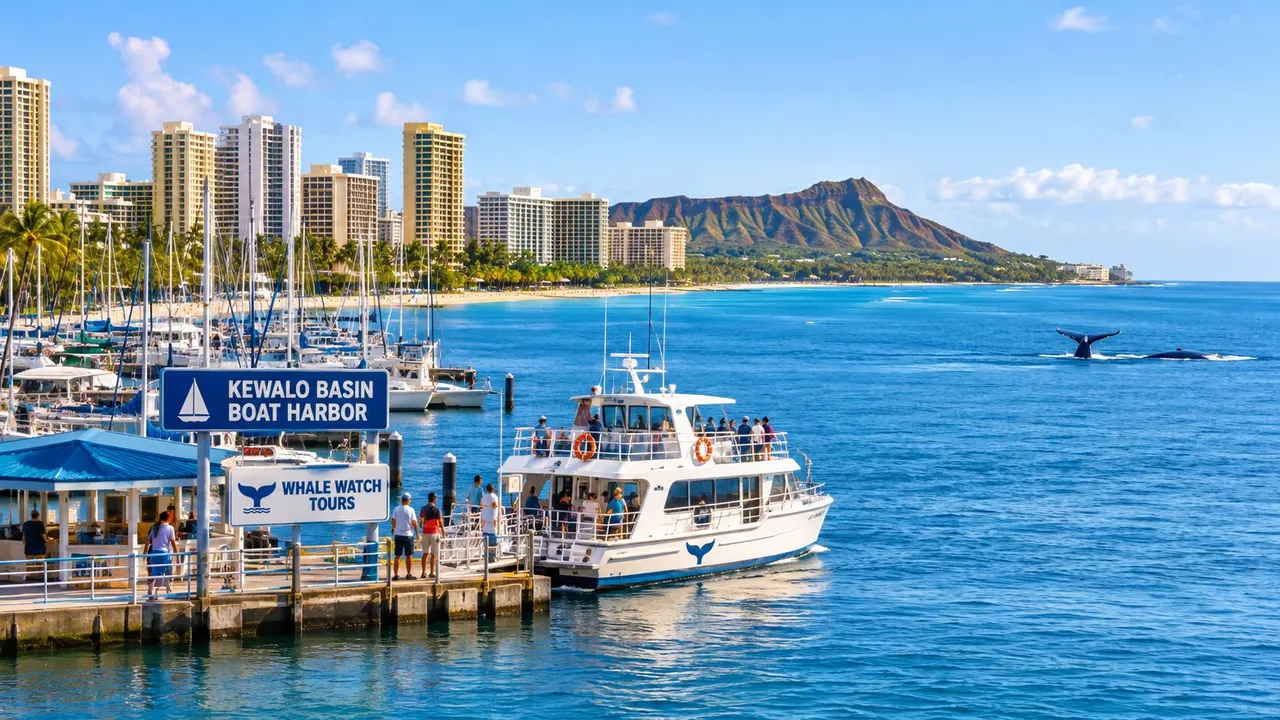
Picture the route. The boat clears the breakwater and turns east, the Waikiki skyline stacked behind you and Diamond Head holding the far end of the view. Under the hull is the shelf, the shallow apron that wraps Oahu before the bottom falls away into deep ocean a few miles out.
Depth is why you don't need a long offshore run to find whales. Humpbacks in Hawaii use relatively shallow habitat, generally water shallower than 600 feet, because the islands serve as a breeding, calving and nursing ground rather than a feeding ground, as the Hawaii Division of State Parks notes. Mothers with calves in particular work that shallower shelf, which is exactly where nearshore routes run. For a closer look at how the season plays out along this stretch of coast, this guide to whale watching in Waikiki covers the same water from the shore side.
Sightings offshore from Waikiki are real but not uniform. The same state guidance notes that Oahu generally records fewer sightings than some other Hawaiian islands. That's the honest reason to pick a whale watch by season and by crew rather than by island reputation.
Three Things to Sort Before You Leave the Hotel
- Confirm the departure point on your confirmation. Harbor names blur together on Oahu, and a 7 a.m. departure is the wrong time to discover you're at the wrong basin.
- Plan the last ten minutes. Parking near the harbor and rideshare drop-offs both tighten up in the morning. Build in a buffer rather than jogging down the dock.
- Check the marine forecast the day before, not the day of. Wind direction and swell height tell you more about visibility than any app's little sun icon.
The setting does the rest. Diamond Head to one side, the Waikiki towers behind you, and a whale somewhere out there deciding whether to surface in front of any of it. A crew can put the boat in the right place. Nobody can put the whale there.
How to Choose a Waikiki Whale Watch Tour
Most whale watches in Waikiki look identical in a brochure. The differences show up in the first twenty minutes on the water, so judge an operator on how they handle animals and children rather than on the boat in the photograph.
What a Good Trip Looks Like
- Group size and boat style. A double-decker with an open bow and wrap-around seating lets a family spread out and keeps sightlines clear when someone spots a blow. Crowded rails are where kids get lifted over other people's shoulders and lose interest.
- A designated spotter. Ask directly whether a crew member is on watch for whales rather than doubling as the photographer. One person scanning the horizon with binoculars beats six people guessing.
- A written approach policy. The operator should describe the regulated approach distance in plain language on the booking page, not in a footnote.
- Guides who narrate behavior. Breaching, tail slaps, pec slaps, traveling, nursing and resting all mean different things for how the boat should sit. You should leave knowing what you watched.
- Eco practices you can name. The NOAA marine life viewing guidelines list the maneuvers to ask about: intentionally crossing a whale's path, separating a mother from a calf, surrounding animals, or pursuing them from behind. Any of those is a hard no.
- Accessibility and comfort. Step-free boarding, shade, restrooms and real seating matter with grandparents and small children aboard.
- A child briefing. Kids from age three and up need to hear, in words they understand, that the whales are not performers.
Red flags: "guaranteed sightings," any version of chasing the whales down, vague answers about approach distances, and an operator who can't tell you which months the animals are even present.
Where a Local Operator Fits
Living Ocean Tours is the top rated and most reviewed snorkel company on Oahu, and it runs a seasonal whale watch out of Kewalo Basin with the same crew discipline it applies to reef trips. Hold any provider against the list above. The Waikiki whale watching tour page lays out the details, and this breakdown of whale watching in Honolulu explains how the coastal routes compare.
Ask before you pay: how close will the boat get, what does the crew do if a whale surfaces inside the exclusion zone, and what happens to my money if weather cancels the trip. An operator who answers all three without pausing has done this before.
What Happens on the Cruise and the Rules Behind It
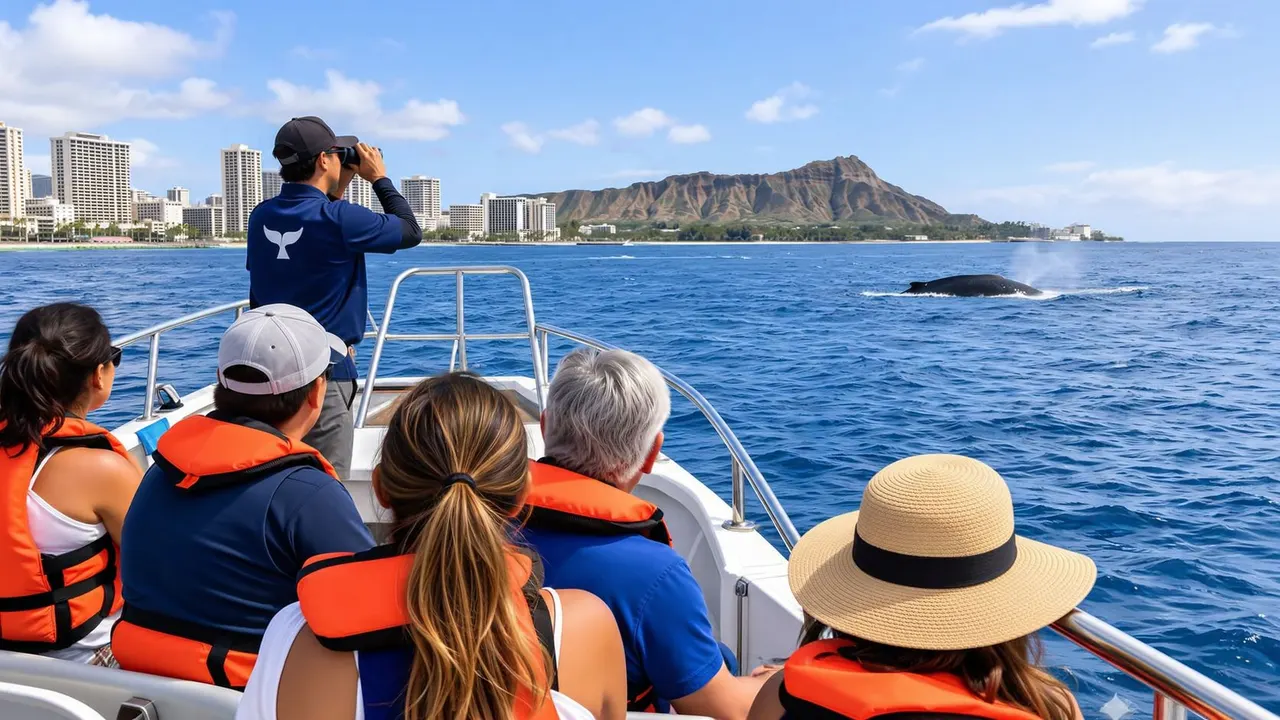
Boarding at Kewalo Basin takes a few minutes. The crew fits life jackets, walks through the approach rules before the engine turns over, and points out the restrooms and the shaded bench. Then the boat idles out past the breakwater and the captain opens up along the Waikiki coastline while a spotter takes the bow with binoculars. The Waikiki Whale Watching Cruise follows that same line, watching for humpbacks that winter along the Waikiki coastline.
The first sign is usually a blow, a white puff that hangs for a second before the wind takes it. Tails and breaches come next. When a whale is inside 400 yards, the captain eases to 6 knots or less, and the approach sector stays conservative, as the Hawaii Division of Boating and Ocean Recreation describes in its guidance for vessels around whales.
Federal law prohibits approaching a humpback within 100 yards, about 90 meters, in Hawaiʻi. The rule covers boats, kayaks, paddleboards, swimmers, drones and any other means, applies throughout Hawaiian waters including sanctuary areas, and reaches out to 200 nautical miles offshore, per NOAA's humpback whale regulations.
What the Crew Does When a Whale Comes to You
Whales don't read the rulebook, and occasionally one surfaces inside the exclusion zone. The response is prescribed and unglamorous. Stop forward movement, leave the engine running in neutral, and wait for the animal to move off. The boat passes behind a traveling whale's path rather than across it. It never splits a mother from a calf, never surrounds an animal, never runs one down from behind.
That geometry is why distance alone doesn't describe a good trip. A boat bearing down on a whale at 120 yards is still pressuring it. A boat idling 200 yards off a whale's flank, engine in neutral, is giving you the better sighting and the animal the better day.
The Distance Table
NOAA sets different minimums for different animals, and the numbers are worth carrying in your head before you step aboard, per NOAA's wildlife viewing guidance for Hawaiian waters.
Treat the 100-yard line as a floor, not a promised viewing distance. Plenty of good trips watch a whale at 300 yards through binoculars for twenty minutes. That's a successful trip, not a consolation prize.
What Passengers Should Do
Stay seated when the crew asks, keep voices low, and skip the sudden move to the rail when a whale surfaces. Don't climb onto the bow for a better angle. Use binoculars or camera zoom instead of asking the captain to close the gap. If an animal chooses to come to the boat, stay calm, give it the right of way, and let it leave on its own terms.
Whale watching is not an aquarium. Many sightings are a distant blow and a dark back, and the trip still earns its fare.
Children do better when the expectations are set early. Tell them the whales are wild, that some of the best moments happen far away, and that a breach is a bonus nobody can schedule. If the whales stay quiet, a good guide fills the time with recent sightings, seabird IDs and whatever else the ocean offers. Report any vessel you see harassing whales to NOAA or the state Division of Boating and Ocean Recreation. For planning around the full winter window, this guide to Oahu whale watching goes deeper on dates and departures.
What to Pack and How to Photograph Whales
Pack for wind and spray rather than for the beach. The water is cooler than the sand, and a two-hour trip crosses more weather than a lounge chair does.
- Reef-safe sunscreen, a hat and polarized sunglasses. Polarized lenses cut glare and let you see a dark back under the surface.
- A light windproof layer. Even a warm Honolulu morning gets cool at speed.
- A refillable water bottle and a dry bag for the phone, wallet and keys.
- Motion sickness tablets taken before boarding, not after the harbor disappears behind you.
- Binoculars for each adult and older child. They turn a distant blow into an actual animal.
Photography That Works From a Moving Deck
- Reach for optical zoom of 200 mm or more on a camera, and switch your phone to its optical lens rather than pinching into digital zoom.
- Shoot in burst mode. A breach lasts about as long as a blink, and ten frames beat one perfectly timed press.
- Keep the shutter fast to freeze spray, and drop the exposure a stop or two so bright water doesn't bleach the whale into a grey smudge.
- Brace against the rail with elbows tucked in. Tripods are useless on a rolling deck.
- Shoot from the shaded side of the boat so the sun is at your back and the whale is lit rather than silhouetted.
Skip the drone, skip the flash, and skip leaning over the rail for a closer frame. If an animal comes alongside, hold still and let it pass.
Give each child a small notebook and a pencil to log time, position and behavior. It keeps them watching the water instead of the snack bag. Keep the camera in the dry bag with the strap already attached, and pull it out only when the crew calls a sighting. For a shoreline comparison and more trip planning, see this Oahu whale watching guide.
Book Your Waikiki Whale Watch This Winter
The booking calendar is the authority on price and dates. Living Ocean Tours runs its Waikiki Whale Watching Cruise from January 2 through March 31, and the trip lasts 1.5 hours, is for ages 3 and up, and costs $49 per person. Check the per-person rate for every traveler in your group, including children, and match the season dates against your travel dates before you lock in flights.
January through March is the window worth aiming at. Work through it in this order.
- Pick a date in January, February or March, ideally early in your stay so a weather cancellation leaves room to rebook.
- Confirm the Kewalo Basin departure point and how you'll get there.
- Ask what happens if weather cancels the trip.
- Choose a departure time and check live availability.
- Call or email with any trip-planning questions before you arrive.
Full trip details sit on the Waikiki whale watching tour page. The office at 1125 Ala Moana Blvd, Slip B-01 is open seven days a week for planning and operations help, and you can reach the team at info@livingoceantours.com or +1 (808) 436-3483.
Book the earliest January or February date that fits the group, and hold a March backup in case weather scrubs the first attempt. That one decision, booking early in the trip, does more for your odds than any other choice you'll make.
Living Ocean Tours runs seasonal whale watches along the Waikiki coastline from Kewalo Basin Boat Harbor, with a crew that treats the approach rules as part of the experience rather than an obstacle to it. If you're planning a winter trip around the humpback migration, the team can help you match a departure date to the strongest weeks of the season and answer questions about the boat, the timing and the water. Visit Living Ocean Tours to see the whale watch schedule and the rest of the Waikiki fleet.


