
Whale Season in Oahu: When to Go and Where to See Them
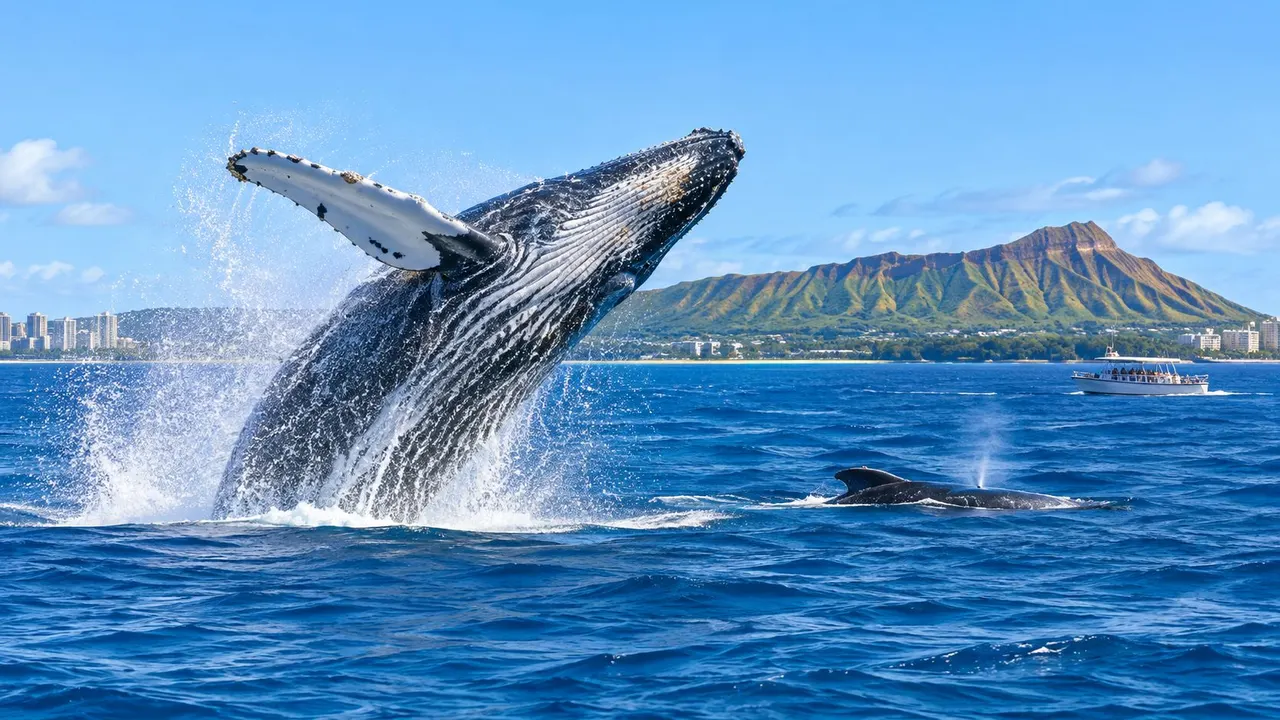

Whale season in Oahu runs from about November through April, and January through March is the peak, when breeding, calving and nursing are most concentrated. That distinction matters more than most visitors expect. Up to 12,000 humpbacks return to Hawaii each year, and the share that moves past Oahu is not spread evenly across those six months. A trip in late November and a trip in early February both fall inside whale season in Oahu, but they do not offer the same odds, the same mix of mothers and calves, or the same booking pressure. Once you understand why humpbacks come here in winter, the calendar starts to make sense, and so do the rules that keep boats at a respectful distance.
When Whale Season Peaks in Oahu
Humpbacks generally arrive in Hawaiian waters from November through April, with the peak viewing period from January through March, according to the Hawaiian Islands Humpback Whale National Marine Sanctuary, which estimates that up to 12,000 humpbacks, representing more than half of the North Pacific population, return to Hawai'i each year to breed, give birth, and nurse their calves. Match your travel dates to that pattern first.
Humpback whale activity off Oahu by month
| Period | Whale activity | Sighting outlook | Trade-off |
|---|---|---|---|
| September to October | First arrivals begin | Sparse and variable | Fewer whales, quieter water |
| November to December | Humpbacks arriving and settling | Moderate and rising | Fewer crowds than peak |
| January to February | Breeding, calving and nursing at peak | Highest odds of sightings | Busiest months; book early |
| March | Peak activity continues with calves | High | Strong odds, still busy |
| April | Whales begin heading north | Declining | Quieter, less certain |
| May | Occasional late departures | Rare | Not recommended for whale-focused trips |
Why the season is concentrated in winter
Humpbacks migrate from high-latitude feeding grounds to Hawai'i's warm, shallow waters for the winter. They are not here mainly to feed. They are here to mate, give birth and nurse newborn calves in conditions that are gentler for a young animal than cold northern seas. That biology explains why activity clusters hard in midwinter instead of spreading evenly.
The edges of the season are real, but thin. First arrivals can appear as early as September and last departures can linger into May, so a September, October or May sighting is possible. A whale focused trip should not be built around those months. Think of November and December as arrival months with rising activity, and April as a departure month with falling odds. January through March gives the strongest probability of breaching, tail slapping, pectoral fin displays and mother and calf travel off Honolulu and Waikiki.
Planning rule: If whales are the main reason for the trip, aim for January to March. If your dates fall in November, December or April, keep the outing, but expect more variation from day to day.
That one rule prevents the most common timing mistake, which is treating every week in a six month window as equal.
What Whale Sightings Look Like From Oahu
Oahu has regular humpback sightings, but expect a good chance, not a promise. Hawai'i state guidance notes in its whale watching FAQ that concentrations around Oahu are generally lower than in Maui, Lana'i, Moloka'i, Kaua'i's north coast and Hawai'i Island's Kohala coast, while January and February are identified as the peak months. A calm trip might still end with only distant blows.
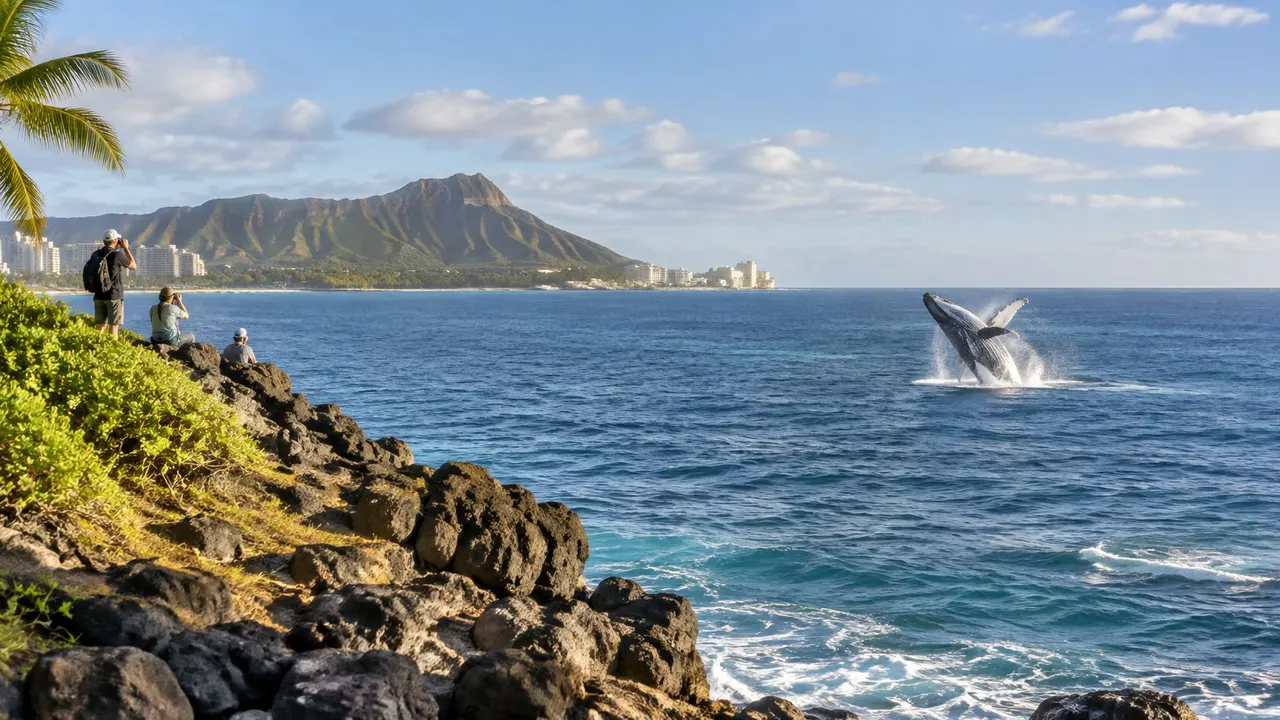
Whales surface intermittently, and sea state affects how easily you spot them. You will not get continuous action. You get a few chances, with quiet scanning in between.
The sequence most sightings follow
First, you usually see a blow, the spout of mist when a whale exhales at the surface. Look for a brief white puff on the horizon rather than a whole animal. Next comes a dark back rolling through the water, then a fluke lifting as the whale dives. Breaches, tail slaps and pectoral fin displays happen, but they are the highlight, not the routine. No crew can order one up on schedule.
Mother and calf pairs are common from January to March. A calf stays close to its mother and surfaces more often, which can give repeated, shorter looks rather than one long view. Flat, calm water and clear mornings make blows easier to spot because there is less chop and glare to hide them.
On our Waikiki Whale Watching Cruise, which views humpback whales that winter in the Hawaiian Islands along the Waikiki coastline, the crew works from high lookout positions and scans constantly for blows, then gives the group time to watch rather than rushing from spot to spot. You can read more about how that scanning works in our guide to whale watching on Oahu. As the top rated and most reviewed snorkel company on Oahu, Living Ocean Tours brings that same lookout habit to winter whale trips.
Patience is part of the sighting. Watch for a blow first. Then the quiet minutes feel like searching rather than waiting.
Best Shore Spots to Watch Whales
You do not have to get on a boat to look for whales, but each shore spot asks something different of you. Pick by access, crowds and how far you are willing to drive.
Shore viewpoints for whale watching on Oahu
| Spot | Side of Oahu | Best for | Watch-out |
|---|---|---|---|
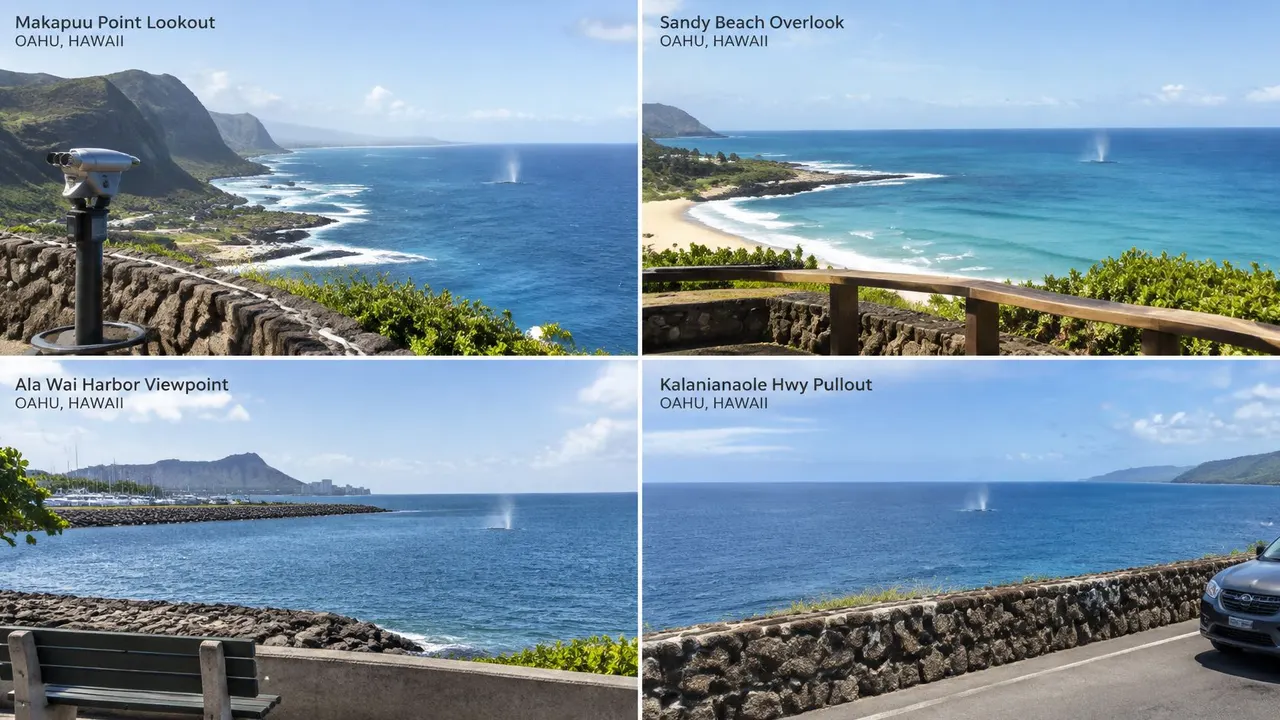
| Makapuu Point Lookout | Windward southeast | Clifftop views over open water | Parking fills early; bring binoculars |
| Halona Blowhole Lookout | South-east coast | Short walk, easy for families | Crowded on busy weekends |
| Kaena Point | Northwest tip | Quieter views with fewer people | Rougher access road; minimal facilities |
| Waikiki Beach and Diamond Head | South shore | Easy access from hotels | Whales usually farther offshore |
How to use each spot
Makapuu Point Lookout gives clifftop height over open water on the windward southeast side. Arrive in the morning because parking fills early in peak season, and bring binoculars as your one required item. Halona Blowhole Lookout on the south-east coast is a short walk with easy access, which suits families with small children, but it gets busy on weekends, so come early and bring water.
Kaena Point at the northwest tip is quieter and suits travelers who prefer sharing the view with fewer people. The access road is rougher and facilities are minimal, so bring everything you need, including sun protection. Waikiki Beach and Diamond Head suit visitors staying nearby who want zero driving. Whales usually sit farther offshore there, so bring binoculars and a beach chair and settle in.
Early morning works best at all four spots. The water is usually calmer and the light is softer, so blows stand out instead of disappearing into glare and chop.
Arrive early, scan slowly from one side of the horizon to the other, and watch any spot where you see a blow for the next surfacing.
If shore viewing leaves you wanting a guided view from the water, Living Ocean Tours departs daily from Kewalo Basin Boat Harbor near Waikiki Beach. Our overview of whale watching spots and tours on Oahu can help you compare your options.
Boat Tours Compared With Shore Viewing
A boat moves you out to where whales travel. You get longer viewing time, a lookout standing above the water, binoculars at hand and narration from a crew that knows local whales and local conditions. A shore spot gives none of that guidance, but it is free and you can leave whenever you like.
The trade off surprises some visitors. A boat does not allow close contact, because viewing distance is still governed by law no matter how the trip is marketed. What a boat buys is position, time and trained eyes, not permission to get nearer.
Decision criteria to weigh
- Budget: Shore viewing costs little beyond parking and binoculars, while a boat adds a ticket price for the whole group.
- Seasickness risk: If anyone in your group gets motion sick easily, a windy day on the water can spoil the outing.
- Young children and naps: Shore viewing lets you work around nap times and leave early without losing a fare.
- Mobility: Some lookouts need only a short walk, while boarding a boat involves docks, steps and a moving deck.
- Your main goal: If whales are the highlight of the trip, a boat improves your chances. If they are an add on to a beach day, shore viewing may be enough.
Pick a morning departure for calmer seas and sit mid boat, where motion is gentlest. That small choice helps children and grandparents in particular. Travelers who only want a few distant blows and a free morning view may do perfectly well from shore with binoculars and flexible time. Booking details for the guided option are covered at the end of this guide.
Legal Distances and Onboard Behavior
Minimum viewing distances for humpback whales in Hawaii
| Who or what | Minimum distance | Rule notes |
|---|---|---|
| Boats and other vessels | 100 yards (91 m) | Stop and put motor in neutral if a whale comes within 100 yards |
| Swimmers, kayakers, paddleboarders | 100 yards (91 m) | Same rule applies whatever the means of approach |
| Drones | 100 yards (91 m) | Treated the same as any approach; keep drones grounded near whales |
| Aircraft | 1,000 feet altitude minimum | Separate rule from the 100-yard zone |
No one may approach a humpback within 100 yards (91 meters) in Hawai'i waters, whether the approach involves a vessel, swimmer, kayak, drone or another means, under the Hawai'i Division of Aquatic Resources guidance on whales and dolphins, which also sets a separate 1,000-foot minimum altitude for aircraft viewing. This is a legal boundary, not a courtesy suggestion.
What the rule actually covers
Deliberately placing a vessel or person in a whale's path so the whale surfaces inside that zone is also banned. According to the Hawai'i Division of Boating and Ocean Recreation humpback regulations, that maneuver is commonly described as "leapfrogging" or interception, and the approach rules apply throughout Hawaiian waters within 200 nautical miles of the islands. In plain terms, you cannot cut in front of a traveling whale and wait for it to come to you.
The rule stays in force when a whale closes the distance on its own. If a whale comes within 100 yards, the operator stops maneuvering, puts the engine in neutral while leaving it running, and waits for the animal to move away. Good operators also keep to no wake speed, avoid sudden course or speed changes and never position a boat between a mother and calf. That steady handling is part of a high quality trip. It protects calves that surface unexpectedly and it lets natural behavior continue. The result is a calmer, longer look from a proper distance.
Six things to do on board
- Listen to the briefing: Note where the lookout stands and what the crew wants you to do when a whale is spotted.
- Stay where you are asked: Stay seated or in your assigned area so the boat stays balanced.
- Keep children close: Hold young children within arm's reach and away from the rail.
- Use optics, not your feet: Reach for binoculars or camera zoom instead of shifting to one side of the boat.
- Stay put if the engine cuts: If the captain goes to neutral, remain where you are and wait.
- Never approach on your own: Do not swim, paddle or fly a drone toward a whale, before, during or after the tour.
Our summary of Oahu whale watching rules collects these points in one place for reference before you board.
The closest encounter is not always the best encounter. A respectful operator may hold distance even when guests want a nearer view.
Report any suspected violation to the NOAA Fisheries Enforcement Hotline at 800-853-1964, as listed in state guidance on protecting marine species. A successful encounter is natural behavior seen from a distance, with the whale carrying on as if your boat were not especially interesting.
Packing and Gear for a Family Whale Trip
Pack for wind, glare and a bit of waiting. Most discomfort on a whale trip comes from cold wind and motion, not from the whales being far away.
For everyone on board
- Compact binoculars, 8x or 10x: They let you watch from the deck instead of pressing toward the rail.
- Telephoto or zoom camera setting: You get usable photos without needing the boat to get closer.
- Reef-safe sunscreen and a rash guard: Sun reflects off the water even on overcast mornings.
- Hat and sunglasses with a strap: A strap keeps both on your head when the wind picks up.
- Warm layer and windbreaker: Wind on open water feels colder than the temperature on shore.
- Motion-sickness medicine: Take it 30 to 60 minutes before boarding so it has time to work.
- Snacks and water for kids: Scanning takes patience, and hungry children run out of it quickly.
- Dry bag: Phones, wallets and car keys stay safe from spray.
For children and grandparents
For children under six, pack a favorite quiet toy, sit near the center of the boat where motion is gentlest, and plan the departure around naps rather than through them. A tired toddler will not care about a breach. Short and sweet wins.
For multigenerational groups, give each generation its own binocular holder so no one waits for a turn, agree on a meeting point at the dock in case the group splits up, and confirm in advance whether life vests are provided for small children. Our Oahu whale watching packing list puts the essentials in one place.
Screenshot this short version before you leave the hotel: binoculars, zoom, sunscreen, hat with strap, warm layer, motion medicine taken early, snacks, water, dry bag. If those nine things are in your bag, you are ready.
Whale Season Oahu FAQ and Quick Facts
Is whale season in Oahu year-round? No. Humpbacks are here in the winter months, with September arrivals and May departures as the outer edges.
When is the best month? January through March, with January and February identified as the peak months.
Can I see whales from shore? Often yes, but usually as distant blows from Makapuu, Halona, Kaena Point or Waikiki, so bring binoculars.
Is a sighting guaranteed on a tour? No. Sightings depend on whale presence and sea state, so ask about the weather policy when you book.
How close can I legally get? No closer than the legal minimum distance by any means, with a separate altitude rule for aircraft.
Do I need to book ahead? Yes for January to March, when departures fill.
Are children welcome? Our Waikiki Whale Watching Cruise accepts ages 3 and up. Confirm life vest and seating needs with us before you come.
Quick facts worth knowing
The recovery behind today's season is remarkable. Before intensive commercial whaling, the North Pacific humpback population was estimated at roughly 15,000 whales, and hunting reduced it to only about 1,000 to 1,400 animals by the early 1970s, according to the NOAA Fisheries humpback whale profile. The Hawaiian Islands Humpback Whale National Marine Sanctuary was created by Congress in 1992, and a large international SPLASH study estimated approximately 10,000 humpbacks used Hawaiian waters as a breeding and calving area in 2006. Every whale you watch from Oahu is part of that protected recovery, which is another reason distance and patience matter.
Book a January to March Whale Watch
Book a January through March departure if whales are the point of the trip. If your dates are flexible, choose a morning departure on a day with a calm forecast, because calmer seas make blows easier to spot and the ride easier on children and grandparents.
Our Waikiki Whale Watching Cruise runs January 2 through March 31, lasts 1.5 hours, is for ages 3 and up and costs $49 per person. Those dates are chosen deliberately to cover the peak window rather than the thin edges of the season. Full details are on our Whale Watch tour page.
Questions to confirm before you book
- Departure window: Does the trip run on your exact dates, and what time should you arrive at the harbor?
- Weather policy: What happens if the sea is too rough on the day?
- Rebooking: Can you move to another day if conditions force a cancellation?
- Children's needs: Are life vests provided for your child's size, and where should your family sit?
You can reach us by email at info@livingoceantours.com or by phone at +1 (808) 436-3483. Our phone hours are 8am to 5pm daily, and our office is open seven days a week to help with planning. Ask us the questions above directly and we will confirm the details for your group.
Living Ocean Tours brings an education led approach to winter whale watching, with lookouts, narration and strict respect for viewing distances.
Your next step is simple. Pick a January to March date, book the morning departure that fits your group, then pack using the checklist above. You will board knowing what a real sighting looks like, why the boat keeps its distance and what to watch for first on the horizon.
Living Ocean Tours runs seasonal whale watching along the Waikiki coastline during the January to March peak, alongside year-round snorkeling and sunset cruises departing from Kewalo Basin Boat Harbor. If you would like a guided trip with a trained lookout, crew narration and respectful viewing distances during whale season in Oahu, visit Living Ocean Tours to choose your date and check availability.


