
Hawaii Whale Watching Season Peak: A 2026 Guide
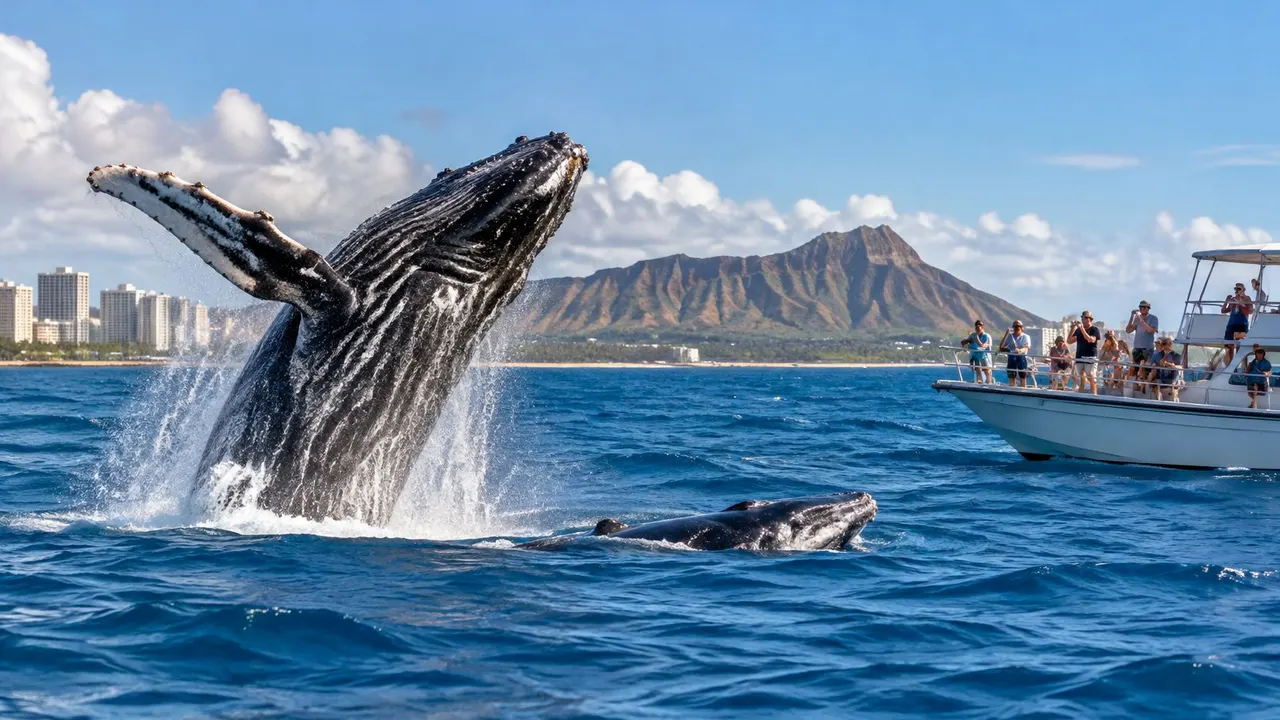
You're in Waikiki in February, coffee in hand, and someone on the beach is pointing offshore. A white plume rises, then a dark back rolls and disappears. That's the moment most visitors realize winter in Hawaii isn't just about escaping cold weather. It's about arriving when thousands of humpbacks do. The question isn't whether winter is whale season. It's whether you're picking the right week, the right island departure, and the right boat for how your group travels.
Why Winter Whales Make Hawaii Special
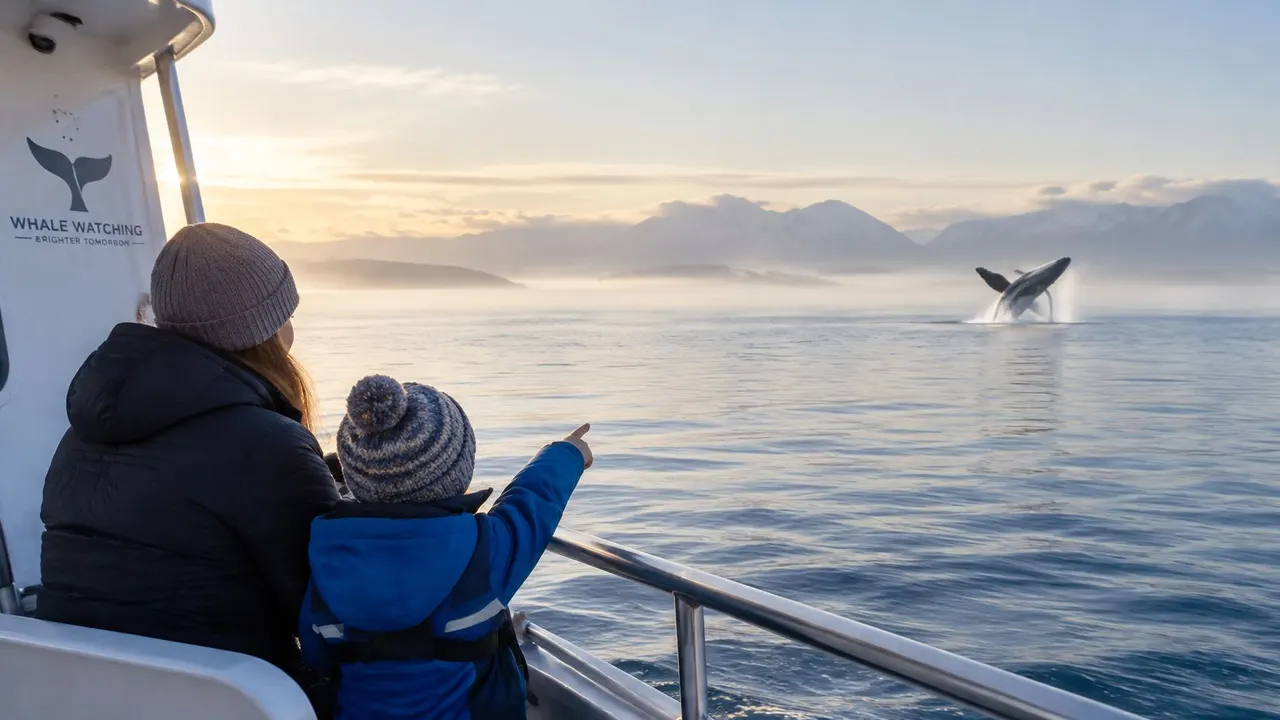
On a late January morning out of Waikiki, the routine is familiar. Diamond Head is still in shadow, the south shore water is glassy before the trades fill in, and the crew is scanning in quadrants, not staring at one spot. First you hear a passenger say it before you see it. A blow, tall and bushy, hangs for a second. Then a second animal surfaces closer, and a calf porpoises beside its mother in water so clear you can track the white pectoral fins below the surface.
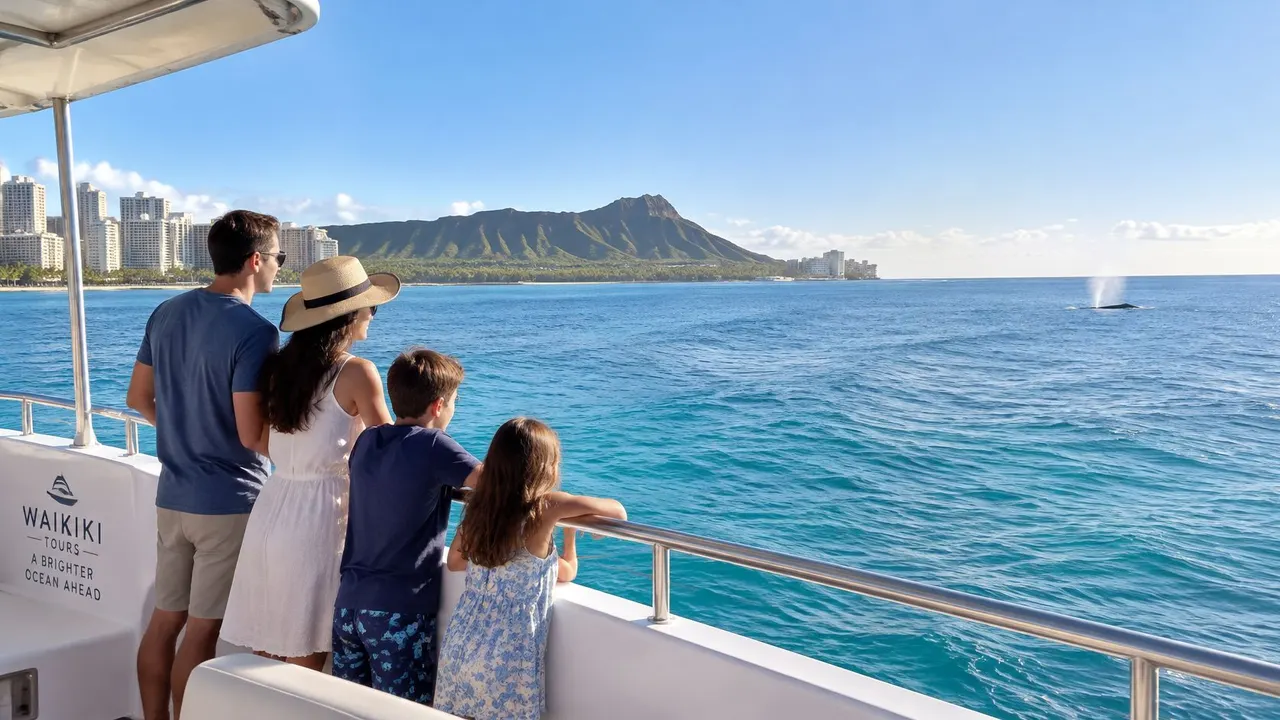
That scene happens because Hawaii functions as a breeding and calving ground, not a feeding ground. Humpbacks migrate from higher-latitude North Pacific feeding areas into warm, relatively shallow water where mothers can give birth and nurse. They generally fast while they're here, living off stored energy, which is why you won't see the bubble-net feeding behavior people associate with Alaska. What you will see is social and maternal behavior, tail slaps, pectoral slaps, breaches, and males competing or escorting a female and calf.
What the Winter Concentration Really Means
The scale is what makes planning worthwhile. NOAA's Hawaiian Islands Humpback Whale National Marine Sanctuary overview estimates as many as 12,000 humpback whales, more than half of the North Pacific population, return during the broader November to May period to breed, give birth, and nurse calves.
That doesn't mean every departure finds a whale beside the boat. Animals move between islands, stay down on long dives, and surface where they choose. It does mean the Hawaii whale watching season peak is built on a genuine seasonal concentration, not marketing language. Winter gives you the density. Your date, departure point, and sea conditions determine how well you use it.
The Season Phased From Arrival to Departure
Think of the season in phases, not as a switch that flips on January 1. Whales trickle in, build to a measurable peak, then thin out unevenly. Each phase feels different on the water and suits a different kind of traveler.
Three Phases on One Calendar
Hawaii Whale Season Phases at a Glance
| Phase | Typical Dates | What You See | Best For |
|---|---|---|---|
| Arrival | November to early December | First scattered whales, early song, quieter boats | Travelers already here, flexible expectations |
| Statistical peak | Mid-January to late March | Highest abundance, calves, competitive groups | Whale-focused trips, families prioritizing sightings |
| Shoulder and departure | April into May | Fewer whales, variable days, easier availability | Lower crowd pressure, combined ocean itineraries |
Early season trips can be rewarding precisely because they're quiet, but crews have to work harder for each encounter and some days produce only distant blows. By mid-January the odds change noticeably. You're more likely to encounter multiple groups on one outing and to see calves practicing the surface behaviors adults do with far more power.
Where the Numbers Point
The most precise window sits inside that peak, not across all of it. NOAA Fisheries' summary of two decades of Hawaiian survey work estimated approximately 11,000 humpback whales in Hawaii's exclusive economic zone during the 2020 peak period, with the strongest abundance window at approximately February 19 through March 22. The formal estimate was 11,278 whales, and NOAA notes that figure describes whales present at a particular time, while the cumulative number visiting across the whole season may be higher because individuals arrive and depart at different times.
Planning translation: January is legitimately high season, but late February into early March is when regional abundance is statistically strongest.
By April, you're not chasing nothing. You're accepting more variability in exchange for availability and breathing room. That's a rational trade for some groups, as long as nobody sells it to you as identical to February.
Maui Versus Oahu and the Other Islands
Every Waikiki visitor eventually asks whether they should fly to Maui just for whales. The honest answer depends on what you're optimizing for, because these islands don't offer the same probability profile.
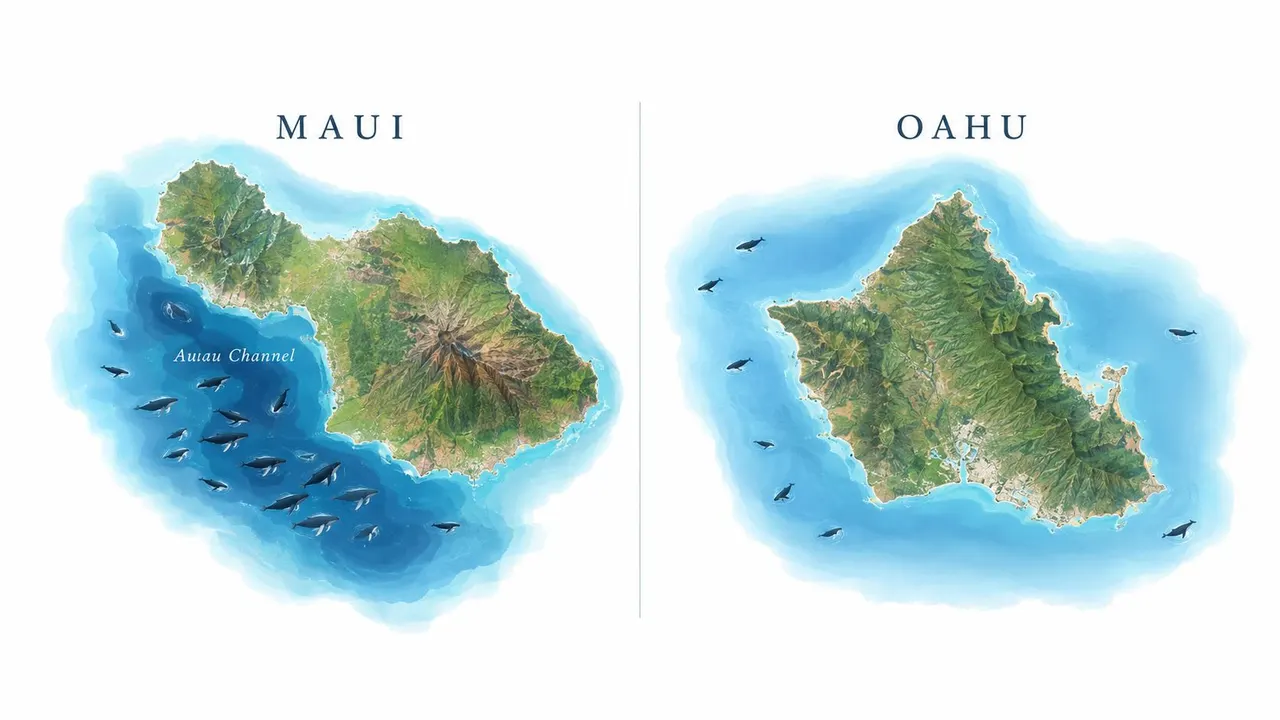
Guidance from Hawaii's Division of State Parks on whale watching timing and islands places the highest concentrations between Maui, Lanaʻi, and Molokaʻi, while Oahu sightings are common yet less frequent than in those areas. The shallow channels in Maui County hold dense aggregations, which is why Maui content so often reads like whales are everywhere, all day. During peak weeks, that impression isn't far off.
What Oahu Does and Does Not Offer
Oahu is a different proposition, and that distinction gets lost when it's pitched as Maui-light. From Waikiki you get convenience that matters with kids and grandparents, a short transfer from your hotel, south shore departures under Diamond Head, and a genuine chance at close, memorable encounters in January through March. What you don't get is Maui County density. Crews on Oahu search more water between groups, and a slow day here can mean distant sightings while a slow day off Maui still produces several groups.
The Big Island's Kona Coast sits in between in character, with typically calm, sunny leeward water and whales spread along a long coastline. It's a strong choice if you're already staying there, less logical as a day trip from Waikiki.
If whales are the single purpose of your vacation and you're choosing islands from scratch, base yourself on Maui. If you're staying on Oahu and want whales woven into a broader trip, go from Waikiki and set expectations correctly. Our detailed breakdown of Oahu whale watching compared with Maui departures walks through that logistics decision if you're still split.
Best Days and Times to Go on the Water
Once you've picked your island and month, the daily choice matters more than many expect. Whales don't keep office hours, but wind, glare, and boat traffic follow patterns you can use.
Mornings Win for Most Groups
On Oahu's south shore, mornings typically start calmer before trade winds build through the day. Calmer water makes blows easier to spot, reduces motion for sensitive passengers, and gives children a better first experience. Afternoons can still produce excellent encounters and warmer light for photos, but chop hides low-profile calves and turns a pleasant ride into work for anyone prone to seasickness. Weekdays also tend to feel less crowded at the harbor and on the water than weekends during peak weeks.
Daily Decision Aid for Oahu Whale Tours
| Group Type | Preferred Window | Sea Conditions | What to Expect |
|---|---|---|---|
| Families with young children | Weekday morning | Light wind, small chop | Easiest spotting, gentlest ride |
| Motion-sensitive adults | Earliest departure | Calmest available day | Shorter exposure to building trades |
| Photographers | Morning or late afternoon | Low glare angles | Better light on blows and breaches |
| Flexible couples | Any peak-season day | Moderate conditions acceptable | More rebooking options if weather shifts |
Timing within the season still anchors everything. NOAA's sanctuary acoustic and survey research page reports west Maui aerial survey density at 1.20 whales per square kilometer in 2018-19, 1.59 in 2019-20, and 1.24 in 2020-21, with February the highest-abundance month in all three seasons. NOAA also tracks male song with bottom-moored recorders, and song intensity rises between December and April as whales arrive, peak, and depart.
Pick your date first for abundance, then your departure time for comfort. For a deeper look at departure timing, see this guide to the best time of day for whale watching from Waikiki.
What a Whale Watch Tour Actually Looks Like
A typical winter departure from Kewalo Basin starts unglamorously, and that's a good sign. You check in, get a safety briefing that covers moving around the deck, and hear where to stand so everyone can see. Crews who brief well at the dock run calmer boats when a whale surfaces and forty people all move to one rail at once.
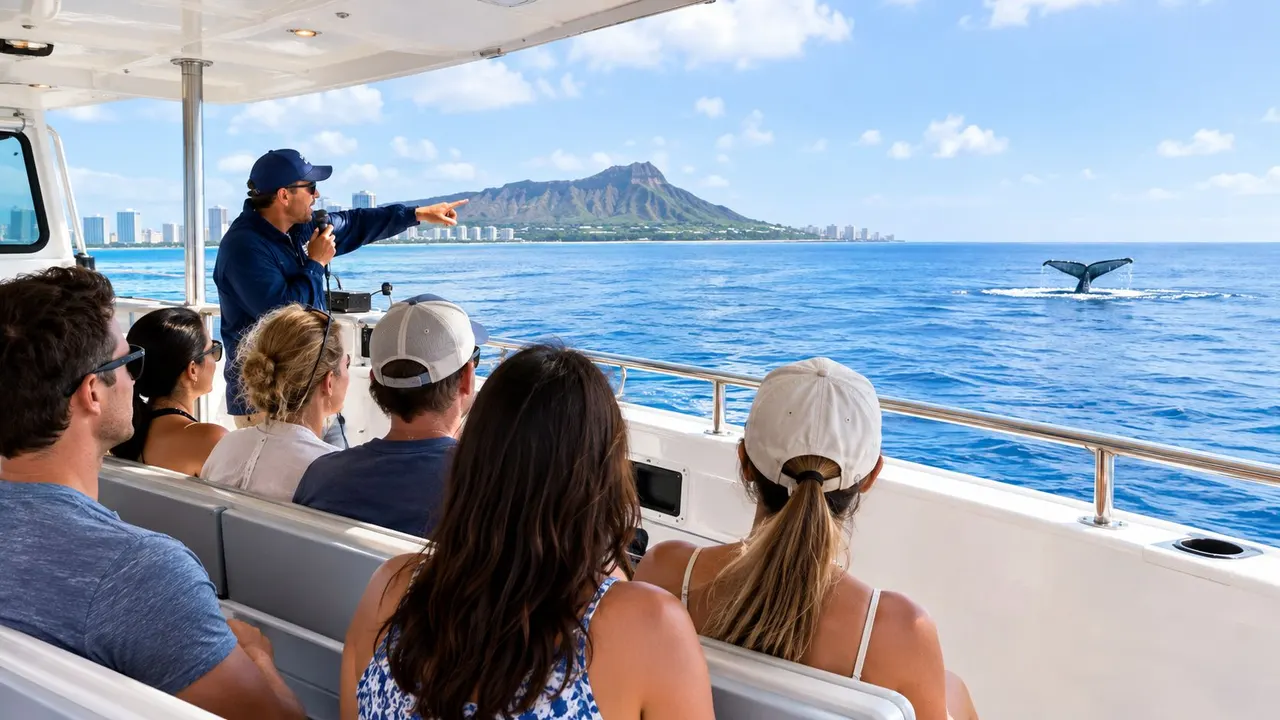
Heading out past Waikiki toward Diamond Head, the captain and crew divide the horizon into search sectors. They're looking for the sequence every guest learns within twenty minutes, a blow first, then a back and dorsal fin, then a deeper arch that signals a fluke-up dive. Between groups, a good naturalist fills the search time with what's happening below, why a calf rides near its mother's head, why an escort stays close, and what a competitive group looks like when multiple males jostle at the surface.
Listening as Well as Looking
Many boats lower a hydrophone, an underwater microphone that lets you hear male humpbacks singing in real time. On a quiet morning the song carries through the hull speakers while the singer himself stays invisible below. Kids who are struggling to spot distant blows often lock in at exactly this point, because hearing a whale is immediate in a way scanning a horizon isn't.
The encounter itself is usually measured in surfacings, not hours beside one animal. A group surfaces, dives, and may reappear hundreds of yards away.
That's why captains position patiently and sometimes shut down and drift. If a whale chooses to approach a stopped boat, you get the encounter everyone hopes for, on the whale's terms. Then it's back to the harbor, usually with Diamond Head photos you didn't plan on and a much better eye for spotting blows from shore for the rest of your trip.
Responsible Viewing Rules Every Operator Should Follow
Responsible viewing isn't a vibe. It's a set of enforceable distances and operating practices, and you can tell within one encounter whether your captain takes them seriously.
The Distances That Are Law, Not Suggestions
NOAA Fisheries' Hawaii marine wildlife viewing guidelines state that federal law prohibits approaching a humpback whale within 100 yards in Hawaii regardless of vessel type, and NOAA recommends a maximum speed of six knots when approaching for observation within 400 yards. That 100-yard rule, roughly a football field, applies to boats, kayaks, paddleboards, swimmers, and drones alike. Aircraft must stay at least 1,000 feet away.
- No chasing or encircling: Operators shouldn't pursue, trap, leapfrog, or place the vessel in an oncoming whale's path.
- Slow inside 400 yards: Speed drops to six knots or less on approach and departure.
- Stop inside 100 yards: If a whale surfaces close, the vessel stops and lets the animal move away.
- No behavior disruption: If whales change direction repeatedly or a calf is present, the right move is more distance, not a better camera angle.
What Good Looks Like From the Rail
A responsible encounter can feel anticlimactic for thirty seconds. The captain slows early, approaches from the side at an angle, holds distance, and lets the whales set the closing speed. A bad encounter feels exciting for the wrong reason, with the boat accelerating toward blows, cutting across a whale's line, or crowding a mother and calf because passengers want closer photos.
Ask before you book how an operator handles a close approach by a curious whale and how long they'll stay with one group. Specific answers signal training. Vague promises of getting you close signal the opposite. You can read more about how this works on local departures in this overview of responsible whale watching practices on Oahu.
Choosing a Month When You Travel in February or Off-Peak
If you can choose any month purely for encounter odds, choose February. The survey density and NOAA's late February abundance window point the same direction. But the best statistical month isn't automatically the best month for your family, and pretending otherwise sets people up for a crowded, rigid trip they didn't need.
Volunteer shore-count information summarized from sanctuary data indicates late-January and late-February counts can be similar, while on Oahu reported March counts were about two-thirds of February levels. That matters for planning. A late January trip isn't a compromise booking, it's often statistically close to February with better availability, easier rebooking after a windy day, and less pressure on every other reservation in your itinerary.
Early March deserves the same honest framing. Whale numbers are declining from peak, but calves are bigger and more active at the surface, boats are slightly less packed, and families traveling around school schedules get flexibility February doesn't offer. Weigh the variables that shape trip quality, not abundance alone.
- Choose February if whales are the headline and your dates are fixed.
- Choose late January for near-peak activity with more scheduling room.
- Choose early March if comfort, availability, and active calves outweigh maximum density.
- Choose December or April only with expectations set for variable sightings.
Booking Checklist for Waikiki and Oahu Visitors
Pull the decisions together in order and booking gets simple. Most disappointment I see comes from reversing that order, picking a boat before thinking about dates, sea conditions, or what the group can handle.
A Short Checklist That Works
- Dates first: Target January through March, with late February strongest and late January close behind.
- Departure second: Book a weekday morning if anyone in your group is young, older, or motion sensitive.
- Operator standards third: Ask about the 100-yard rule, hydrophone use, group size, and weather rebooking before you pay.
- Expectations last: Brief your group that Oahu offers common but not Maui-density sightings, and that listening to song counts as an encounter too.
For Waikiki-based visitors, a whale watch pairs naturally with the rest of a south shore itinerary. You can review the seasonal Waikiki whale watch tour departing near Waikiki alongside other ocean days, and this additional guide to planning an Oahu whale watching outing covers harbor logistics in more detail.
Living Ocean Tours is the top rated and most reviewed snorkel company on Oahu, and its winter whale departures run within that same January through March peak window from the Waikiki area.
Book the morning, dress in layers for wind on the ride out, bring polarized sunglasses for spotting blows against glare, and give yourself one flexible backup day in peak weeks. That single buffer day does more for your odds than any other planning move.
Ready to see the Hawaii whale watching season peak from the water instead of the beach? Living Ocean Tours runs seasonal Waikiki whale watching departures during the January through March peak, with experienced crew, responsible viewing practices, and easy access from Waikiki hotels. Visit Living Ocean Tours to check winter dates and reserve your morning on the water.


