
Cruise to See Whales in Oahu: Season, Tips and Tours
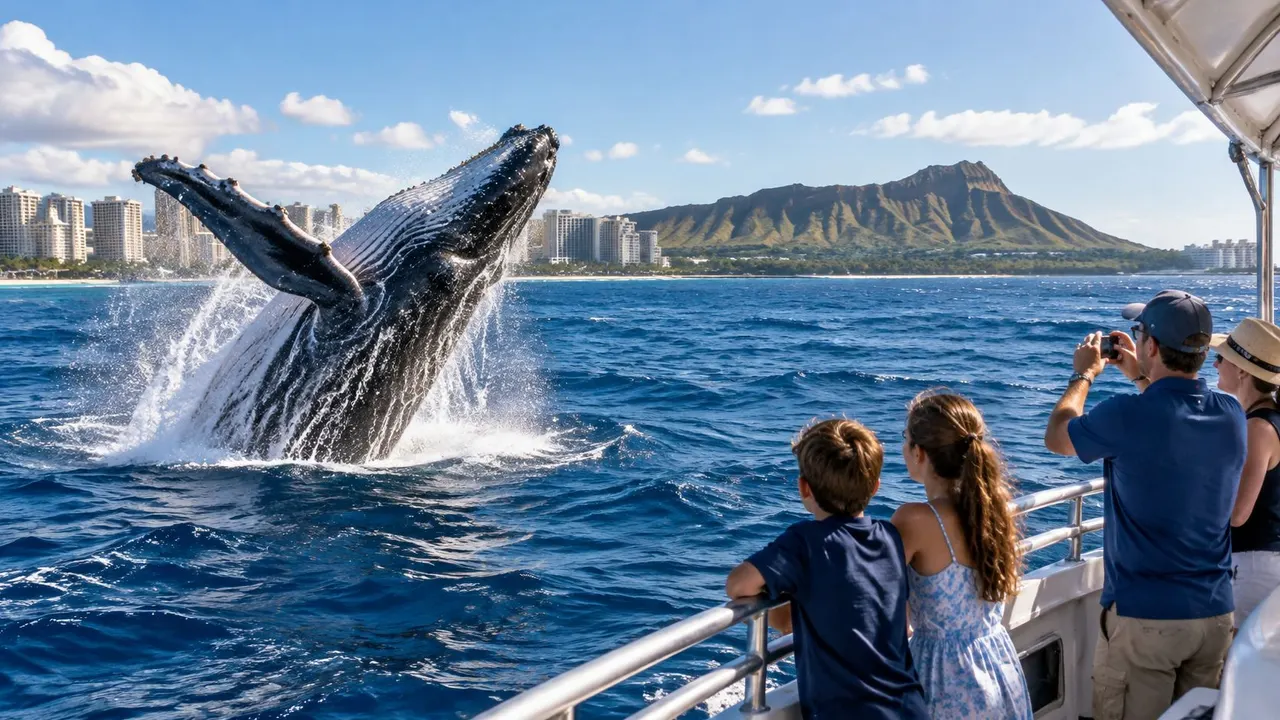
Whale-watching tourism generated more than US$2 billion worldwide in 2009, according to the International Whaling Commission. That scale helps explain why travelers sometimes arrive expecting a polished performance. But a cruise to see whales is an opportunity to observe wild animals, not a reservation for a breach beside the boat.
Around Oahu, a rewarding trip starts with the right season, realistic expectations, and a family that's comfortable on the water. A distant blow can be a genuine sighting. A quiet period can be part of a good encounter. And a captain who keeps a respectful distance is doing the job properly.
Whale Season Around Oahu Month by Month
Humpback whales winter in Hawaiian waters, making approximately November through April the relevant viewing season, with NOAA expecting peak numbers in the Hawaiian Islands Exclusive Economic Zone from approximately mid-February through mid-March, according to the Hawaiian Islands Humpback Whale National Marine Sanctuary. They come primarily to mate, give birth, and raise calves, rather than to perform the feeding behavior travelers may associate with other destinations.
For practical vacation planning, think of the heart of winter as your strongest opportunity. The edges of the season require more flexibility because arriving and departing whales aren't distributed evenly around the island.
Read the calendar as an outlook, not a promise
The table below gives qualitative planning labels, not measured sighting percentages. Its behavior descriptions are examples of what you might observe, not activities scheduled for particular months.
| Month | Whale presence | Most likely sighting | Outlook |
|---|---|---|---|
| November | Early arrivals, season opens | Scattered blows, few breaches | Fair |
| December | Rising seasonal presence; male song becomes prominent underwater | Blows and occasional tail lifts | Good |
| January | High, core season | Repeated blows, breaching possible | Very good |
| February | Peak begins mid-month | Groups and sustained surface activity possible | Excellent |
| March | Peak continues through mid-March | Surface activity, including mothers with calves | Excellent |
| April | Declining, late departures | Scattered blows at distance | Fair |
| May | Few whales remain | Occasional sightings | Limited |
| June to October | Off-season, rare | Dolphins and seabirds are more realistic wildlife interests | Poor for whales |
Male song is a separate kind of evidence from a visible encounter. NOAA's acoustic monitoring overview identifies December through April as the period when humpback song dominates underwater ambient noise in many Hawaiian locations. That doesn't mean passengers will hear singing from the deck, or that a singing whale will surface nearby.
A February trip can still involve long stretches of scanning. An early-season outing might produce an unforgettable breach. Season improves your opportunity, but it doesn't determine an individual whale's behavior.
Planning rule: Choose a date inside the strongest seasonal window when whales are the main reason for your outing. For a trip near either end of the season, leave room in your itinerary to adjust.
Don't make your departure the final activity before an airport transfer. A flexible vacation day gives you options if weather changes the operating plan, and it keeps a wildlife outing from becoming a stressful deadline.
What Seeing Whales on a Cruise Really Looks Like
Say your family has just settled aboard a boat off Waikiki. A guide points toward a pale puff above the horizon, and everyone lifts a phone. By the time you find the right patch of water, the puff has disappeared.
That blow counts as seeing a whale, even if it doesn't resemble the photograph that inspired your booking. Humpbacks winter along the Waikiki coastline, so the viewing area can be within reach of Honolulu without the encounter feeling close or continuous.
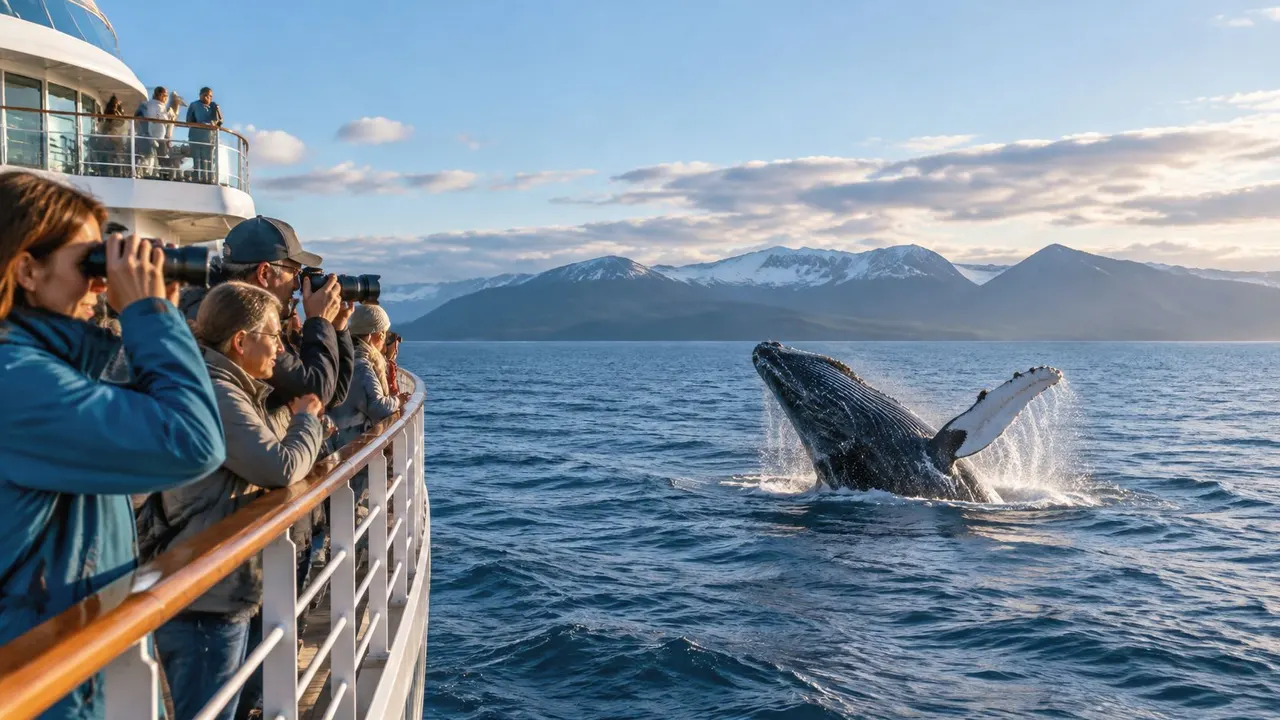
Recognize the sighting ladder
Think of whale watching like birdwatching in a park. Some days you notice a flock across a lagoon; on others, a bird lands near the railing. Both are worthwhile, but you can't order the second experience.
- A distant blow: Look for a brief plume, then keep watching that area instead of immediately checking your photo.
- A back and diving tail: You may see the curved back first, followed by the tail lifting before a dive.
- Pectoral-fin or tail slapping: Surface splashes can draw attention before you clearly distinguish the animal.
- A breach: A whale launches partly or largely out of the water. It's dramatic, brief, and easy to miss while adjusting a camera.
- Extended surface activity: A mother and calf or another group may remain observable, allowing the guide to explain what guests are seeing.
This isn't a guaranteed progression. Your trip might stop at the first item, skip straight to a breach, or include no visible whales.
Conditions shape the experience
Calmer water makes small blows easier to distinguish from whitecaps. Morning departures are often a sensible starting point for planning, but a morning ticket isn't a promise of smooth seas, and an afternoon outing isn't automatically inferior. Ask about the actual forecast rather than choosing solely by the clock.
Ocean conditions also affect whales beyond the day's viewing weather. Food availability in their feeding grounds can influence their condition and seasonal abundance, which is another reason not to treat last season's encounters as a forecast for your departure. The NOAA responsible wildlife-viewing guidance provides a useful foundation for observing animals without turning an encounter into a pursuit.
When whales stay quiet, look back toward Diamond Head, watch seabirds, and listen to the guide's explanation of migration and conservation. A sea turtle may appear, too, but other wildlife shouldn't become a replacement guarantee.
Boat Viewing Versus Shore Viewing on Oahu
Shore viewing is worth trying, but it's best treated as a scenic opportunity rather than your only whale-watching plan. The sanctuary's recreation guidance identifies Oahu's southeast coast as a viewing area while noting that sightings there are less frequent than at several other Hawaiian locations.
Public coastal viewpoints around Diamond Head and Makapuu can suit travelers who want to scan the ocean without committing to a departure. Choose a safe, established viewing place, bring binoculars, and avoid assuming that access to every trail or managed attraction is free.
| Factor | Boat cruise | Shore viewing |
|---|---|---|
| Closeness to whales | Potentially clearer views of blows, tails, and surface behavior while respecting separation rules | Distant, often small blows on the horizon |
| Cost | Paid trip per guest | Free from public lookouts where no access fee applies |
| Comfort | Check the vessel's seating, restroom, and shade arrangements | Bring sun protection; seating and shelter aren't assured |
| Seasickness risk | A consideration for motion-prone guests | No boat-motion exposure |
| Guide commentary | Crew interpretation of behavior and migration | Usually self-guided, using signs or a phone guide |
| Best for | Families prioritizing a dedicated viewing opportunity | Budget-conscious travelers and short, flexible visits |
Choose the experience your group can enjoy
A boat gives you a moving observation platform and a crew focused on finding wildlife. That can make a blow or tail easier to interpret, especially for children who don't yet know what they're looking for. It still doesn't mean the captain can steer directly toward every animal.
Land works particularly well when someone in the group dislikes boats or wants the freedom to stop after a short scan. You can make the outing worthwhile with a coastal walk or scenic stop rather than waiting indefinitely for a sighting.
At Living Ocean Tours, we depart daily from Kewalo Basin Boat Harbor near Waikiki Beach. Living Ocean Tours is Oahu's top rated and most reviewed snorkel company, a credential relevant to travelers comparing guided ocean experiences, though it shouldn't be confused with a whale-sighting guarantee.
Use our Oahu whale-watching planning guide to help decide whether a dedicated departure fits your itinerary.
Choose a boat when you want focused wildlife searching and guided interpretation. Choose shore viewing when flexibility, scenery, and keeping costs down matter more than getting a clearer view.
Viewing Distances and Rules That Protect Whales
Humpbacks in Hawaiian waters must not be approached within 100 yards, about 91 meters, and NOAA recommends vessel speeds of 10 knots or less in whale-viewing situations, as explained in its marine-life viewing guidelines. The separation requirement applies regardless of whether someone approaches by boat, kayak, paddleboard, swimming, or drone.
Aircraft have a separate limit of at least 1,000 feet, about 300 meters, and if a whale approaches a motorized boat on its own, NOAA advises remaining stationary with the engine in neutral until it moves away, according to the sanctuary's whale-protection regulations. A whale choosing to come closer doesn't give the captain permission to follow it afterward.
What a responsible crew does
- Keep a designated lookout. Someone must watch for whales while the captain also manages navigation, nearby traffic, and changing sea conditions. Passengers can help by calmly pointing out a blow without rushing across the deck.
- Reduce speed around whales. Slower travel gives the crew more time to react and reduces the severity of a potential strike. A good encounter begins before the boat reaches its viewing position.
- Manage accidental proximity without pursuit. If the boat enters the separation zone, the captain should stop or slowly increase distance as appropriate. Chasing, intercepting, approaching head-on, or cutting through a group isn't acceptable viewing behavior.
- Keep an escape option available. Propulsion and steering need to remain ready when maneuvering is necessary. The captain should avoid placing the boat directly in a whale's travel path or creating a situation with no safe way out.
- Let an approaching whale pass. When an animal comes toward the boat, passengers should stay calm and follow crew instructions while the captain handles the stationary, neutral-engine procedure.
- End the encounter when necessary. If maintaining safe separation becomes difficult, leaving is the responsible decision. More viewing time isn't worth crowding animals or compromising navigation.
Your job as a guest
Stay seated when directed, use handholds, and keep your weight inside the rail. Don't lean outward to improve a photograph or move suddenly toward the side where a whale appears.
Binoculars and camera zoom are the right tools for a closer look. Touching, swimming toward, or encouraging a captain to chase a whale undermines the encounter you came to enjoy.
Our responsible Oahu whale-watching guide can help your family understand the difference between an exciting encounter and an inappropriate approach. The same practical standard should apply whether you're aboard a family departure or arranging a private outing.
Family Safety for Kids, Seniors and Motion-Sensitive Guests
A whale cruise is still a boat trip. Motion, sun exposure, and secure footing deserve as much planning as the wildlife.
| Guest | Main concern | What to do |
|---|---|---|
| Young children | Restlessness and seasickness | Request a mid-boat seat where available, pack permitted snacks, and bring a quiet activity |
| Motion-prone adults | Seasickness | Ask a pharmacist or clinician about medication and timing before boarding; watch the horizon |
| Older guests | Slippery decks and steps | Wear grippy closed-toe shoes and use handrails |
| Pregnant guests | Delayed care, motion sickness, and slip risk | Our tours aren't recommended during pregnancy; speak with your doctor before booking |
| Guests with mobility limits | Boarding and moving on deck | Contact us about your boarding and access needs before booking |
Plan around the person who needs the most support
For a child, make spotting an activity rather than a test. Ask them to look for a puff, a dark back, or a splash, and make clear that they haven't failed if a whale disappears before they see it. A quiet whale-spotting game is more useful than promising that the next animal will jump.
Motion-sensitive adults should avoid spending the departure looking down at a phone. If medication is appropriate, follow its label and professional advice about when to take it; don't wait until nausea begins to ask what might help. Wristbands aren't a substitute for a suitable prevention plan.
We don't recommend our tours for pregnant women because access to health care can be delayed, motion sickness can be a concern, and boats present slip-and-fall risks. A discussion with your doctor is important, but it shouldn't replace understanding our recommendation before you make travel arrangements.
Older travelers and guests with mobility limitations need a clear picture of boarding, steps, seating, and movement aboard. Tell us what assistance you need rather than assuming that a general description of a boat answers your access questions.
Our guide to whale watching with kids can support the family conversation before departure.
Family decision: Plan around the least patient or least steady person in the group. A comfortable, manageable outing is more valuable than an ambitious trip someone has to endure.
Packing Checklist for a Whale Watching Cruise
Pack a compact bag the night before, then leave it where everyone can find it. You'll want your hands free for boarding and handrails, not occupied by loose jackets, bottles, and camera cases.
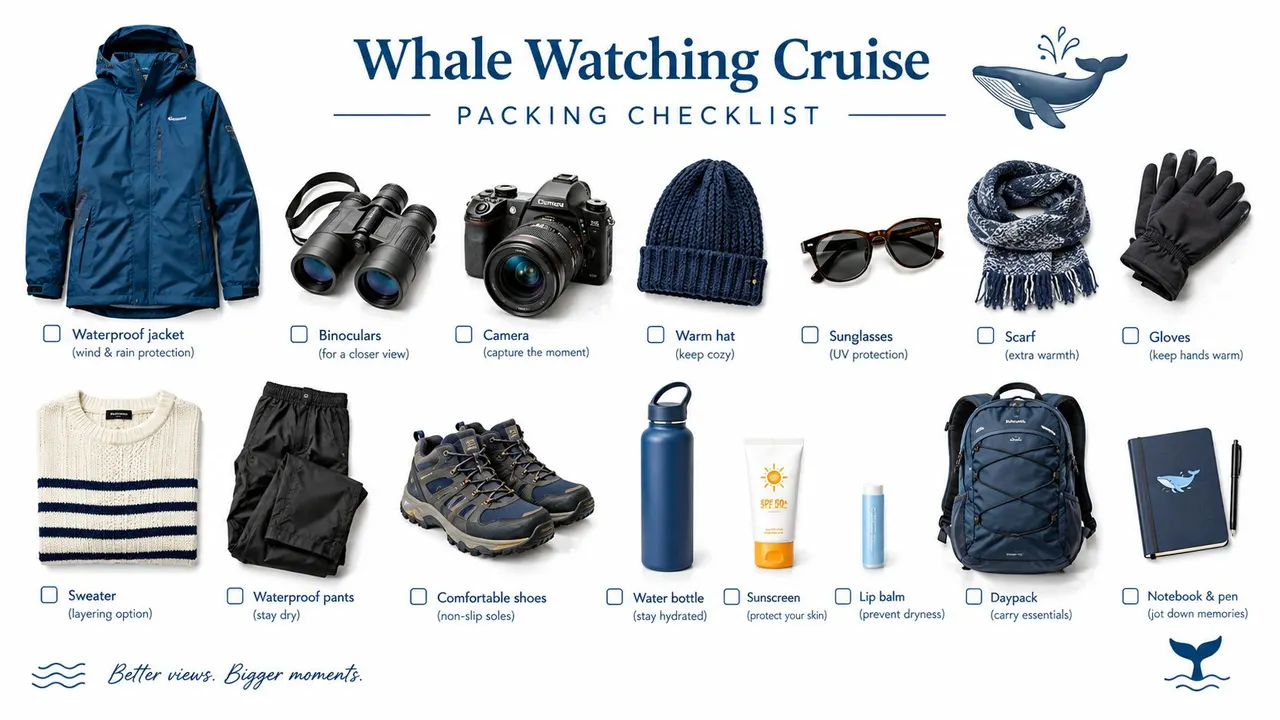
Sun and skin
- Sunscreen: Choose a product suitable for Hawaii and apply and reapply according to its label. Don't rely on a reef-safe marketing claim alone when checking ingredients.
- Secured hat: A chin strap helps keep your hat aboard when the breeze rises.
- Long-sleeve sun shirt: Covering your shoulders and arms reduces the amount of exposed skin you need to manage.
Sight and comfort
- Polarized sunglasses: These help cut glare while you scan the water.
- Binoculars: They're useful for distant blows, especially when the captain is holding a respectful viewing position.
- Phone or camera with zoom: Start with a wide view so you can find the animal before zooming in.
- Light windbreaker: Bring a layer for spray and a cool breeze.
- Grippy closed-toe shoes: Secure footwear is more practical than smooth soles on a moving deck.
Stomach and everyday essentials
- Motion-sickness preparation: Carry any medication recommended for you, and follow its directions before departure.
- Permitted snacks and refillable water bottle: Keep familiar food handy for children, and ask about food restrictions before packing.
- Small towel: Use it for spray or a damp seat.
- Charged phone and compact power bank: Save enough battery for your return transport.
- Card or cash: Bring a payment option if you'd like to leave a gratuity.
Leave glass bottles, sunscreen containing oxybenzone, irreplaceable valuables, and oversized bags at your accommodation. Keep essentials in a small, closable bag rather than spreading them across the seating area.
If you're rushing out the door, don't forget the sunscreen and secured hat. Preventing uncomfortable sun exposure is much easier than dealing with it halfway through the outing.
Book Your Winter Whale Cruise Before Peak Season
Choose your winter departure early enough to preserve flexibility, especially when your family has limited days available. Don't interpret this as a claim that a particular sailing is almost sold out. The practical advantage of planning ahead is that you can coordinate transport, health needs, and a backup day without rushing.
Our Waikiki Whale Watching Cruise runs from January 2 through March 31, lasts 1.5 hours, welcomes guests ages 3 and up, and costs $49 per person. It explores the Waikiki coastline for humpback whales wintering in Hawaiian waters.
Make the booking fit your vacation
- Start with a suitable departure time. A morning can be a useful first choice for families seeking potentially calmer conditions, but use the forecast and your group's routine to make the final decision. Don't book a time that requires skipping breakfast or rushing a tired child out the door.
- Check age and health suitability before paying. Make sure every guest meets the age requirement and can comfortably manage a moving boat. Discuss medication questions with a qualified health professional, not as an afterthought at boarding.
- Read the cancellation and weather terms. Confirm what happens if the operator changes the departure, what your own cancellation deadline is, and whether any wildlife-related policy applies. Don't assume a missed sighting automatically means a refund or replacement trip.
- Keep another day available. Weather can interfere with an otherwise carefully planned vacation. A backup day is useful only if it doesn't already contain an unmovable flight, prepaid excursion, or important family commitment.
We're open seven days a week to help with trip planning and operations. Before booking, collect your group's questions in one message so access concerns, timing, and passenger suitability can be addressed together.
Use our Oahu whale-cruise planning information to organize your decision, then review the Waikiki Whale Watching Cruise details for the departure you want.
Book for the opportunity to observe and learn, not for a specific photograph. A whale sighting is a wildlife event, never a guarantee, and a responsible captain won't trade an animal's space for a better camera angle.
Living Ocean Tours offers seasonal whale-watching cruises along the Waikiki coastline, departing from Kewalo Basin Boat Harbor near Waikiki Beach. Visit Living Ocean Tours to explore the winter outing, check your family's suitability, and choose a departure that leaves room for the unexpected.


