
Best Time to Go Whale Watching in Hawaii: Months and Tips

Table of Contents
- Hawaii Whale Watching by Month
- Why the Peak Matters
- Compare Evidence With Convenience
- Departure Time and Sea Conditions
- Plan for the Ride
- Judge the Approach, Not the Photograph
- From the Harbor to the Viewing Area
- Set Expectations Before Boarding
- Make the Reservation in Order
January through March is the best overall time to go whale watching in Hawaii, with mid-February to mid-March offering the strongest peak. Plan around that window if seeing humpbacks is a priority, but choose the actual departure around your family's comfort and the ocean forecast.
As many as 12,000 humpback whales, more than half of the North Pacific population, return to Hawaiian waters during the seasonal migration, according to NOAA's recreation guidance. That's an extraordinary gathering, but it isn't a promise that a whale will breach beside your boat. For Waikiki visitors, a good trip combines favorable timing, patient observation, and a crew that gives the animals room.
Best Months and Peak Weeks for Whale Watching in Hawaii
Start with the season, then narrow your dates. NOAA's Hawaiian Islands sanctuary overview places the broader humpback season from November through May, identifies January through March as the best overall viewing period, and explains that whales come to Hawaii's warm, shallow waters to mate, give birth, and nurse their calves.
Those activities explain why Hawaii is such a special place to watch humpbacks. You're observing animals during an important reproductive season, not waiting for trained behavior. Some encounters involve obvious surface activity; others require watching for a blow or a back breaking the surface.
Hawaii Whale Watching by Month
The seasonal pattern gives you a useful planning framework. Treat these descriptions as relative opportunities, not a prediction for an individual sailing.
December can work well when the holiday calendar determines your vacation. The trade-off is that an early-season booking doesn't offer the same seasonal opportunity as a trip during the central winter period. Likewise, a late-season outing can be rewarding, but it's better suited to someone who'll enjoy the coastal boat ride even if whales remain elusive.
For families making a special trip specifically for humpbacks, I'd prioritize the central winter months over trying to catch the season's edges. That choice improves the biological opportunity without requiring children to understand why an advertised whale watch might find few whales.
Why the Peak Matters
The NOAA Fisheries abundance assessment places the modeled peak at approximately February 19 through March 22, and reports that February was the peak month in each of the three West Maui aerial-survey seasons studied. The same assessment gives peak-period West Maui estimates of 2,207 animals in 2018–2019, 2,826 in 2019–2020, and 2,207 in 2020–2021, with corresponding densities of 1.20, 1.59, and 1.24 whales per square kilometer.
Those are local survey estimates, not a count of whales available to every boat in Hawaii. Their practical value is the consistent seasonal pattern: late winter offers a stronger opportunity to encounter whales than the beginning or end of the migration.
More whales can mean more opportunities to observe surface activity and mother-and-calf pairs. It doesn't mean every animal will breach, or that a particular departure will encounter an active group.
Planning rule: Build a several-day stay around the modeled peak, and schedule your whale watch early enough in the vacation to leave room for a weather-related change.
Late January and early March are sensible alternatives when flights, school schedules, or lodging narrow your options. Don't treat the modeled peak as a switch that turns sightings on and off. Visibility, sea state, weather, and whale behavior still shape each trip.
Which Hawaiian Islands Have the Best Whale Watching
Choose the island that supports your whole vacation, not just the most dramatic whale photograph. Oahu makes practical sense when you're staying in Waikiki: you can plan a dedicated whale watch without adding an interisland flight and another hotel transfer.
NOAA's sanctuary overview supports January through March as the peak viewing period across Hawaii, making that the defensible seasonal recommendation for an Oahu departure. You don't need to leave Oahu just because another island has more prominently reported survey results.
Compare Evidence With Convenience
Maui has the strongest documented local case in the survey results discussed above. That makes it a reasonable choice if whales are the main purpose of your vacation and your itinerary is still open. It doesn't establish a universal success rate or prove that every Maui departure outperforms every Oahu trip.
For a closer look at the itinerary trade-offs, use our Oahu versus Maui whale-watching comparison. Compare harbor access and lodging convenience alongside wildlife opportunity, especially when grandparents or young children are traveling.
If you're already staying in Waikiki, start with a local departure. If you're choosing between otherwise suitable islands, favor the actual sailing conditions over an island's reputation.
A manageable morning and a comfortable ride often serve a family better than a complicated transfer made solely to chase a perceived advantage.
Best Time of Day and Sea Conditions
Morning is a sensible starting point for comfort, not a guaranteed whale-sighting advantage. Earlier departures often offer calmer conditions before daytime wind builds, but swell, passing weather, and the route can outweigh that pattern. Confirm the outlook with the operator rather than assuming an early booking automatically means smooth water.
For children and motion-sensitive adults, the ride matters. A departure that fits breakfast, sleep, and an unhurried trip to the harbor can be a better choice than the earliest possible boat if getting there leaves everyone exhausted.
Departure Time and Sea Conditions
These are typical planning patterns, not measured morning-versus-afternoon sighting rates or a forecast for your travel date.
Calmer water helps you notice a blow or a brief movement at the surface. It doesn't cause whales to appear. Don't pay more for a departure solely because someone describes a particular hour as feeding time or promises more breaches.
Plan for the Ride
- Protect against sun and glare. Bring sunscreen, a secure hat, and sunglasses so watching the horizon stays comfortable.
- Carry water and a light layer. Sun exposure at the dock and wind underway can feel very different.
- Make a motion-sickness plan. Ask a pharmacist or clinician about suitable options before departure, especially for children.
- Read the weather policy. Know what happens if the operator cancels and whether you can move to another available sailing.
If your group needs an early departure, reserve ahead rather than counting on walk-up space. Before paying, check both the marine-weather cancellation terms and your own cancellation deadline.
I'd choose the earliest departure that comfortably fits the family's day, then keep another suitable departure in mind. If conditions change, let the captain's assessment guide the decision rather than insisting on the time you originally preferred.
Responsible Viewing Rules at Sea
Federal regulations prohibit approaching a humpback whale within 100 yards, roughly the length of a football field, by boat, kayak, paddleboard, drone, swimming, or other means, according to NOAA's Hawaii humpback regulations. The restriction applies year-round throughout Hawaiian waters, including outside the sanctuary.
Distance is part of a responsible encounter. A photograph can make a whale look close, but it doesn't tell you how the vessel behaved or whether the animal surfaced unexpectedly.
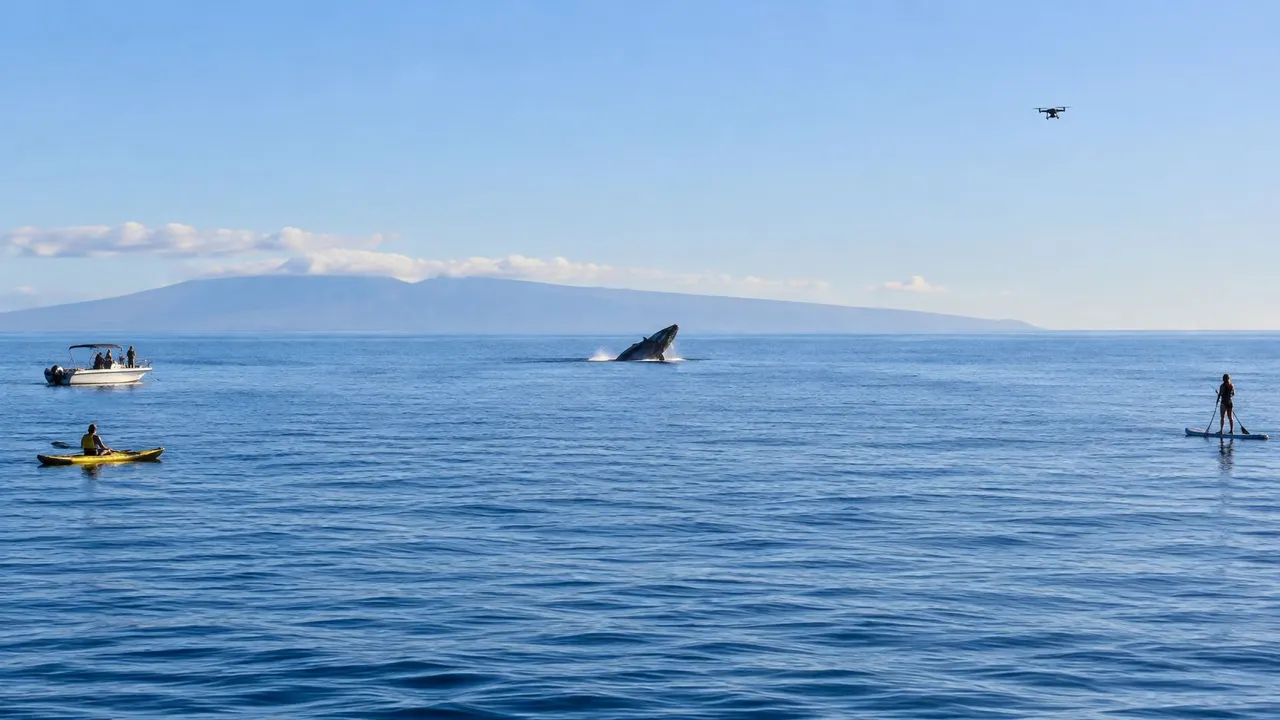
Judge the Approach, Not the Photograph
NOAA's marine-life viewing guidance advises against chasing, encircling, or leapfrogging whales and calls for particular care around calves. Responsible viewing means avoiding pressure on the animals, not maneuvering repeatedly to manufacture a closer encounter.
A distant breach watched without pursuit can be a better experience than a close pass created by crowding. You can appreciate the animal's movement, listen to the guide's interpretation, and keep watching without demanding that the captain follow every change of direction.
Look for these operating practices:
- Slower movement near whales. The crew adjusts vessel handling rather than rushing toward activity.
- Parallel or rearward positioning. The boat avoids cutting across the animals' path.
- Space between vessels. Several boats don't crowd the same whale.
- Extra care around mothers and calves. The crew gives these animals room rather than treating them as a close-up opportunity.
For local context, our Oahu whale-watching rules guide explains what visitors should expect from protected-distance viewing. Set the same expectation for children before boarding: the boat is there to observe, not to make whales come closer.
A better booking question: Ask how the crew maintains distance and responds when whales change direction, rather than asking how close the boat gets.
A clear answer tells you more than a gallery of dramatic images. So does a crew willing to explain why waiting, holding position, or leaving an animal alone is sometimes the right decision.
What a Family Whale Watch from Waikiki Looks Like
A family outing starts with getting to the correct harbor without rushing. Our tours depart daily from Kewalo Basin Boat Harbor near Waikiki Beach, and our seasonal Waikiki Whale Watching Cruise observes humpbacks wintering along the Waikiki coastline. Check your confirmation for the departure time and arrival instructions before leaving your hotel.
At boarding, keep children close and give everyone time to get settled. Treat the safety briefing as part of the outing, particularly for children who haven't been on an ocean boat before. Explain that they'll need to listen when the crew gives directions.
From the Harbor to the Viewing Area
A useful way to prepare children is to describe the outing in order: boarding, traveling along the coast, listening to the crew, and watching patiently for signs of whales. Crew interpretation helps turn a brief glimpse into something meaningful, whether you notice a blow, a back at the surface, or more conspicuous activity.
The screenshot below shows the company website, not a promise of the wildlife you'll encounter on a whale watch.

Living Ocean Tours is Oahu's top-rated and most-reviewed snorkel company. Our whale-watching offering also emphasizes safety, education, and responsible wildlife viewing.
Set Expectations Before Boarding
Don't promise children a breach. Tell them that whales surface on their own schedule and that spotting a quiet animal can take concentration. Our guide to whale watching with kids can help you prepare for the outing without turning it into a test of whether wildlife performs.
- Bring familiar essentials. Water, sun protection, and a light layer make it easier to stay comfortable.
- Explain the sounds. Boat engines, wind, and crew announcements are normal parts of the trip.
- Give children a simple task. Ask them to watch a stretch of water and alert an adult if they notice a blow.
- Keep the outcome open. Sightings aren't guaranteed, and quiet observation is part of wildlife watching.
For a multigenerational group, discuss boarding, seating, and motion sensitivity before booking. The right preparation leaves more attention available for the coastline and the animals, rather than preventable discomfort.
Book Your Winter Whale Watch Cruise
Choose your preferred peak-season date first, then match the departure to your group. Leave some flexibility in the vacation instead of putting the outing immediately before a flight or another nonrefundable activity. A backup date is useful only if you're still on the island and available to sail.
Our Waikiki Whale Watching Cruise runs January 2 through March 31, lasts 1.5 hours, welcomes guests ages 3 and up, and costs $49 per person. Those details help you decide whether the outing fits your family's ages, attention spans, and budget.
Make the Reservation in Order
- Choose a date within the peak period. If your calendar allows it, prioritize the central part of the winter season. Late January or early March can also fit a strong whale-focused itinerary.
- Review the current checkout details before paying. Confirm the selected sailing, total price, passenger ages, and departure instructions so everyone in the group is booking the same experience.
- Pick a comfortable departure time. Start with an earlier option if it works for your family, but don't build a rushed morning around an unrealistic hotel-to-harbor schedule.
- Read the rough-sea cancellation and rescheduling terms. Distinguish an operator cancellation from a change you request, and keep the confirmation accessible on your phone.
- Reserve the cruise and retain a backup date. Use the Waikiki whale watch tour page to review the outing, then select the available departure that suits your group.
Our Oahu whale-watching planning guide provides additional local context if you're still fitting the cruise into a broader Waikiki itinerary. For families, the most useful comparison isn't just ticket price. It's whether the departure, passenger requirements, and weather terms work for everyone traveling.
For help planning, email info@livingoceantours.com or call +1 (808) 436-3483. Our phone hours are 8am to 5pm daily.
The best time to go whale watching in Hawaii remains January through March, with mid-February to mid-March the strongest overall stretch. The best departure for your family is the one that pairs that seasonal opportunity with manageable conditions, a workable schedule, and respectful viewing.
Living Ocean Tours offers a seasonal Waikiki Whale Watching Cruise along Oahu's coastline, departing from Kewalo Basin Boat Harbor near Waikiki Beach. Visit Living Ocean Tours to choose your winter sailing and plan a family outing built around patient, responsible humpback viewing.


