
Best Month for Whale Watching in Hawaii 2026
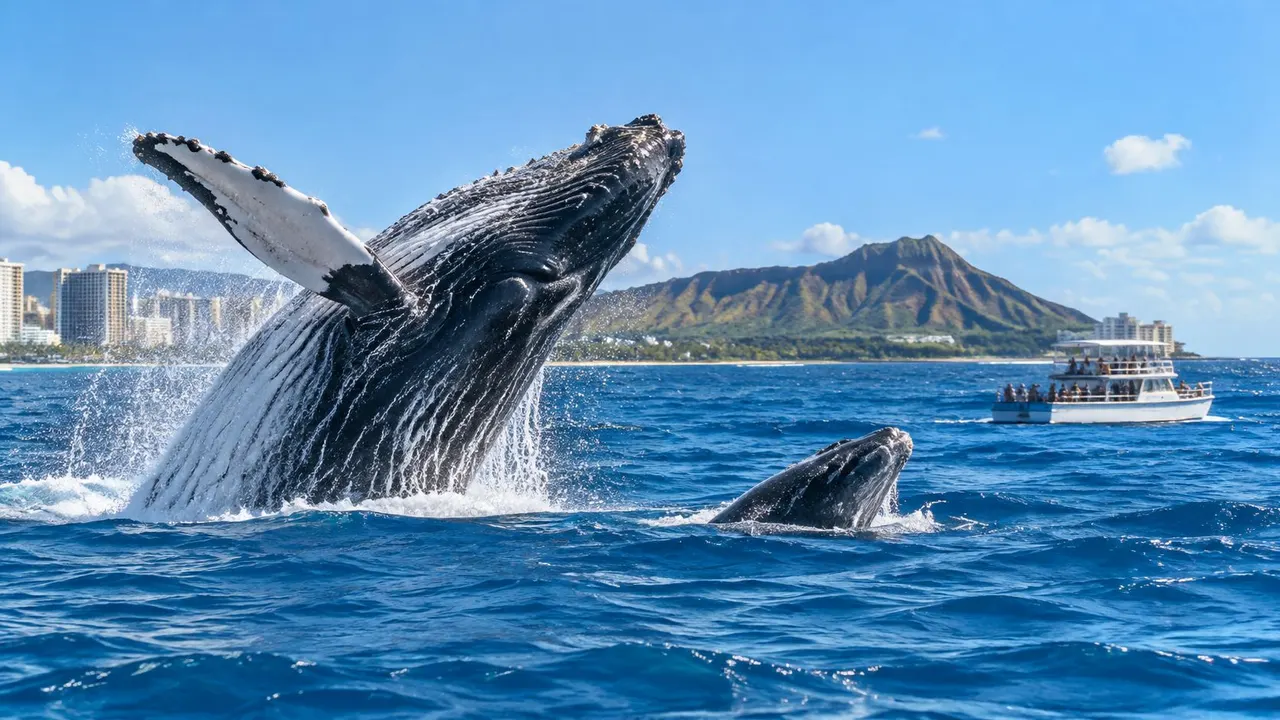
February is the best single month for whale watching in Hawaii. January through March is the premium booking window, and expected maximum abundance runs from about mid-February to mid-March.
A peak month raises the odds of blows, breaches, and calves. It does not park a whale next to the boat on one afternoon. I would lock February when the whole family can choose any winter dates, and I would keep the full January through March stretch open when the hotel is already in Waikiki. Honolulu does not deliver the same density as the channels between Maui, Lanai, and Molokai. South-shore cruises still find humpbacks, but the groups are thinner and the quiet days are more common. Pick the month for abundance, then pick the shore for how close you want to be to the main winter gathering.
Why February Is the Best Month
Say the kids get one winter trip and the whole point is a humpback. February is the best single month for whale watching in Hawaii.
NOAA's Hawaiian Islands Humpback Whale National Marine Sanctuary estimates that up to 12,000 humpback whales, more than half of the North Pacific population, return to Hawaiian waters each year from November through May to breed, calve, and nurse. NOAA names January through March as the peak whale-watching period, which puts February in the center of that window. A NOAA Fisheries assessment narrows the expected maximum further, to about mid-February through mid-March. January is already peak. March stays excellent, then starts the slide toward spring.
Those whales leave cold Arctic feeding grounds for warm, shallow Hawaiian water. They mate, give birth, and raise calves here. Picture the islands as a winter harbor. It starts filling in fall, it is fullest in late winter, and it empties in spring. February is the month when that harbor is most crowded.
The Hawaii Division of State Parks places the migration peak in January and February, inside a season that can begin as early as September and run through May. February is the overlap of that state peak and the federal January-through-March peak.
Hawaii's Sanctuary Ocean Count schedules volunteer surveys on the last Saturday of January, February, and March. That long-running public count is a better yardstick than one lucky social post.
A strong month means higher probability, not a whale on every ticket. Animals keep arriving and leaving, so Tuesday can be quiet while Thursday is full of tail slaps.
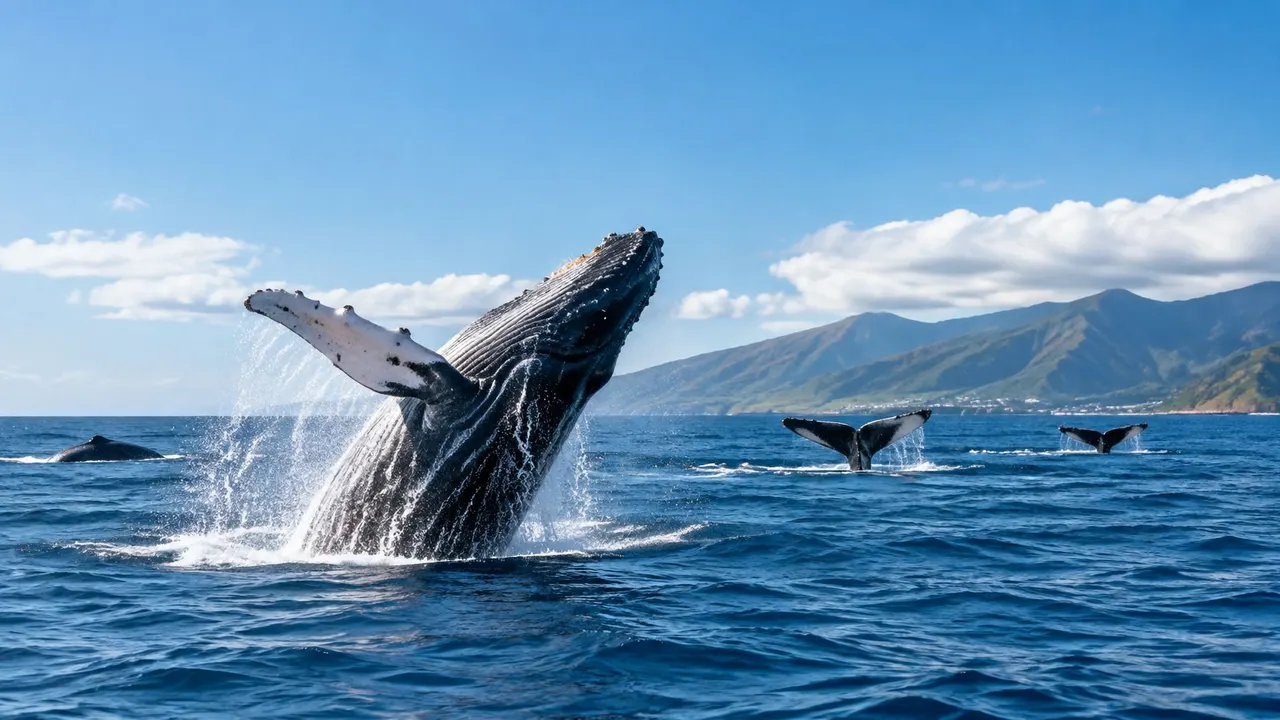
After the month is set, the next choices are how the rest of the season compares, which island holds the whales, and how a Waikiki family should book.
Month by Month Sighting Odds
Use the table before you buy flights. It runs in season order, from the first scattered animals to the last northbound departures.
| Month | Season status | Sighting likelihood | What you are likely to see |
|---|---|---|---|
| September–October | Early arrivals | Low | A few scattered humpbacks |
| November | Season opens | Moderate and rising | More adults; singing increases |
| December | Building | Good | Regular sightings and holiday crowds |
| January | Peak | Very high | Breaches, tail slaps, and calves |
| February | Best single month | Highest | Peak numbers, song peak, mothers and calves |
| March | Peak, then easing | Very high early, high later | Strong early March, then a gradual decline |
| April | Shoulder | Moderate and falling | Fewer whales and quieter boats |
| May | Season close | Low | Last whales leaving for feeding grounds |
Early season through the holidays
September and October are early arrivals only. Odds stay low, and the whales you do find are scattered. I would not fly in for whales in those months.
November opens the main season. More adults show up, and the singing builds. A sighting is possible. It is not something I would promise a first-time family.
December is a real viewing month, with regular sightings. It also brings holiday crowds and higher fares. Early December is softer than the last ten days. If your dates are fixed around Christmas, go, and keep a second morning free.
The core, then the fade
January is already peak. Breaches, tail slaps, and mothers with young calves are the usual show. You do not need to wait for February if January flights are cheaper.
February is the default best month. It sits inside both the state peak and the January-through-March federal peak, and it overlaps the stretch when numbers are expected to max out.
March stays excellent, especially the first half, then eases as animals turn north. Early March is a fair backup when February hotels are gone.
April is a quieter shoulder. Odds fall, and the boats are less packed. May is the close, with low odds and the last departures toward feeding grounds. Skip May when whales are the reason for the trip.
University of Hawaii researchers found that humpback song levels increase from November through January, peak in February and March, and decline during April and May as whales head back to high-latitude feeding grounds. That song curve matches the table. The North Pacific humpback population that visits Hawaii seasonally is estimated at approximately 8,000 to 12,000 whales, which is why late winter is the productive window.
Practical rule: Pick February when you can. Take January or early March when flights or hotels are easier. Treat December and April as shoulder trips, not as equal substitutes.
Where Whales Gather Around the Islands
The same February week does not look the same from every shore. The best statewide month is not a promise that every island is equally full.
Where the groups actually stack up
The highest reported concentrations sit in the sheltered waters between Maui, Lanai, and Molokai, along northern Kauai, and off Hawaii Island's Kohala Coast. Maui's channels earn the whale-alley reputation because calves and escorts use those calm, shallow passages. A boat there is often inside the gathering, not searching the edge of it.
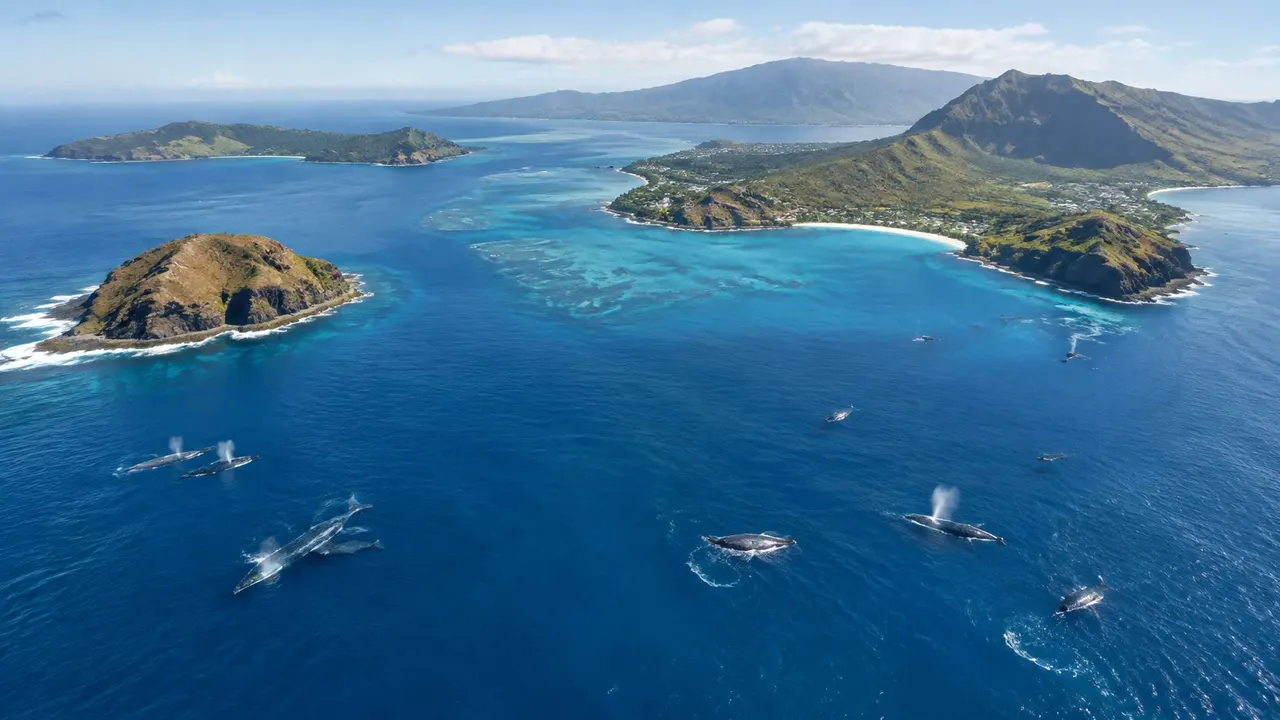
Oahu is a different viewing environment. Sightings are common from lookout points and from boats off the south and west shores, including the Waikiki coastline. They are generally less frequent than those inter-island concentrations. A Honolulu family should not expect a whale beside every catamaran. Some mornings you get a distant blow and a rolling back. Some mornings the south shore stays quiet while Maui's channels are busy.
NOAA's boating guidance for the sanctuary identifies January through March as the broad statewide peak, while Hawaii's Division of State Parks calls January and February the strongest months and notes that Oahu sightings are common but generally less frequent than concentrations between Maui, Lanai, and Molokai. February can maximize statewide odds. For someone already sleeping in Waikiki, January through March is the honest planning window, not a single magic week.
How to pair the month with the island
Whales can show up early and linger late, yet the thick part of the season is much narrower than that full span. A quieter December or April trip can still work if you want fewer visitors and you can live with lower odds. It is a poor trade when a missed whale would ruin the vacation.
- Already in Waikiki: Book any date inside January through March. March can mean fewer visitors while activity is still strong.
- Free to choose an island only for whales: January or February around Maui, Lanai, and Molokai maximizes density.
- Kohala or north Kauai on the itinerary: Those shores sit in the high-concentration set, so a whale morning fits the rest of the trip instead of fighting it.
- Comparing a city vacation with a channel trip: Read a straight Oahu whale watching versus Maui comparison before you assume a Waikiki catamaran matches a Maui Nui passage.
Pick the month for abundance. Then pick the island for how close you want to stand to the main gathering areas. Convenience and density are not the same decision.
What to Expect on a Waikiki Whale Watch
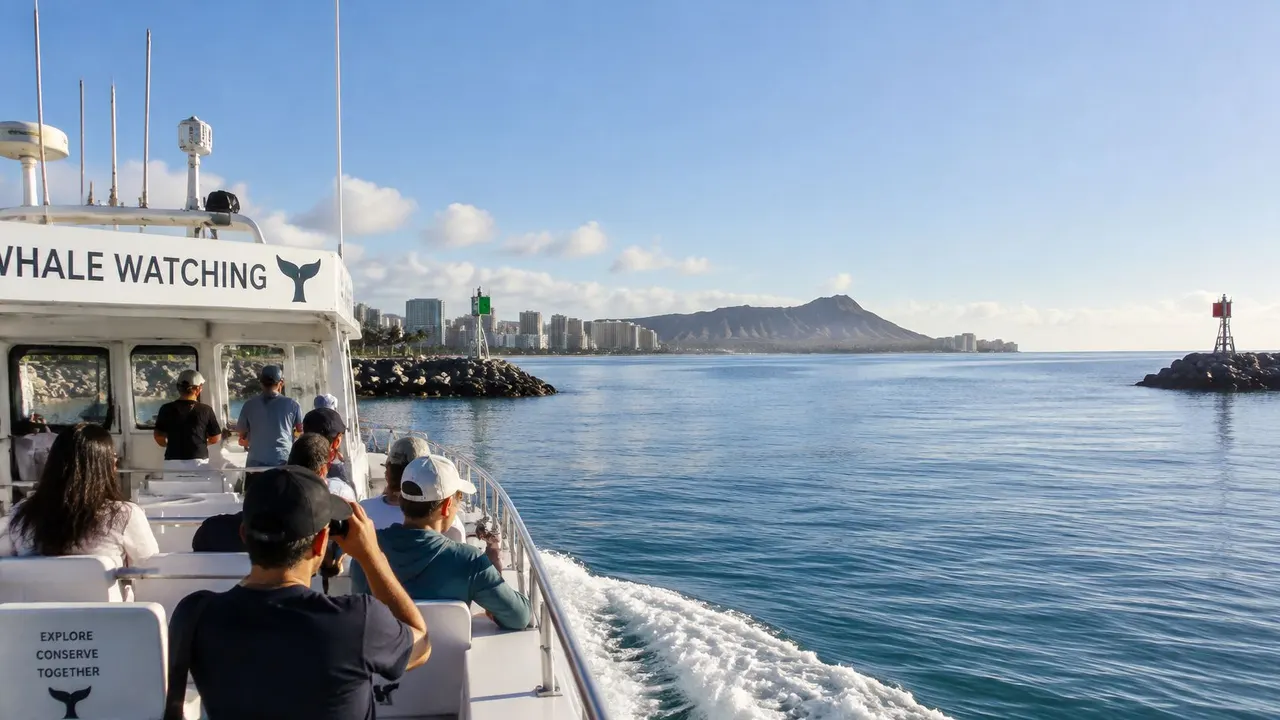
A winter departure from Kewalo Basin Boat Harbor is a short ride from Waikiki Beach. The boat heads along the south shore, with Diamond Head on the skyline, and searches that coastline for humpbacks that winter in Hawaiian waters.
The sighting sequence
The first clue is usually a distant blow, a misty puff that hangs for a second. Then a back rolls at the surface. A raised tail means a dive. A pectoral-fin slap is louder than most families expect. Sometimes the whole animal clears the water in a breach, and sometimes it does not happen at all on that trip.
Mothers with calves are the moment people remember. They are also the reason a careful captain slows down and holds distance. You are on a lookout cruise, not a swim-with-whales tour. A 90-minute outing is long enough for a search and a few surface sequences. It is not a guarantee of a close pass.
Mornings often bring calmer seas, which makes the spout easier to spot before the trade winds pick up. Afternoon light can make those same blows easier to photograph. I would take the morning with kids who get restless, and the later trip when someone on board cares more about pictures than a glassy ride.
Who runs the south-shore cruise
Living Ocean Tours is the top rated and most reviewed snorkel company on Oahu, and our Waikiki Whale Watching Cruise looks for those winter humpbacks along the Waikiki coastline. Tours depart daily from Kewalo Basin Boat Harbor, near Waikiki Beach. The office at 1125 Ala Moana Blvd, Slip B-01, Honolulu is open seven days a week for planning and operations.
The Waikiki whale watch is the dedicated winter cruise. If you want a plain account of what a south-shore trip feels like before you commit the morning, this cruise to see whales walk-through is the place to start. Come ready for sun, a bit of spray, and a narrator who would rather hold position on a blow than chase the next splash.
How to Watch Whales Responsibly
The best month is also the month when the rules matter most. More whales, more boats, and more people with drones all show up in the same few weeks.
The distance and the speed
Hawaii's marine wildlife guidance is specific. Federal law prohibits approaching a humpback whale within 100 yards, whether you are on a boat, a kayak, a paddleboard, swimming, or flying a drone. The same guidance says aircraft must remain at least 1,000 feet above humpback whales. Boaters are advised to keep 15 knots or less, or a safe planing speed, during whale season. These limits run through the November-to-May viewing period and matter most in the January-to-March peak.
If a whale approaches the vessel, the right move is to put the engines in neutral and let the animal set the distance. Closing the gap because the calf is cute is still an approach. Mothers and calves get the same 100-yard rule. Crowding them is illegal, and it is also the fastest way to end the encounter, because the pair leaves.
A good guide cuts the engine, points out the blow, and explains what a tail slap or an escort whale is doing. A bad plan is any seller who promises you will swim, snorkel, or paddle up to a humpback. That pitch is not a premium upgrade. It is a violation.
What passengers should do
Stay seated when the captain slows. Do not ask the crew to chase a breach. Do not launch a drone from the beach or from a tour over a pod. The view from a legal distance is the product.
- Legal distance: Keep 100 yards off every humpback, including a curious calf that surfaces nearer on its own.
- Slow speed: Hold 15 knots or less, or a safe planing speed, while you are in whale water.
- No chase: If the animal moves off, you do not follow it in.
- No drone: Aircraft stay at least 1,000 feet up, and a hobby drone is not an exception.
- A crew that teaches: Pick the boat that narrates the behavior instead of pursuing the splash.
The legal look is the whole experience. A patient stop on a blow beats a fast turn toward a breach you were never allowed to crowd.
Book February or the January to March Window
Choose February if you can pick any month. If the family is already on Oahu, any date from January 2 through March 31 is the working window, and mid-February to mid-March is the overlap with estimated maximum abundance. Skip September, October, and May when whales are why you came.
What the stock numbers change about a ticket
A NOAA Fisheries stock assessment expects peak numbers in the Hawaiian Islands' exclusive economic zone from about mid-February to mid-March. It reports a Hawaiian abundance estimate of 11,278 whales, with a wide 95% confidence interval of 4,049 to 31,412. That range is a reminder that a mobile population is hard to pin down, not a reason to book May.
Residence time is the part families feel on the boat. The assessment cites research finding that 66% of identified whales were observed in the same field season for two weeks or less. A whale-rich month is not the same sea state every morning. Individuals arrive, leave, and shift among islands. Book early in the stay and keep a second morning open. A flexible ticket beats a sunset-only plan, because you cannot move a missed afternoon to the next day if you fly out at dawn.
The Waikiki cruise that matches those dates
Our Waikiki Whale Watching Cruise runs from January 2 through March 31, lasts 1.5 hours, welcomes ages 3 and up, and costs $49 per person. Departures leave Kewalo Basin near Waikiki Beach, so you do not need an interisland flight to get on the water. Oahu should not chase Maui density. Book the south shore, and treat an extra breach as a bonus rather than the minimum you paid for.
Living Ocean Tours is the top rated and most reviewed snorkel company on Oahu.
Details on how we set up an Oahu whale watching morning are on that page. Pack light layers, reef-safe sunscreen, and a dry layer for kids. Mornings on the south shore can feel cool once the boat is moving, even when the beach looked hot from the hotel.
Crews keep the legal distance, so the reward is an unhurried look at a winter breeding ground rather than a chase. Come for the higher seasonal odds. Leave room for the morning that only gives you a far blow, and for the morning that gives you a calf beside its mother.
Living Ocean Tours runs a winter Waikiki whale watch from Kewalo Basin for families who want humpbacks without leaving Oahu. February is the strongest single month, and the January through March departures are the honest window from this shore. See dates and trip notes at Living Ocean Tours.


