
Whale Watching Hawaii Best Time: Months, Hours and Tips

Table of Contents
- Humpback whale sighting likelihood by month
- How to use the calendar
- Check conditions in this order
- Shore viewing for flexibility
- A boat for a dedicated experience
- Choose an island around the whole trip
- What the rules mean on your trip
- What you should do as a passenger
- Make the reservation work for your family
- Prepare for the experience, not just the photograph
January through March is the best window for humpback whales around Oahu, with late February the single strongest period and as many as 12,000 whales returning to Hawaiian waters each season. Choose the calmest early departure within that window for the clearest, most comfortable view.
The distinction matters: the month determines how many whales are likely to be around; the marine forecast determines how well you can watch them. A windy peak-season afternoon can be harder on your family, and harder for spotting distant blows, than a quiet morning outside the busiest part of winter.
Book around the migration, then stay flexible about the day. Don't build the entire outing around getting a breach photograph. Watching a whale surface, breathe, and disappear beneath the water is the experience, and no captain controls what happens next.
When Whales Are Most Likely in Hawaii
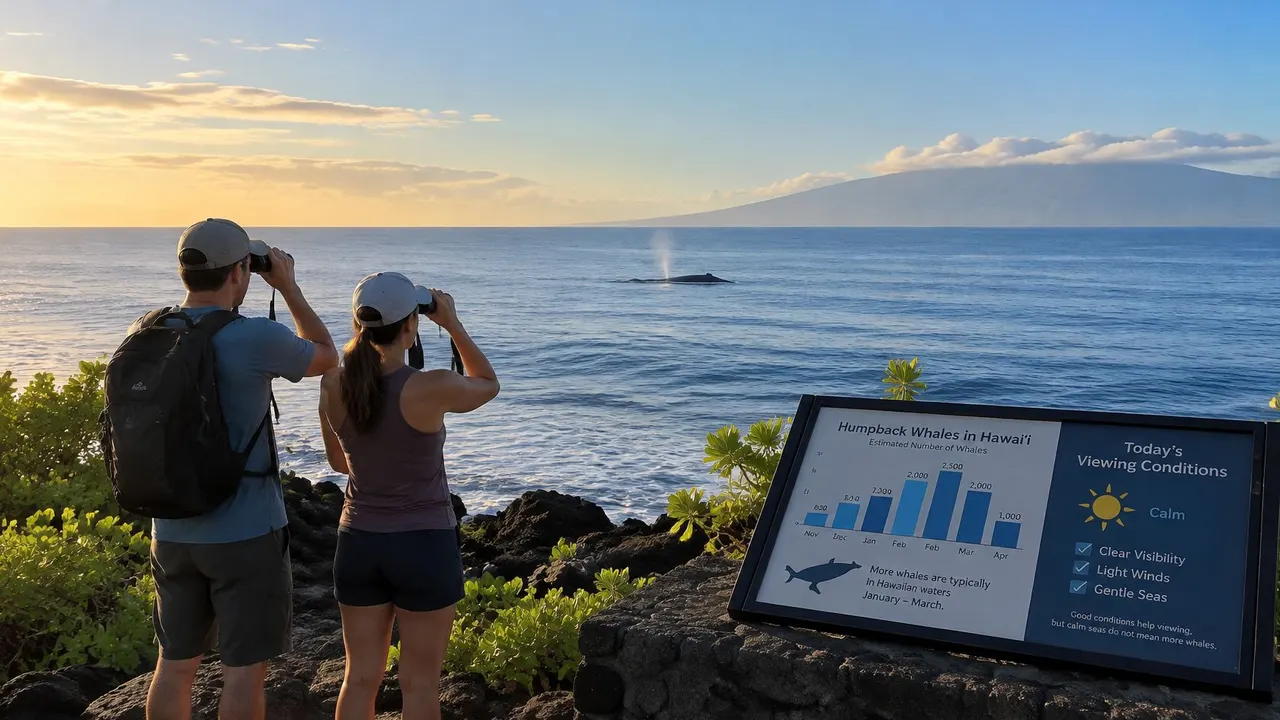
Choose the heart of winter if whales are the reason you're coming. According to NOAA's Hawaiian Islands Humpback Whale National Marine Sanctuary boating guidance, as many as 12,000 humpbacks, more than half of the North Pacific population, may return between November and May, with greatest abundance generally January through March and a modeled high point around February 19 through March 22.
Those are statewide seasonal patterns, not a promise for an individual departure. Whales move between offshore and nearshore habitats, and a productive morning doesn't establish where they'll surface later.
Humpback whale sighting likelihood by month
Use these qualitative ratings to choose travel dates, not as measured probabilities for a particular boat.
The off-season distinction is substantial: NOAA's sanctuary account of long-term whale monitoring describes 37,384 individually identified sightings from 2002 through 2023, with 99.97% occurring between November and May and none recorded in that dataset during June or September. That doesn't establish that an off-season encounter is impossible. It establishes that summer is a poor choice for a whale-focused vacation.
How to use the calendar
November is an arrival period, so treat a sighting as a bonus rather than the foundation of your itinerary. December improves as the migration builds, but it isn't the strongest choice when you can select your dates freely.
The central winter months give you more room to plan around weather. March remains a worthwhile whale-watching month, while April requires more flexible expectations. By May, don't sacrifice other vacation priorities for a dedicated search.
Shoulder periods can mean fewer boats, but fewer boats don't mean more whales. Choose them for a quieter itinerary, not because they offer a better biological window.
Our Waikiki Whale Watching Cruise watches humpbacks that winter in the Hawaiian Islands along the Waikiki coastline. For a whale-focused Oahu stay, my recommendation is to book at least two outings in January or February and treat late-season opportunities as a backup, not the main plan.
Best Hours and Sea Conditions for Sightings
Sanctuary shore-count monitoring summarized in NOAA Fisheries' marine-mammal guidance detected whales on 89% of Oahu count mornings in January and February, during the first three 15-minute scans across 2007–2026. That supports choosing a winter morning, but it's not evidence that whales are biologically more active before lunch, and it isn't a boat-tour success rate.
Calmer early water and standardized observation times can help explain that result. The practical advantage of an early departure is usually the view and ride, not an appointment on the whales' schedule.
Check conditions in this order
- Read the marine forecast. A sunny land forecast tells you little about offshore wind, swell, or the ride outside the harbor. Check those separately.
- Choose the earliest departure on the calmest available day. Smooth water makes a dark back or brief blow easier to distinguish, and it's more comfortable for children and ocean-trip beginners.
- Watch for strengthening trade winds. If winds build after midday, whitecaps and spray can make scanning harder. Don't assume every afternoon will be rough, but don't ignore a forecast that says yours will be.
- Keep behavior expectations realistic. No departure time guarantees breaching, tail slapping, or prolonged surface activity.
Cloud, haze, and glare also change what you can see. A bright reflection across the water can conceal a distant whale, while low cloud or rain can shorten your useful viewing distance. Polarized sunglasses help with surface glare, but they can't fix poor visibility.
Day-of decision: If the forecast shows building wind, move to a morning slot or reschedule within the same week.
Winter swell deserves separate attention, especially around north-facing shores. It can make exposed coves unsafe or inaccessible even when Waikiki looks inviting. Follow local closures and the captain's operating decision rather than using conditions at your hotel beach as your ocean forecast.
Shore Viewing or a Boat Tour on Oahu
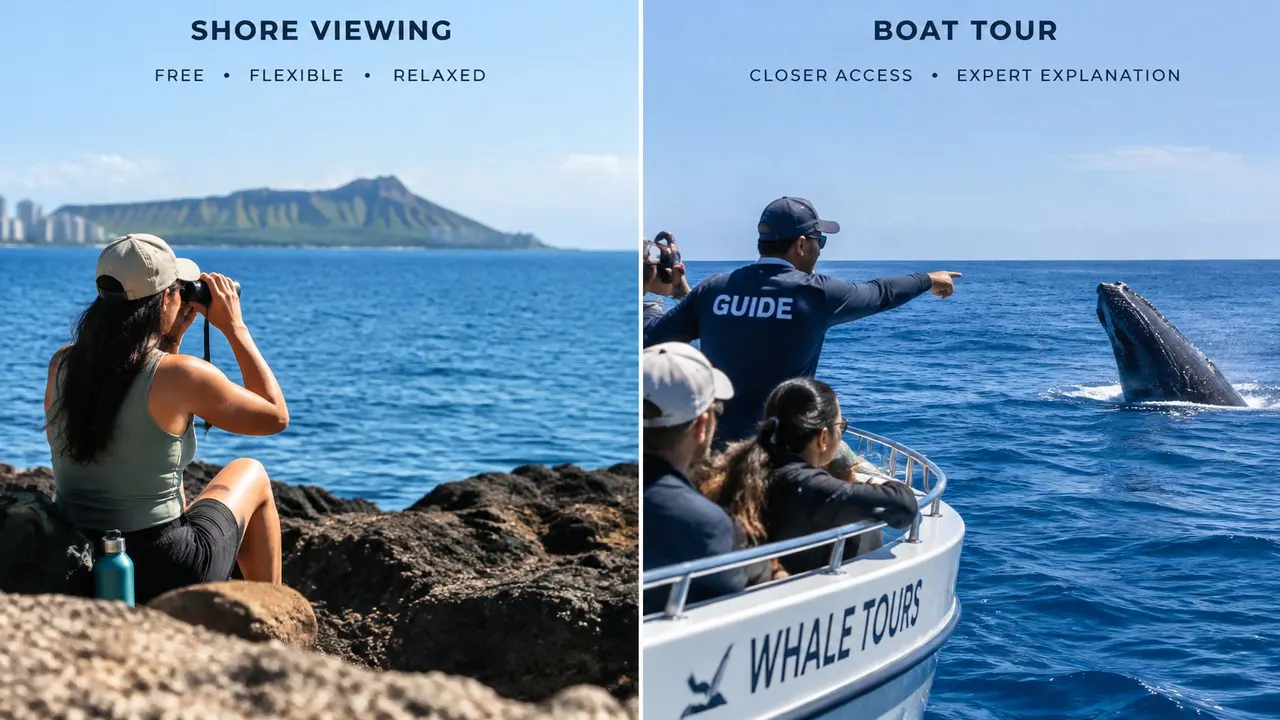
Shore viewing is free and flexible; a boat gives you a moving vantage point and help interpreting what you're seeing. Neither option guarantees a sighting, but they serve different purposes. Choose the shore when you want an easy scan between other plans, and choose a dedicated cruise when whale watching is the activity you want to prioritize.
Shore viewing for flexibility
From Waikiki beaches or accessible stretches of the Diamond Head coastline, scan beyond the breaking surf for a brief vertical blow or a dark back breaking the surface. Bring binoculars, brace your elbows, and spend time looking rather than repeatedly moving to another spot.
Scan with your unaided eyes first, then use binoculars to investigate movement. That's easier than searching a broad ocean through a narrow magnified field. Keep children away from exposed edges, and don't step onto wet rocks to improve the angle.
A shore session also gives your family a useful introduction to what whale watching involves: patience, scanning, and brief sightings rather than continuous action.
A boat for a dedicated experience
Our cruise lasts 1.5 hours, welcomes guests ages 3 and up, and departs from Kewalo Basin Boat Harbor near Waikiki. That makes it straightforward to add a focused wildlife outing without rearranging an entire Oahu day.
A guide can help distinguish a blow from windblown spray and explain the behavior visible at the surface. The moving viewpoint also gives you a different perspective from a fixed beach lookout, without turning the outing into a chase.
Use our Waikiki whale-watching guide when deciding how to fit a cruise around your stay. Leave comfortable time for getting to the harbor rather than assuming that a departure near Waikiki means boarding directly from your hotel beach.
Kayaks and paddleboards aren't a workaround for getting closer. You can encounter whales while paddling, but don't rent equipment with the intention of pursuing them. For a free check on visibility, start ashore; for a closer, guided experience within wildlife protections, book a boat.
Other Hawaiian Islands With Stronger Odds
Oahu is convenient, but it isn't Hawaii's strongest whale-watching location. NOAA's Hawaiian Islands Humpback Whale National Marine Sanctuary overview identifies regular Oahu sightings while noting that encounters are typically more frequent in Maui, Lanai, and Molokai waters, along Kauai's north coast, and off Hawaii Island's Kohala Coast.
That distinction matters most when repeated whale encounters are the main purpose of your holiday. It matters less when you're combining wildlife with a Waikiki stay, restaurants, beaches, and other Oahu activities.
- Maui, Lanai, and Molokai waters: Shallow, protected channels support concentrated activity, but reaching them adds travel and potentially more cost.
- Kauai's north coast: Strong viewing potential comes with exposure to winter conditions, so location alone doesn't ensure an operable boat day.
- Hawaii Island's Kohala Coast: A worthwhile whale-focused destination, but an interisland visit adds flights, transfers, and harbor logistics.
Choose an island around the whole trip
Humpbacks come to Hawaiian waters to breed, give birth, and nurse calves. Relatively shallow, protected island waters provide important habitat during that period, which helps explain why sightings aren't distributed evenly around every coastline.
Don't translate that into a rule that every sheltered bay contains whales. Animals move, weather changes access, and the best-known viewing area can still produce a quiet outing.
More travel is worthwhile when whales are the purpose of the trip. It's less compelling when the transfer would consume the day your family wanted to spend on the water.
For a Waikiki-based traveler, an interisland day trip can put you in a stronger viewing region. Compare the complete journey, though: getting to the airport, reaching the departure harbor, and leaving enough margin for the return. A rushed transfer isn't automatically better than a relaxed local cruise.
If you're planning an entire holiday around whales, use our guide to whale-watching months in Hawaii to align the destination with the core winter season. Choose Oahu for convenience and a reasonable viewing opportunity; travel to a stronger concentration area when repeated surface activity outweighs the additional logistics.
Federal Rules for Approaching Humpbacks
Federal law prohibits approaching a humpback whale within 100 yards, or 90 meters, by any means, including boat, kayak, paddleboard, swimmer, drone, or aircraft, as explained by Hawaii's Department of Land and Natural Resources marine-species protection guidance. If a whale approaches a vessel inside that distance, the operator should place the engine in neutral and wait for the animal to move away.
These protections matter because Hawaiian waters are breeding and nursery habitat. Mothers and calves need room to move without boats repeatedly interrupting their path or attempting to manufacture a close encounter.
The state's boating-with-humpback-whales guidance recommends 15 knots or less, or minimal planing speed, in whale habitat where water is 100 fathoms deep or less, approximately 600 feet, and 6 knots or less when approaching or departing whales from within 400 yards. Treat those speed recommendations as additional precautions, not permission to enter the prohibited approach zone.
What the rules mean on your trip
A whale can surface close to a stationary vessel on its own. That's different from a captain steering into its path, and it doesn't authorize continued pursuit after the animal moves away.
Leapfrogging means intentionally getting ahead of a whale so it surfaces near the boat. A responsible operator doesn't use that maneuver to deliver dramatic photographs, even if passengers are asking for a better angle.
Aircraft and drones aren't exceptions. Don't assume that watching from above removes the possibility of disturbance or allows you to bypass protected separation.
What you should do as a passenger
- Let the captain control the position. Don't pressure the crew to move closer for a photograph.
- Watch without pursuing. Never enter the water or paddle toward a whale to extend an encounter.
- Value a patient operator. Waiting at a respectful distance is part of competent wildlife viewing, not a failure to provide an exciting trip.
Our Oahu whale-watching planning resource can help you prepare for the outing. The right expectation is observation on the animals' terms, not guaranteed proximity.
Book the Right Date and Tour
Our Waikiki Whale Watching Cruise runs January 2 through March 31, lasts 1.5 hours, welcomes guests ages 3 and up, and costs $49 per person. Tours depart daily from Kewalo Basin Boat Harbor near Waikiki Beach.
Living Ocean Tours is Oahu's top-rated and most-reviewed snorkel company. For winter visitors, our seasonal whale cruise offers a dedicated way to look for humpbacks along the Waikiki coastline.
Make the reservation work for your family
- Book the earliest departure on the calmest forecast day. Start with conditions rather than choosing a convenient hour and hoping the ocean cooperates. If you're booking before a useful forecast is available, choose an early slot and review conditions closer to departure.
- Reserve a second February or March date as a backup. Put the first outing early enough in your stay to leave room for another opportunity. Read the booking terms before assuming an additional reservation can be canceled or moved.
- Pack water, sunscreen, layers, and a light jacket. Wind on the boat can feel different from standing outside your hotel. Keep your hands available for moving around safely rather than carrying loose belongings.
- Choose an early slot if motion sickness concerns you. Prioritize the calmer forecast, and discuss suitable prevention with a pharmacist or clinician before departure if needed. Don't wait until you're uncomfortable offshore to start thinking about it.
- Confirm the departure time the day before. Review your booking details and harbor directions, and keep the departure morning free of tight connections or appointments.
For multigenerational groups, assign someone to manage the reservation details and share the meeting information with everyone. Check the minimum age before booking, particularly if your family includes a toddler.
Prepare for the experience, not just the photograph
Tell children what they'll be looking for: a puff above the surface, a rounded dark back, or a tail disappearing beneath the water. That gives them something achievable to watch for instead of expecting a whale to leap beside the boat.
Keep your camera ready, but spend part of the outing watching without a screen. A wide view of the water helps you follow the action, while a tightly zoomed camera can leave you searching after the whale has moved.
Our Oahu whale-watching trip guide is a useful companion when organizing the day. Keep the rest of your schedule loose enough that a weather adjustment doesn't unravel the holiday.
Booking priority: Secure a strong seasonal date, protect some flexibility, and let the marine forecast settle the final timing.
Aim for late February or early March if you can choose freely, and reserve the earlier outing now rather than leaving whale watching until your final vacation morning. That gives you a strong seasonal choice and room to respond to conditions.
If November, December, or April is your only travel window, sightings remain possible, but confirm which operators are running whale-focused departures. A calm day can improve the experience within those dates; it doesn't erase the difference in seasonal abundance. If the forecast shows strengthening wind, move the trip rather than forcing the original plan.
Living Ocean Tours offers seasonal Waikiki whale-watching cruises from Kewalo Basin Boat Harbor, giving winter visitors a guided opportunity to look for humpbacks along Oahu's coast. Visit Living Ocean Tours to choose your winter departure, then leave room in your itinerary for the calmest available day.


