
Waikiki Drone Rules for Your First Boat Tour
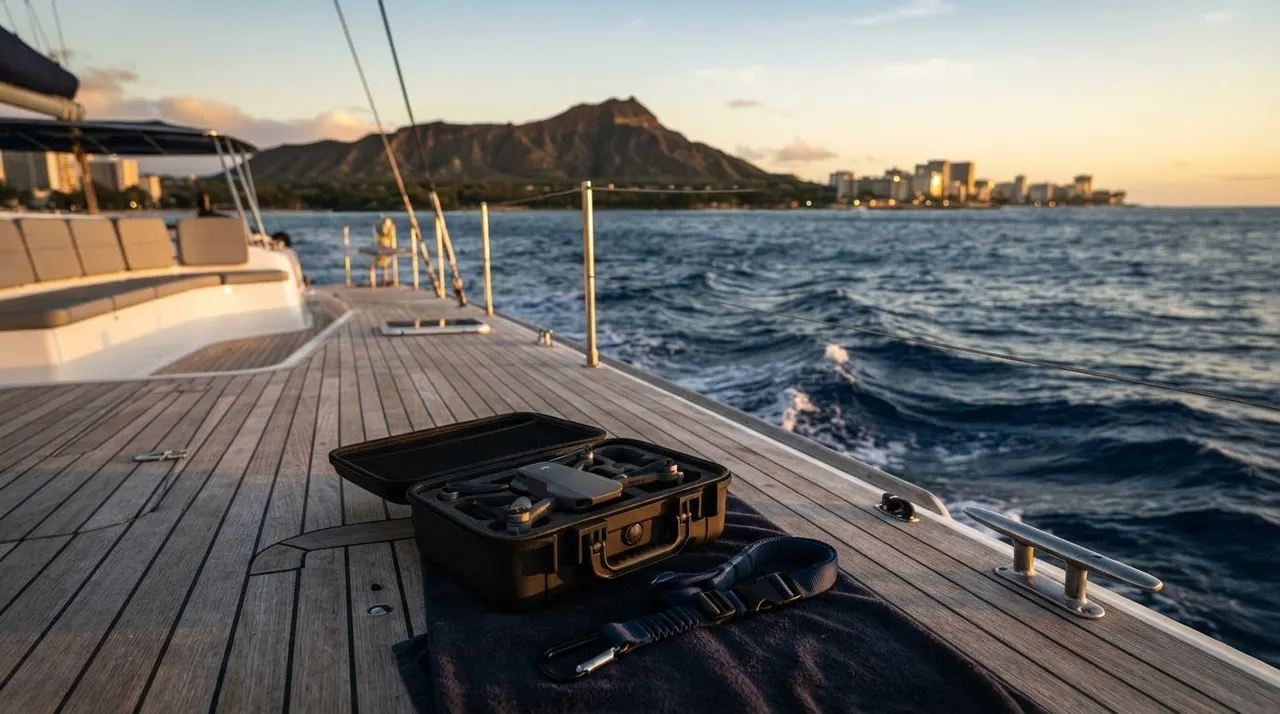
Planning a boat day in Honolulu and packing a drone? Waikiki drone rules can turn a simple vacation video into a legal, safety, and wildlife question before you ever reach the harbor.
For most first-time guests, the safest choice is to keep the drone secured and enjoy the coastline without launching. Waikiki beaches, city parks, state-managed areas, controlled airspace, tour-boat policies, and marine wildlife concerns all matter. Start with the rules that apply on land, then consider what changes when your takeoff point is a moving vessel.
Can You Fly a Drone During a Waikiki Boat Tour?
The practical answer for visitors
You may be allowed to fly a recreational drone in some parts of Oahu, but a Waikiki boat tour isn’t automatically a legal launch opportunity. You still need to meet FAA requirements, confirm the airspace, follow local property rules, and receive permission from the boat operator.
Waikiki Beach is a busy urban shoreline surrounded by hotels, roads, parks, beaches, and flight activity. A drone that seems harmless from your hotel balcony can create a hazard for beachgoers, tour boats, helicopters, and other aircraft.
If you haven’t checked every requirement before boarding, leave the drone in its case. You can still enjoy wide views of Diamond Head, the Waikiki shoreline, and the Pacific from the boat’s upper deck.
A boat launch isn’t a loophole
Launching offshore doesn’t remove FAA obligations. You still need to follow the same rules for registration, Remote ID, visual line of sight, altitude, and aircraft separation.
Local restrictions can also follow the location where you launch and land. A boat crew may prohibit takeoffs from the deck, especially when guests are moving around, swimmers are nearby, or the vessel is underway. The captain’s instructions take priority during the trip.
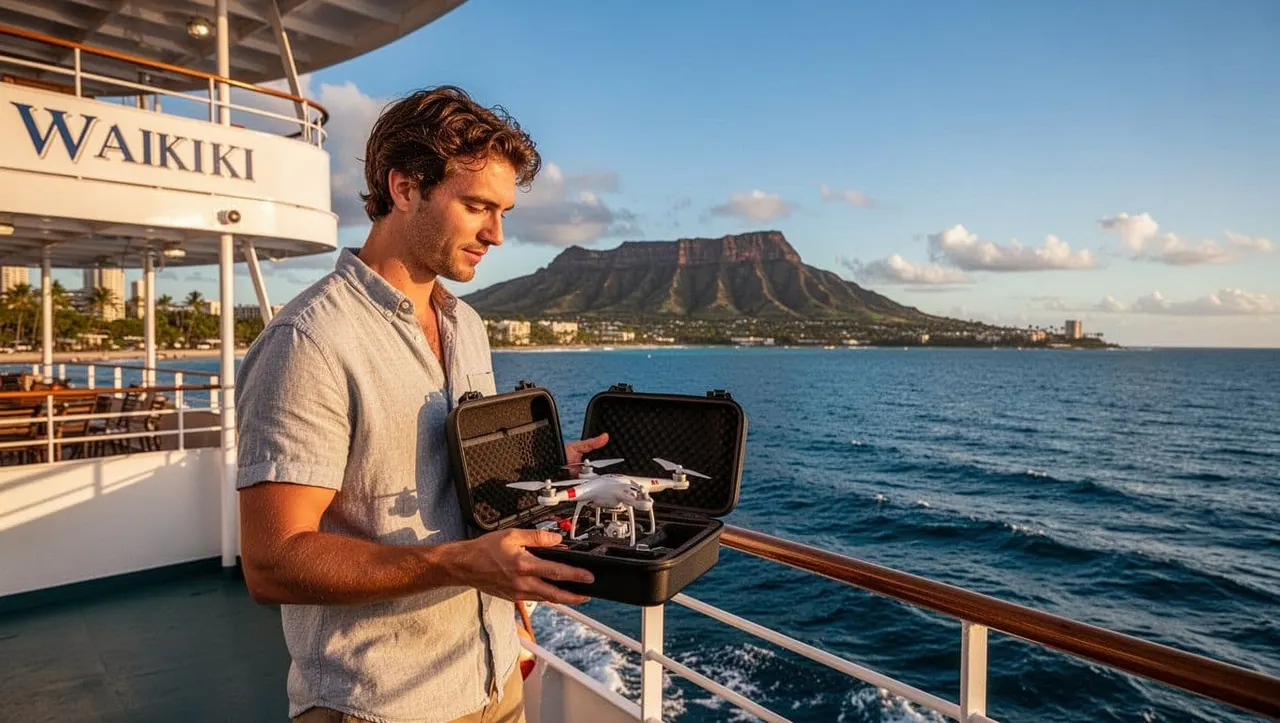
A boat launch changes your takeoff surface, not your legal obligations. FAA rules still follow the aircraft.
Waikiki drone rules: federal FAA requirements
The FAA rules apply whether you launch from a beach, hotel property, parking area, or boat. Before your trip, review the FAA’s recreational flyer rules and confirm that your equipment meets the current requirements.
Pass the TRUST test
Recreational flyers must pass the FAA’s free Recreational UAS Safety Test, known as TRUST. You must carry proof that you passed whenever you fly.
The test covers basic safety principles, including yielding to manned aircraft, recognizing airspace restrictions, and operating responsibly around people. It takes little time, but you shouldn’t wait until you arrive in Hawaii.
The FAA’s TRUST information page explains the requirement and provides access to approved test resources. Save your completion proof on your phone and keep a copy with your travel documents.
Register your drone and check Remote ID
For recreational flights, you generally must register a drone that weighs 250 grams, or 0.55 pounds, or more. Registration takes place through the FAA’s DroneZone, and the aircraft must display its registration number as required.
A registered drone must also comply with Remote ID unless you fly within a Federally Recognized Identification Area, known as a FRIA. Depending on your aircraft, compliance may come from built-in Standard Remote ID or an approved broadcast module.
Carry proof of registration when you fly. If you rent or borrow a drone, confirm who registered it and whether the aircraft’s Remote ID setup is current. A vacation flight is still subject to the same federal requirements as a flight at home.
Follow basic flight limits
Your recreational flight must stay within visual line of sight. You need to see the drone directly, without relying only on the phone display or another device.
You must also:
- Keep the aircraft at or below 400 feet above ground level.
- Yield to all manned aircraft.
- Avoid careless or reckless operation.
- Keep a safe distance from people and moving vehicles.
- Follow any temporary flight restrictions or local airspace notices.
These requirements become harder to manage over open water. Bright sun can reduce screen visibility, wind can push a small drone away quickly, and a moving boat can make recovery difficult.
Check Airspace Before Your Boat Tour
A legal takeoff location doesn’t guarantee that the airspace above it is available for your flight. Oahu has heavy aviation activity, including commercial aircraft, helicopters, military operations, and sightseeing flights.
Use B4UFLY before you leave
Check the planned takeoff point and the area where you intend to fly using the FAA’s B4UFLY airspace guidance. The service helps recreational flyers identify locations with airspace restrictions and important safety information.
Check more than the hotel address. Review:
- The beach, park, or private property where you may launch.
- The harbor or shoreline where you will board.
- The area over the ocean where the drone would operate.
- The route between the vessel and the planned filming location.
Airspace information can change. Check on the day of your flight, not only when you book your vacation.
Understand LAANC authorization
Some controlled airspace requires authorization before you fly. The Low Altitude Authorization and Notification Capability, or LAANC, can provide approval for eligible operations through an FAA-approved provider.
You can begin with the FAA’s DroneZone access portal and follow the current instructions for your flight category. Approval for controlled airspace doesn’t override a city park ban, a state property restriction, a private-property rule, or a boat operator’s decision.
Honolulu and Hawaii restrictions you need to know
Federal approval is only one part of the decision. Local land managers control where you can launch and land, while Hawaii law adds restrictions around state marine waters and aquatic life.
Waikiki beaches and city parks
Don’t assume that a public beach is a public drone launch site. Waikiki Beach sits within a dense city environment, and local guidance treats Honolulu-managed beaches and parks as restricted places for recreational takeoff and landing without the proper permission.
The same concern applies to nearby areas such as Kapiolani Park and Ala Moana Beach Park. A city park permit, when available, doesn’t replace FAA authorization. You may need separate clearances from the property manager and aviation authorities.
Honolulu’s drone permit information for botanical gardens shows how city property rules can require formal approval and additional clearances. The exact process varies by property, so check with the agency managing your intended launch point.
State parks and monuments
Hawaii state park rules generally restrict the use, launch, or landing of drones unless you receive permission for an approved purpose. That matters if you plan to film near Diamond Head State Monument, Sand Island State Recreation Area, or another state-managed location.
A scenic view doesn’t change the land designation. Check whether the shoreline, overlook, trail, or park belongs to the City and County of Honolulu, Hawaii State Parks, the federal government, or a private property owner.
If you can’t identify the land manager and confirm permission, don’t launch there.
Marine waters and aquatic life
Hawaii Revised Statutes section 188-23.5 restricts the possession or use of an unmanned aerial vehicle on, in, or near state marine waters for the purpose of taking aquatic life without a permit from the Department of Land and Natural Resources. The law allows simple reconnaissance, but that doesn’t give you permission to interfere with wildlife.
For a vacation flight, avoid using a drone to locate fish, direct people toward animals, or pursue turtles, whales, dolphins, or seabirds. A drone hovering over a reef can disrupt animals and swimmers even when the operator never touches the water.
What Changes When You Launch From a Boat?
Get permission before boarding
Ask the tour operator about its drone policy before you arrive at the harbor. Don’t wait until the boat is moving, then unpack the aircraft on deck.
The operator may prohibit all recreational launches because of guest safety, deck space, wind conditions, propeller hazards, or insurance requirements. A captain also needs to manage navigation and passenger safety without an aircraft operating overhead.
Tell the crew what you plan to carry. If the answer is no, keep the drone stored for the entire trip. That decision protects you, the crew, and everyone else on board.
Plan for wind, motion, and recovery
Boat decks create a difficult launch and landing surface. Wind over the water can increase quickly, and the vessel may roll, turn, or change speed while your drone is in the air.
Return-to-home settings also deserve attention. If the drone records its takeoff location and the boat moves, the aircraft may return toward a point that is no longer over the vessel. A low battery, weak signal, or sudden gust can turn a short flight into a lost-aircraft recovery.
Never launch over swimmers or crowded decks. Keep people clear of the aircraft, use a secure takeoff area approved by the crew, and avoid hand-catching unless you have proper experience and the operator permits it.
Your phone’s map can show a strong signal while your drone’s actual recovery point keeps moving beneath it.
Protect Turtles, Whales, and Fellow Guests
Keep drones away from marine wildlife
Hawaii’s waters are home to Hawaiian green sea turtles, humpback whales, tropical fish, seabirds, and other animals that need space. Your drone shouldn’t chase, circle, descend toward, or hover above them.
The safest wildlife rule is simple: if an animal changes direction, dives, surfaces away from you, or appears distressed, increase your distance and land immediately. During seasonal whale watching, let the boat crew manage the encounter. They understand how to observe animals without turning the sighting into a pursuit.
A drone can make a small animal look close on video while remaining farther away in real life. Avoid low passes and dramatic approaches, even when the footage would look impressive.
Respect guests, swimmers, and private spaces
A drone’s camera can capture people who never agreed to appear in your vacation video. Waikiki is crowded, and the shoreline includes hotels, balconies, beachgoers, paddleboarders, snorkelers, and nearby boats.
Don’t film into hotel rooms or private balconies. Avoid recording identifiable guests without permission, and don’t fly above groups simply because the aircraft can fit through the space.
Noise also affects the experience. Propellers can disturb a quiet sunset, interrupt a safety briefing, or distract snorkelers entering the water. Keeping your drone secured may be the most considerate choice of the day.
A Better Plan for First-Time Guests
Keep the drone packed unless every answer is clear
You don’t need to make a complicated decision at the dock. Before leaving your hotel, confirm five things:
- You passed TRUST and have proof with you.
- Your drone is registered if its weight requires registration.
- Remote ID is active, or you have a valid FRIA exception.
- B4UFLY shows that your planned location and airspace allow the flight.
- The property manager and boat operator both permit takeoff and landing.
If any answer is unclear, don’t fly. Store the drone in a padded, water-resistant case and keep batteries protected from heat and moisture.
Capture the view without launching
A boat tour gives you strong photo opportunities without adding an aircraft to a busy sky. Use your phone or camera from an approved passenger area, and ask the crew where you can stand for a clear view.
The upper deck can provide open sightlines toward Diamond Head and the Waikiki coast. During snorkeling trips, focus on the experience in the water rather than trying to film the reef from above. Your guide can point out wildlife and explain how to observe it respectfully.
You can also schedule a separate flight only after confirming a legal launch location, airspace status, and local permission. A dedicated plan is safer than trying to fit a drone flight into a crowded tour departure.
Why Living Ocean Tours Keeps the Focus on the Ocean
Living Ocean Tours departs from Kewalo Basin Boat Harbor, just minutes from Waikiki Beach in Honolulu. The company offers guided snorkeling, wildlife cruises, sunset sails, seasonal whale watching, Friday fireworks cruises, and private ocean experiences along the Waikiki coastline.
Living Ocean Tours is the only tour company with professional snorkel guides, giving you knowledgeable support when you’re entering the water for the first time. The crew can help you understand safe water entry, reef etiquette, and the importance of observing marine life without touching it.
You can browse Living Ocean Tours’ Waikiki ocean tours when you want a guided way to see Oahu’s coast without managing an aircraft from a crowded beach or moving deck.
Comfortable boats make the view easier
The fleet includes the Coast Guard-inspected, custom-built Coral Kai and Lokahi double-decker vessels. Both boats offer shaded seating, restrooms, dry storage, and sturdy ladders for water entry.
The Coral Kai has generous open-deck space for enjoying the coastline. The Lokahi includes a cash bar, an upper-deck waterslide, and a SeaKeeper stabilization system that reduces rolling and can make the ride more comfortable for guests who worry about seasickness.
That combination gives you a better way to enjoy the Pacific. You can watch for sea turtles, look toward Diamond Head, or photograph the sunset while the crew handles navigation and safety.
When you’re ready to plan your ocean day, check the current tour schedule and availability before your preferred date fills.
Your Five-Minute Preflight Decision
The most useful Waikiki drone rules are the ones you check before the propellers spin. Use this quick decision process at your hotel or before leaving for Kewalo Basin:
- Check the aircraft weight, FAA registration status, and Remote ID.
- Confirm that your TRUST proof is saved and available.
- Review B4UFLY for the exact launch area and intended flight zone.
- Identify the land manager and ask whether takeoff and landing are permitted.
- Ask the boat operator before bringing the drone onto the vessel.
- Check wind, visibility, battery condition, and recovery plans.
- Keep the aircraft grounded around wildlife, swimmers, and crowded decks.
If one part of the plan fails, choose a no-launch day. You can return home with better memories than a damaged drone, an interrupted tour, or a violation you didn’t expect.
Enjoy Waikiki Without Taking the Risk
Waikiki drone rules combine FAA requirements with Honolulu property restrictions, Hawaii marine protections, airspace checks, and boat-operator policies. A boat launch doesn’t bypass any of them, and the water adds wind, motion, signal, and recovery problems.
For most first-time guests, keeping the drone secured is the right call. Enjoy the coastline from a stable tour boat, listen to your professional guide, and give turtles, whales, swimmers, and fellow passengers the space they deserve.


