
Snorkeling Oahu: Why Some Reef Fish Change Sex
Some reef fish change sex because reproducing as a female at one stage of life and a male at another can offer a reproductive advantage. When you’re snorkeling Oahu reefs, that biology adds another layer to the fish community beneath your fins.
At Living Ocean Tours, we encourage you to notice the smaller reef residents alongside the turtles. Their feeding routes and interactions reward patient observation, even when their reproductive history remains invisible.
Start with what sex change means, then separate the science from what you can see during a swim.
Key Takeaways for Your Reef Visit
You don’t need to identify a fish’s sex to appreciate its place on the reef. These distinctions give you a useful starting point:
- Some fish reproduce as one sex before changing to another during their lifetime.
- Female-to-male sex change is called protogyny, but you shouldn’t apply that pattern to every reef fish.
- A brief underwater encounter doesn’t reveal a fish’s reproductive history.
The important distinction is between a biological process and a visible behavior. You might watch a fish feed or defend space, yet neither action proves that it has changed sex.
As you’re snorkeling Oahu waters, treat these encounters as opportunities to observe living animals. A photograph or memorable interaction can document what happened without explaining everything behind it.
What It Means for a Fish to Change Sex
One reproductive role follows another
The scientific term is sequential hermaphroditism. A fish functions reproductively as one sex, then changes to another at a different stage of its life.
Hawaii’s Life History Compendium of Hawaiian Fishes distinguishes these reproductive systems. Female-to-male change is protogyny; male-to-female change is protandry.
That distinction matters because “fish change sex” can sound like one universal process. In reality, the direction of change belongs to the biology of the species involved.
You also shouldn’t confuse sequential sex change with simultaneous hermaphroditism. Those terms describe different reproductive arrangements, even though both fall under the broader subject of hermaphroditism.
The change involves reproductive function
Sex change means more than looking different. It involves the animal’s reproductive system, rather than a temporary shift in appearance.
That is why a passing fish can’t give you the whole answer. Its visible characteristics capture one moment, while its reproductive history extends beyond your encounter.
Nor does the process mean that every individual follows an identical path. A species-level description tells you about its reproductive system, not the complete history of whichever fish swims past your mask.
For your reef visit, the useful takeaway is straightforward: you can appreciate this biology without trying to diagnose it underwater.
Why Reproductive Roles Can Change
Reproductive success can depend on life stage
The evolutionary explanation centers on reproductive success. Under some mating systems, the advantages of reproducing as a male or female differ as an individual grows.
A larger male may gain greater access to mates. Meanwhile, an individual may reproduce successfully as a female earlier in life. Where those advantages favor different reproductive roles at different stages, a sex-changing strategy can persist.
This is an evolutionary explanation, rather than a conscious decision by a fish. It also doesn’t mean that becoming male is always advantageous. The relevant balance depends on the species and its reproductive system.
You can understand the central idea without assuming that every large fish has changed sex or every small fish eventually will.
Hormones are part of the biological process
Researchers also study how changes in reproductive function happen inside the animal. Hormonal regulation is part of that investigation.
For example, a research preprint on fish sexual systems discusses evidence that estrogen regulates sex change in honeycomb grouper, Epinephelus merra.
That example concerns a named species. It doesn’t establish one hormonal explanation for every fish you might encounter around Oahu.
Keeping that boundary makes the science more useful. You get a concrete example of biological regulation without turning it into a universal rule or a promised snorkeling sighting.
The Fish Families Behind the Science
Wrasses and parrotfishes appear in the research
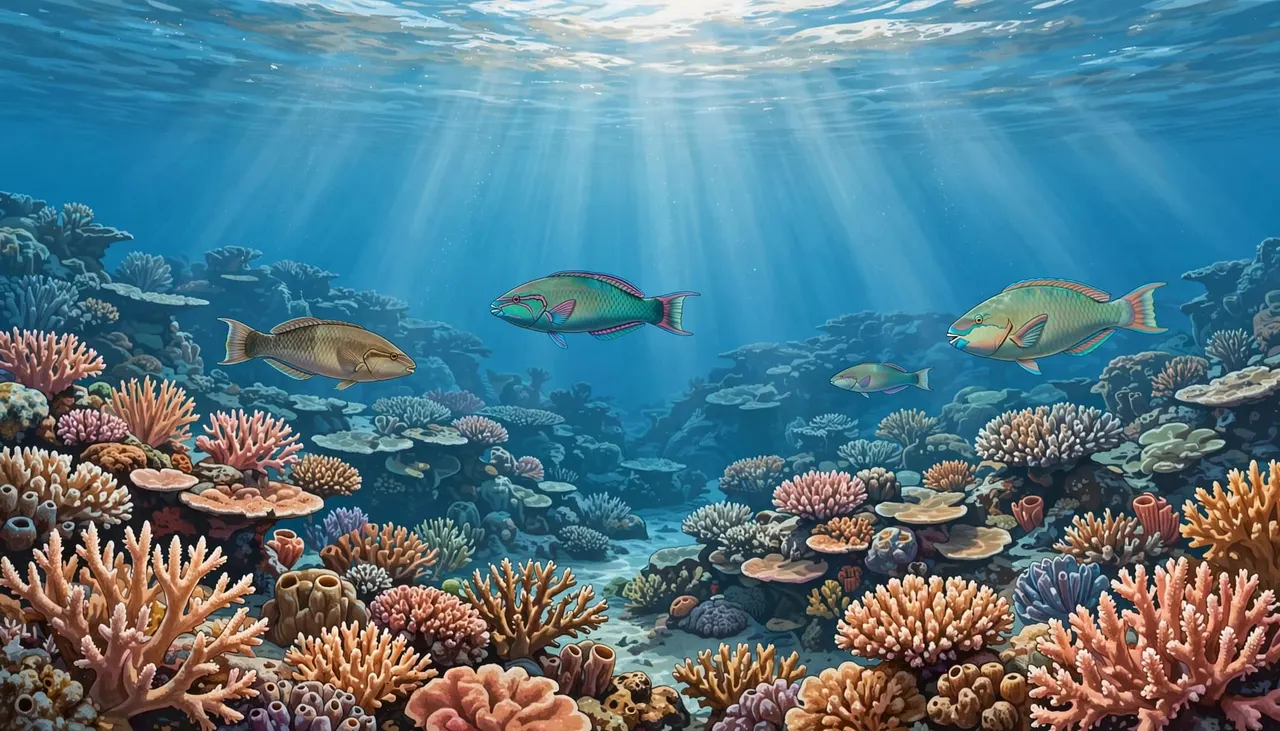
Wrasses and parrotfishes are relevant groups when you explore the science of reef-fish reproduction. A study of sex-change body sizes describes female-to-male sex change in eight labroid species: four labrids and four scarids.
Labrids are wrasses, while scarids are parrotfishes. Those family names help connect scientific writing with familiar reef-fish groups.
However, eight studied species don’t stand for every member of either group. You shouldn’t extend a finding to an unidentified fish simply because it resembles a wrasse or parrotfish.
The research gives you a reason to look beyond a fish’s appearance. It doesn’t provide a shortcut for assigning a reproductive history during your swim.
Feeding offers a separate window into reef life
When you’re snorkeling Oahu reefs, a parrotfish’s beak-like mouth offers something more directly observable than its reproductive state.
Watch where it feeds. Parrotfishes scrape material from reef surfaces, and you may hear crunching as they work. That activity connects a recognizable body feature with an action you can witness.
Butterflyfish, yellow tangs, and Hawaii’s state fish, the humuhumunukunukuāpuaʻa, add other opportunities for observation. Look at their shapes and movements without assuming they share the reproductive system described in a study.
Learning about sex change should broaden your curiosity. It shouldn’t turn every colorful fish into evidence for the same biological story.
What You Can Observe While Snorkeling Oahu
Start with position and repeated movements
Choose a patch of reef that you can observe safely, then pause for 20 to 30 seconds. Watch which fish stay near one area and which continue across the reef.
A repeated feeding route is worth noticing. So is the distance one fish maintains from another. These details help you describe an encounter more precisely than saying the reef looked busy.
For families, this creates an easy shared activity. After returning to the boat, compare the movements each person remembers.
You might notice something different from your partner or child. Neither observation needs to reveal a hidden biological process to be interesting.
Keep your observations separate from explanations
If one fish approaches another, you can describe that approach. Calling it courtship, competition, or a reproductive transition requires more evidence.
Likewise, a fish leaving a patch of reef doesn’t tell you why it left. Your presence may also influence what happens next.
A short sighting can document movement and interaction, but it can’t establish a fish’s reproductive history.
When you’re snorkeling Oahu, that distinction protects the quality of your observations. You can enjoy the encounter without filling every gap with an explanation.
A useful memory might be as simple as a fish repeatedly returning to the same feeding surface. The detail matters even when the reason remains unknown.
Observe Reef Life Without Changing Its Behavior
Your approach affects the encounter. If you chase a fish, you may end up watching its response to a swimmer rather than its usual activity.
Keep your hands to yourself and use controlled fin movements. Maintain clearance above coral, and never stand on the reef or hold it for support. Coral colonies consist of living animals, even when their hard surfaces resemble rock.
Avoid feeding fish, too. Let their own movements determine what you see instead of drawing them toward you.
Respect for reef communities extends beyond a single swim. Research on California sheephead found that size-selective fishing affects reproductive traits, including population sex ratios and the timing of sex change. That finding concerns the studied population, rather than a prediction about every Hawaiian reef.
For your visit, the practical lesson is to leave wildlife undisturbed. You don’t need to approach closer to make an encounter more meaningful.
If your mask needs adjusting or you feel uncomfortable, follow your guide’s directions rather than reaching for the bottom. Your comfort matters, and coral shouldn’t become a handhold.
Explore Waikiki’s Reefs With Our Guides
With Living Ocean Tours, you can explore reef habitat with support rather than dividing your attention between wildlife and an unfamiliar outing. We’re the only tour company with professional snorkel guides, so you have guidance while you get comfortable in the water.
Our Honolulu snorkel and wildlife experiences include visits to Turtle Canyons, Waikiki’s natural turtle cleaning station. We provide snorkeling gear and knowledgeable guides, with a welcoming approach for different experience levels.
The turtles may draw your attention first. However, the surrounding fish community gives you plenty to watch between turtle encounters.
When you’re planning a day snorkeling Oahu waters, choose an experience that supports both your comfort and respectful observation. We depart from Kewalo Basin Boat Harbor, near Waikiki.
For a guided visit to the Turtle Canyons cleaning station, you can CHECK AVAILABILITY for your preferred outing.
Bring your curiosity, but leave room for an unscripted encounter. A guide can support your visit without turning wildlife into a guaranteed sequence of sightings.
See More by Watching Carefully
Some reef fish change reproductive roles during their lives, and that biology makes reef communities even more interesting. Yet your best underwater observations often concern what you can see directly.
As you’re snorkeling Oahu reefs, give feeding routes and fish interactions your attention. Keep observation separate from assumption, and give wildlife space to continue its activity.
You don’t need to witness sex change to appreciate the science behind it. A calm, respectful swim lets you enjoy the reef while leaving its residents undisturbed.


