
Bubble-Net Feeding: What to Know Before Oahu Whale Watching
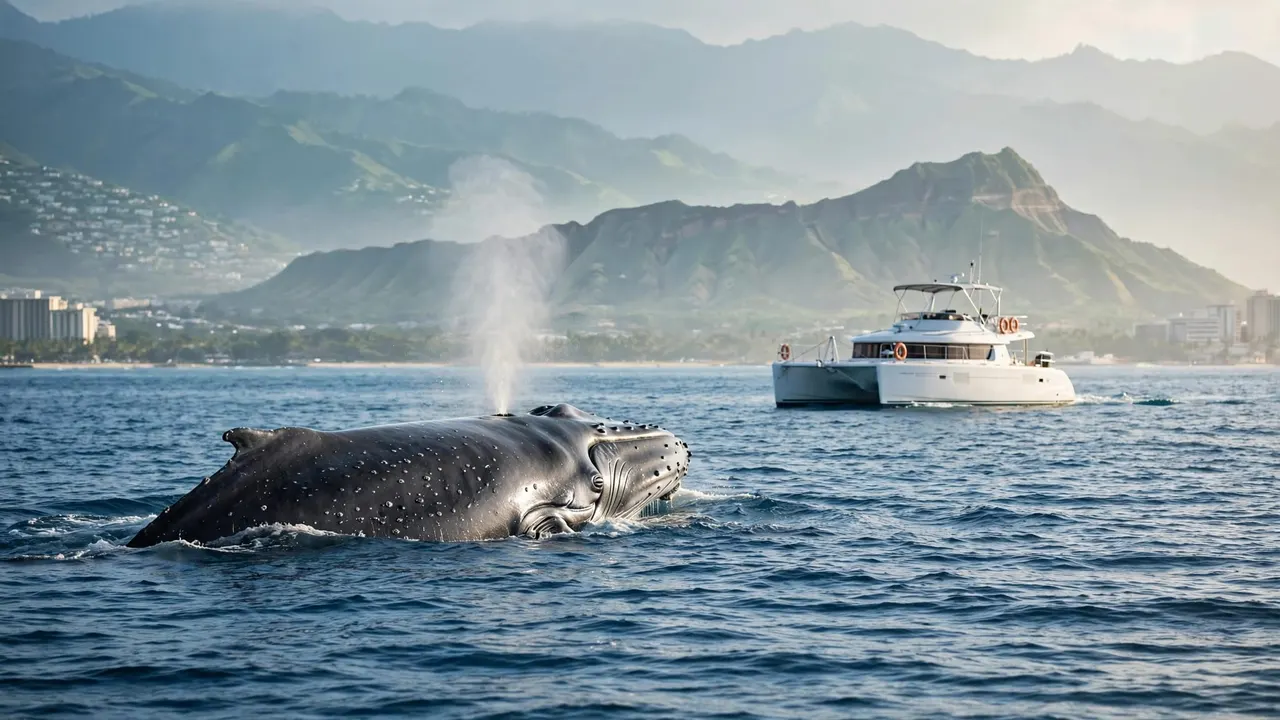
Bubble-net feeding is a hunting technique in which humpback whales blow bubbles around prey, then feed within the concentrated school. The behavior usually takes place in colder feeding waters, so you shouldn’t expect to see it on a whale watch off Oahu.
Before your trip with Living Ocean Tours, understanding this technique gives you a glimpse of the work humpbacks do before their winter migration. It also makes the whales you see near Waikiki even more fascinating.
How bubble-net feeding works

A humpback’s bubble net begins underwater, where it can be difficult to see the full sequence from a boat. The illustration above shows the general idea: bubbles rise around a school, helping concentrate prey in a smaller area.
Bubbles form a moving barrier
During bubble-net feeding, a humpback swims in a circular pattern while releasing bubbles. As those bubbles rise, they form a curtain around the prey.
The bubbles aren’t a physical net, but they can help keep a school together long enough for a whale to feed. Depending on the encounter, you might see a circle of bubbles at the surface before a whale appears.
A whale can change the size and shape of a bubble net as it swims. That flexibility helps it respond to prey moving beneath the surface.
A whale feeds inside the circle
Once prey is concentrated, a humpback can rise into the school with its mouth open. Its expandable throat allows it to take in a large volume of water and food at once.
From the surface, the most dramatic moment may be the appearance of a huge open mouth. Below the water, though, the circling and bubble-making have already done much of the work.
Do humpbacks feed alone or in groups?
You may have seen footage of several humpbacks rising through a bubble net together. That group behavior is memorable, but a single whale can also create and use a bubble net.
Some whales hunt together
In some feeding areas, multiple humpbacks gather around the same prey. Their movements can appear coordinated as they circle, release bubbles, and approach the concentrated school.
Group feeding doesn’t follow one fixed script. Whales may behave differently as conditions change, and you can’t assign every animal a particular job just by watching a short surface encounter.
Researchers have studied those differences with tags that record underwater movement. One NOAA-hosted study of bubble-net feeding examined data from 26 humpbacks feeding in the Southern Gulf of Maine.
A single whale can make a net
In Southeast Alaska, researchers have documented individual humpbacks creating bubble nets while feeding on their own. A lone whale can circle its prey and release bubbles without a group beside it.
That distinction matters when you picture the behavior. Bubble-net feeding describes a way of concentrating food, rather than a guarantee that several whales are working together.
How humpbacks filter food from seawater
Humpbacks don’t chew their food as you do. They’re baleen whales, which means they have rows of flexible, fringed plates hanging from their upper jaws.
The mouth takes in water and prey
When a humpback feeds, grooves along its throat expand as its mouth fills. The resulting mouthful can contain seawater and a large concentration of prey.
The whale then closes its mouth and pushes water back out through the baleen. Those fringed plates help retain the food inside. Once the water drains away, the whale swallows its catch.
You won’t be able to see every part of that process from an Oahu whale-watching boat. Still, knowing how the mouth works helps you understand why a concentrated school is useful.
Feeding builds reserves for migration
Time spent feeding helps humpbacks build the fat reserves they need for their long journeys. Adults draw on those reserves during migration and while spending time in breeding areas.
A nursing mother faces an especially demanding period because she must support her calf as well as herself. The energy she stored before reaching Hawaii helps sustain that work.
Why Hawaii is different from the feeding grounds
Hawaii is an important part of the humpback’s annual cycle, but its warm winter waters play a different role from northern feeding areas. That difference is the key to setting expectations for your Oahu trip.
Northern waters provide food
Many North Pacific humpbacks spend time feeding in colder, productive waters before traveling south. According to NOAA Fisheries’ humpback whale profile, their feeding grounds are generally in cold waters, including areas near the Aleutian Islands and the Bering Sea.
Some whales travel thousands of miles between feeding and breeding areas. Routes and distances vary, so you can’t tell exactly where an individual whale has been just by seeing it off Waikiki.
After winter breeding and calf care, humpbacks travel back toward feeding areas. Your Oahu sighting captures one part of a much longer journey.
Hawaiian waters are breeding habitat
Thousands of humpbacks come to Hawaii’s warm, shallow waters in winter to mate, give birth, and care for young. Around Oahu, you may see animals traveling or surfacing together rather than looking for a meal.
Humpbacks can feed in Hawaii, though it appears to be uncommon. A 2024 paper on Hawaiian feeding observations describes two documented instances of humpbacks feeding on schools of fish in Hawaiian waters.
Those observations don’t make bubble-net feeding an expected part of a Waikiki cruise. They do show why it’s more accurate to say that feeding is rare here than to say it never happens.
What you can see while whale watching off Oahu

You don’t need to witness bubble-net feeding to enjoy an encounter. A whale’s brief moments at the surface offer plenty to watch, especially when you know where to focus.
Look for a blow, then watch the water
A humpback’s exhale often appears as a misty plume above the ocean. Once you spot one, keep your eyes on the surrounding water. You may see the whale’s back roll into view before it dives again.
A tail fluke can appear as the animal heads below the surface. Sometimes the whale stays underwater long enough that you’ll need patience before another glimpse.
Binoculars can help you follow distant activity. If you’re using a camera, take a moment to watch without the screen, too. A surfacing can be brief, and you may enjoy seeing it directly.
Give every behavior room for interpretation
You might see a breach, a tail slap, or a mother and calf traveling together. You might also see only a distant blow. All are genuine glimpses of wild humpbacks.
Avoid assuming that a splash, an open mouth, or a cluster of bubbles means a whale is feeding. Surface clues rarely reveal the whole story, and the animals don’t follow a schedule for visitors.
Keep your whale encounter respectful
Humpbacks need space to travel, rest, socialize, and care for their young. On a boat, your captain handles positioning while you observe and follow the crew’s directions.
Federal rules prohibit approaching a humpback within 100 yards in Hawaiian waters. If a whale approaches the vessel, stay aboard and let the crew respond rather than trying to arrange a closer encounter. The Hawaiian Islands Humpback Whale National Marine Sanctuary explains the humpback whale approach regulations.
Never enter the water to approach, touch, feed, or chase a whale. Give mothers and calves the same generous space you would want around any wild animal caring for its young.
A respectful distance can also make the experience more rewarding. You get to watch the whales choose their own direction and pace, without asking them to perform for the boat.
Plan a Waikiki whale watch with us
Our seasonal Waikiki whale watching tour departs from Kewalo Basin Boat Harbor, close to Waikiki. Living Ocean Tours runs whale-watch trips from January through March, giving you an opportunity to look for humpbacks during their time in Hawaiian waters.
You can enjoy the coastline while our crew watches for activity and positions the boat responsibly. Our vessels have shaded seating and onboard restrooms, along with open areas for scanning the water.
No departure can promise a whale sighting or a particular behavior. If seeing humpbacks is a priority for your vacation, consider booking early in your stay so you have more flexibility around your plans.
CHECK AVAILABILITY for your Waikiki whale watch.
You can also read what guests have shared about their experiences with us.
Key takeaways for your whale watch
Bubble-net feeding helps humpbacks concentrate prey with rising bubbles. A whale may make a net alone, or several whales may feed near one another.
Hawaii is primarily a winter breeding and nursery area, so look for blows, backs, flukes, and other surface activity rather than planning on a feeding display. Give each whale space and let the encounter unfold naturally.
Frequently asked questions
Can you see bubble-net feeding in Oahu?
You shouldn’t count on it. Humpbacks do most of their major feeding in colder northern waters. Feeding has been documented in Hawaii, but it isn’t the behavior you should expect on an Oahu whale watch.
Do all humpback whales use bubble nets?
No. Humpbacks use different feeding behaviors, and bubble-net feeding isn’t something every individual must do. Even among whales that make bubble nets, the size of the group and the shape of the net can vary.
Is a circle of bubbles proof that whales are feeding?
A circle of bubbles alone doesn’t tell you everything happening underwater. Enjoy the sight, but avoid drawing a firm conclusion without enough information to identify the behavior.
Can you swim with humpback whales in Hawaii?
You shouldn’t enter the water to approach a humpback. Hawaii’s approach rules protect the space whales need, and a boat-based encounter lets you observe them without pursuing them in the water.
Take the bigger journey with you
When you see a humpback off Oahu, you’re looking at an animal that has traveled a long way after feeding in northern waters. Bubble-net feeding is one part of that larger annual cycle.
A distant blow or a quiet dive can be meaningful, too. Give the whale room, watch patiently, and enjoy the moment it chooses to share.


