
Best Time to Whale Watch in Hawaii: Month by Month Guide
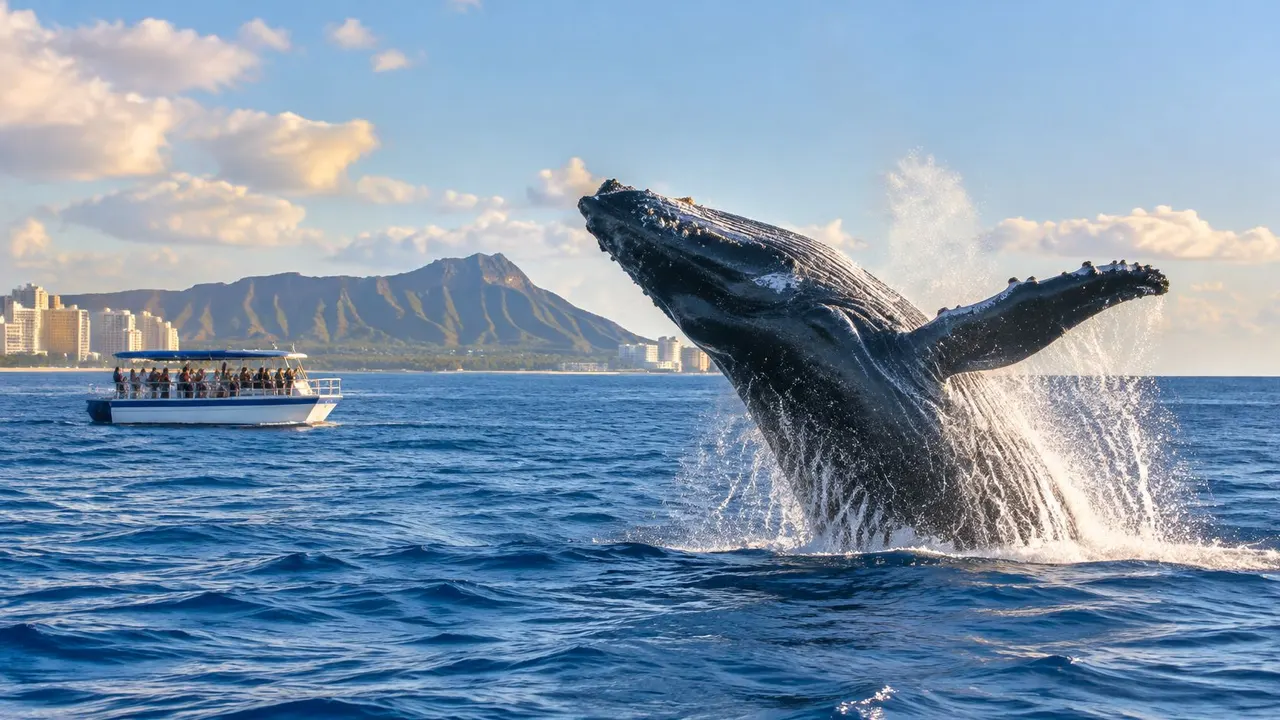
Table of Contents
- Why the morning wins
- Three checks before you book
- Keeping kids and queasy guests comfortable
- What you're looking at
- What a high-quality sighting actually is
January through March is the best time to whale watch in Hawaii, and the strongest stretch runs from mid-February through mid-March. Oahu sightings follow that same winter pattern, so a Waikiki departure in those weeks gives you the highest odds.
That window is crowded for a reason. NOAA's Hawaiian Islands Humpback Whale National Marine Sanctuary estimates that as many as 12,000 humpback whales, more than half of the North Pacific population, return to Hawaiian waters from November through May. They come to mate, give birth, and nurse, not to feed. A good trip is still a wildlife encounter. Whales surface when they surface, and nobody on the boat can promise a breach on cue.
Peak Months for Whale Watching on Oahu
January through March is the month range I would plan around, and Oahu follows the same seasonal rhythm as the rest of the state. The Hawaiian Islands Humpback Whale National Marine Sanctuary describes the islands as the principal winter breeding grounds for North Pacific humpbacks. Approximately half of that population, amounting to thousands of whales, travels here each winter and spring to mate, give birth, and nurse calves. During January, February, and March those animals concentrate in warm, shallow habitat and are actively courting, calving, and nursing. That mix is why those three months are the most dependable for both sightings and natural behavior, including surfacing, breaching, and mother-calf pairs.
Our Waikiki Whale Watching Cruise looks for humpbacks that winter in the Hawaiian Islands along the Waikiki coastline. Whales are commonly seen offshore from Oahu. Official Hawaii guidance still notes that sightings are generally more frequent around Maui, Lanai, Molokai, Kauai's north coast, and the Kohala Coast. Treat an Oahu trip in peak months as a strong bet, not a guarantee.
December and April can still be productive, but sightings are less consistently concentrated than in the three-month peak. November is an arrival month. May is late stragglers. From June through October, humpbacks aren't in Hawaiian waters, so a whale watch isn't a real option.
A recent season shows how the calendar lands. NOAA reported that the 2024–2025 humpback whale season ran from December 1, 2024, through May 1, 2025. The January to March peak sits inside that broader November to May opportunity, which on the water sometimes stretches into May.
Practical rule: If your dates fall in January, February, or March, plan the day around a whale encounter. If they fall in a shoulder month, treat the outing as lower odds and hold a backup date.
The Strongest Weeks Inside the Winter Season
The three peak months aren't equal. NOAA sanctuary guidance on boating near whales puts the highest probability from January through March, with the strongest biological window concentrated approximately from February 19 through March 22. Sanctuary guidance names January through March as the normal abundance peak, while NOAA population modeling places the seasonal maximum from mid-February to mid-March.
Density rises as the breeding season progresses. These whales migrate here to breed, calve, and nurse rather than feed, so more animals are on the grounds, and more mothers are paired with calves, toward the middle of winter. February is the overlap month, which is why I rank it first when two travelers ask me to pick one week.
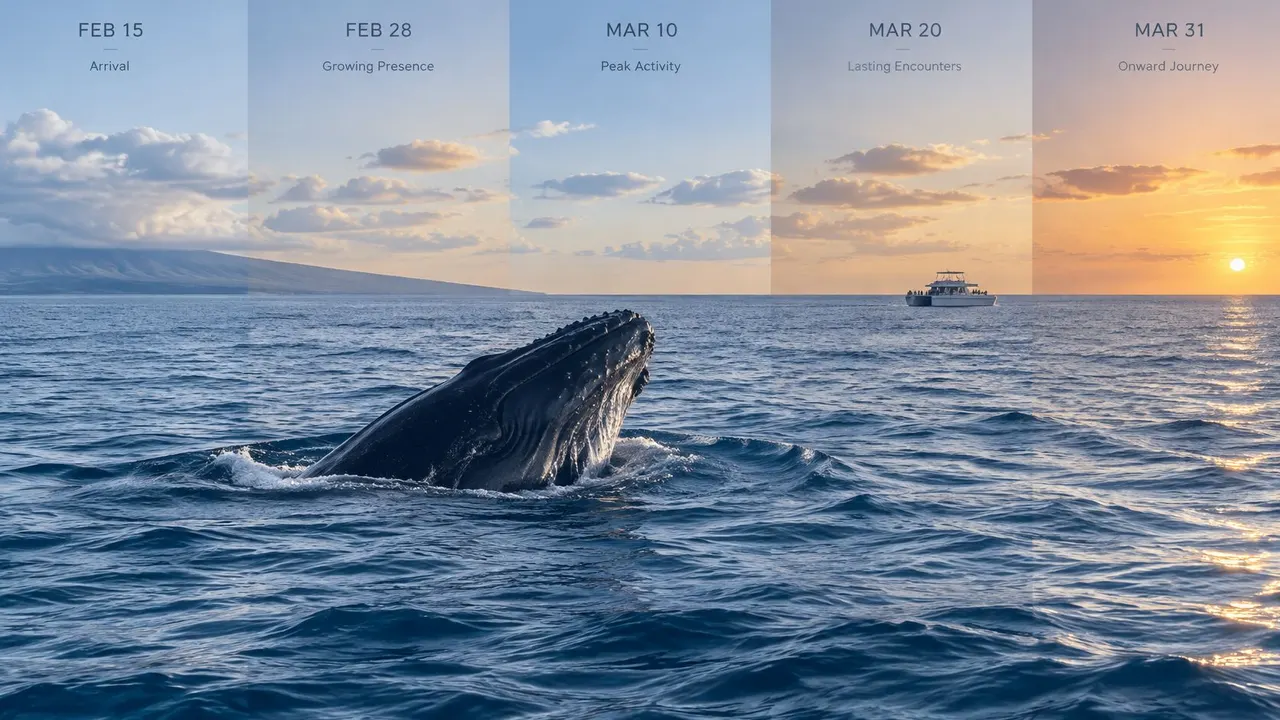
Use this ladder when you book, and remember each rung is a probability window. Island, weather, sea state, and where the whales are that morning all move the odds.
- February 19 to March 22: Highest density. This is the first date I would lock.
- Early to mid-February: Still inside the peak months, with courtship groups building.
- Late January: A strong start. Whales are established, even if the season hasn't topped out.
- Late March: A fallback that still sits inside the NOAA peak viewing season. Shoulder weeks in late November, December, April, and May stay viable, with less favorable density.
For Oahu departures, schedule at least one trip in February or early March and keep a second date open. Encounter rates change with the island, the weather, and daily whale distribution. Pick the target week, then book the backup inside the same window so a windy morning doesn't end the season for you.
Best Time of Day, Sea Conditions and Family Comfort
Month picks the whales. Time of day picks whether you can see them, and whether the kids stay happy.
Why the morning wins
A blow is a puff of mist a long way off. On flat water that puff stands out. Once trade winds stack whitecaps, the same blow disappears into the chop, and the boat starts to work. Afternoon swell doesn't only hide spouts. It also sends more guests to the rail. Late day can feel gentler, but low light makes a distant spout hard to separate from glare. I would not pick sunset as the first whale watch of a family trip.
Three checks before you book
- Read the marine forecast the evening before. Look at wind speed and swell, not just the beach forecast.
- Note any afternoon wind advisory. If the morning is clean and the afternoon is flagged, take the morning.
- Ask how rough days are handled. A responsible boat moves or cancels rather than punching through a bad sea just to sail.
Keeping kids and queasy guests comfortable
A trip of about 1.5 hours suits young children. Older kids usually enjoy the job of spotting spouts once someone shows them what a blow looks like. For motion:
- Medication first. Take it before boarding if a doctor has told you that product is appropriate. Waiting until you feel ill is too late.
- Pick the calmest morning slot. That single choice does more than any seat trick.
- Sit low, near the middle. Less motion than the bow or the upper deck.
- Watch the horizon, not the water beside the hull. Close-up waves make the inner ear argue with your eyes.
Pack water, a hat, reef-safe sunscreen, and a light layer. The open ocean is cooler and windier than the sand at Waikiki. For accessibility, tell us ahead of time about boarding steps, seating, and restroom access so we can set the boat up before you arrive.
Living Ocean Tours is the top rated and most reviewed snorkel company on Oahu, and the same crews run the winter whale watches. Tours depart daily from Kewalo Basin Boat Harbor, a short ride from Waikiki Beach.
Families with young children, and anyone who gets seasick, should choose a morning departure in February or early March. You get peak whale density and the calmest water in the same outing.
What Whale Behavior You Can Expect From the Boat
Most of what you see is distant. A whale watch is a wildlife encounter, not a show, and the common view is a back and a blow well off the rail.
Humpbacks reach Hawaii after an approximately 3,000-mile migration from Alaska, sometimes in as few as 28 days, according to NOAA Fisheries' humpback whale species profile. That trip is why the animals are here in winter and early spring and not at the same level the rest of the year. NOAA research found that nearly the entire Hawaiian Archipelago is used during that season, so the pattern isn't limited to one channel.
What you're looking at
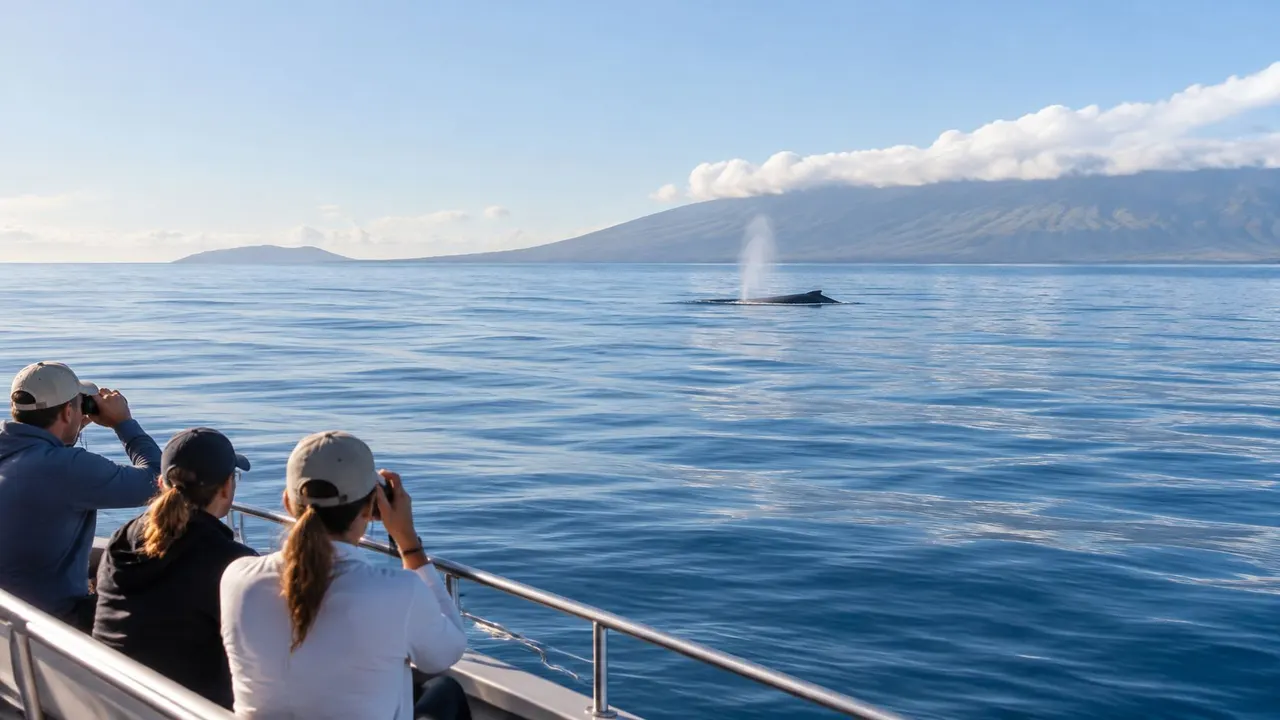
Blows are the visible spout. That's usually the first sign a whale is near the surface, and it's the skill worth learning in the first ten minutes.
Repeated surfacings mean an animal is resting or traveling. You'll see the back, then a pause, then the back again on a steady line.
Tail displays, sometimes called lobtailing, show up as the whale dives. The flukes lift and may slap. Pectoral fin slaps are the long side fin hitting the water. A breach is the moment a whale launches partly clear of the sea. It can happen once and not again.
Mother and calf pairs stay close. The calf is smaller, surfaces more often, and sticks to the mother's flank. In peak weeks, courtship groups are common: several whales following one female. From a legal distance that can look busy, with backs crossing and blows stacking, even when no animal is near the boat.
A successful sighting is a steady view of blows and repeated surfacings, plus a guide who tells you which animal is which. A poor one is a single distant puff and a long quiet stretch. Judge the trip across the full outing, not by whether one whale came close.
Viewing Rules That Keep Whales and Guests Safe
Federal law prohibits approaching a humpback within 100 yards, about the length of a football field, in Hawaii waters. NOAA's marine wildlife viewing guidelines apply that limit to a boat, a kayak, a drone, a swimmer, or any other vessel or object. Operators also have to avoid sitting in the whale's path, causing it to surface inside that distance, or disrupting normal behavior. A careful captain may hold off even when a whale is plainly visible.
Speed is part of the same rule set. Hawaii's Division of Aquatic Resources recommends 15 knots or less in waters 600 feet deep or shallower, and 6 knots or less when within 400 yards. If a whale comes inside the legal buffer on its own, the vessel stays put or the engine goes to neutral until the animal moves away. Cutting across a path to "get the shot" is the behavior that gets people, and whales, hurt.
What a high-quality sighting actually is
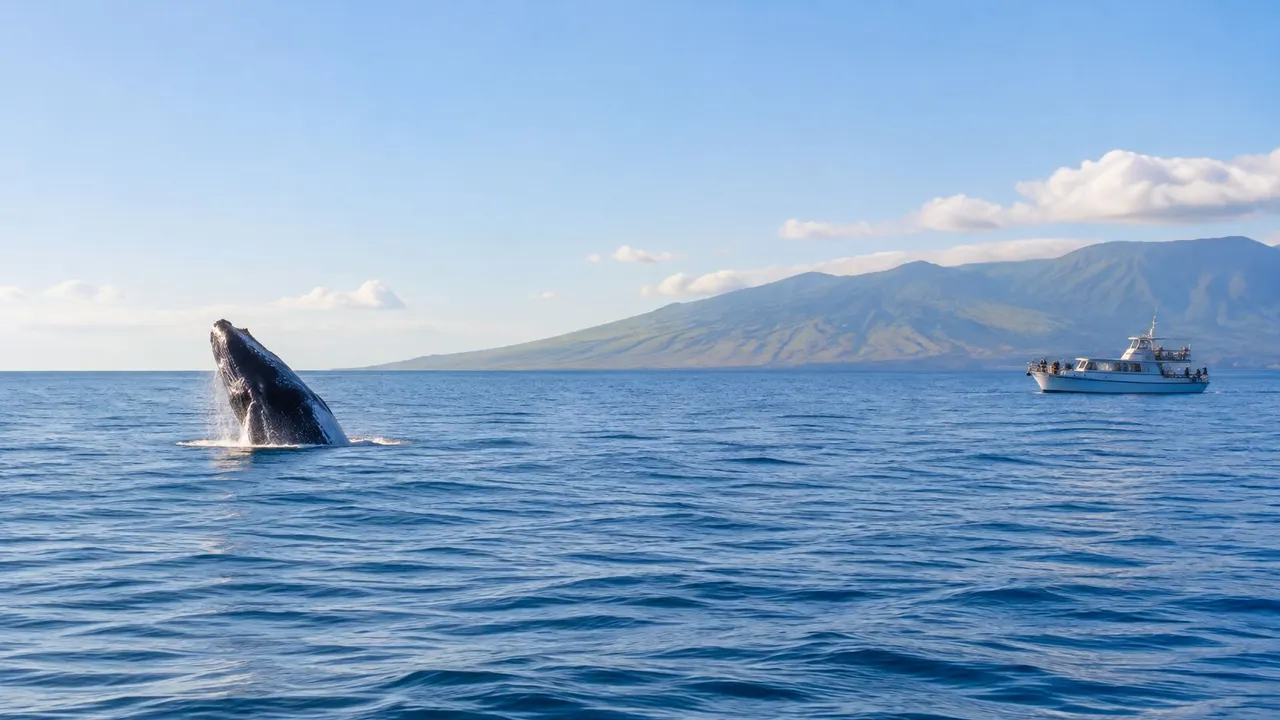
The closest photograph isn't the measure. Observation quality is. That means breaches, blows, tail displays, repeated surfacings, a guide who explains what you're seeing, and a boat that follows the buffer. A close approach can be disturbance, or unlawful conduct, even when it looks exciting from the rail.
On board, skip the drone, keep children seated and supervised, and follow crew instructions the first time they're given. A responsible operator will tell you the 100-yard rule before you leave the harbor, won't chase a pod, and will shut down or hold position when a whale approaches. If a company sells "we get you right next to them," book someone else.
Book a Winter Whale Watch Before Dates Fill
Pick a target date between February 19 and March 22, and book a second morning inside that same stretch. I would reserve both the same day. Peak weeks fill, and a windy forecast shouldn't be the thing that ends your only chance.
Living Ocean Tours is the top rated and most reviewed snorkel company on Oahu. The Waikiki Whale Watching Cruise runs from January 2 through March 31, lasts 1.5 hours, suits ages 3 and up, and costs $49 per person. Full details are on the Waikiki whale watch tour page.
The office at 1125 Ala Moana Blvd, Slip B-01, Honolulu, HI 96814 is open seven days a week for trip planning. Email info@livingoceantours.com or call +1 (808) 436-3483. If the forecast turns rough after you book, we don't force the departure. Call or email and we'll move you onto the backup morning you already hold. Confirm the current weather practice, price, and age minimum on the live booking page when you reserve, since those details can change.
Check the marine forecast, take the earliest morning in the peak window, and lock the second date before the season fills.
Living Ocean Tours runs seasonal humpback whale watches along the Waikiki coastline from Kewalo Basin, with the same crews who take families snorkeling the rest of the year. If your dates land between January and March, a morning cruise is the simplest way to see the migration without leaving town. Visit Living Ocean Tours to compare the winter whale watch with the rest of the daily departures and hold your date.


